
Cabinet Refinishing vs Cabinet Replacement: Which Returns More at Resale
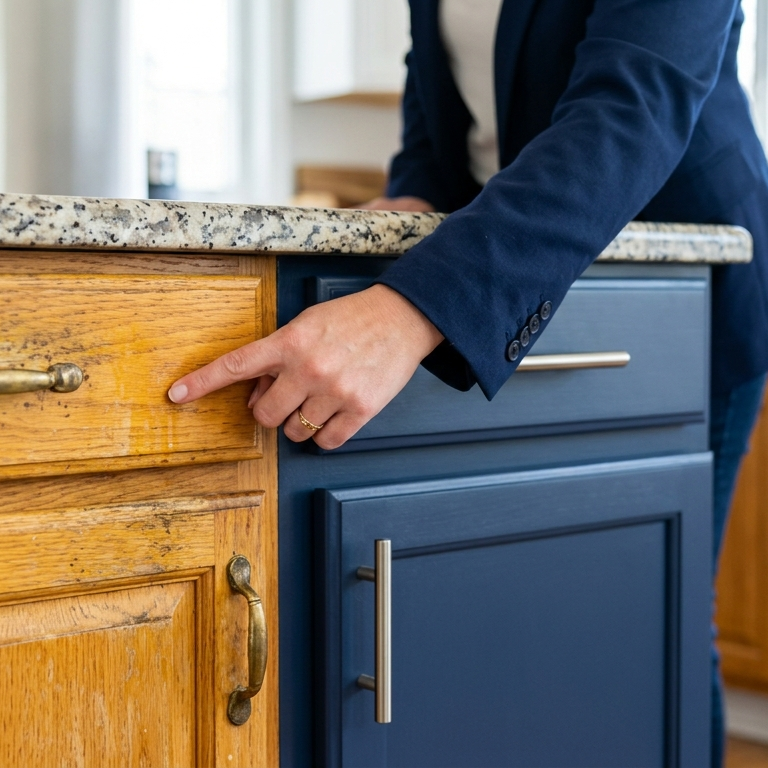
Your listing agent shows up for the walkthrough on a Thursday morning. She pulls open the kitchen drawer next to the dishwasher, slides it twice, then runs her hand down the cabinet door above the cooktop where the finish has gone tacky from years of cooking oil. She steps back, scans the rest of the room, and says the line you've been bracing for since you scheduled the appointment.
"The cabinets are the first thing buyers will look at. These are going to cost you something."
Then comes the question every seller has to answer. Spend a little and refinish what's there. Spend a lot and rip them out. The math on which one puts more money back in your pocket isn't obvious — and the gap between the two answers is bigger than the average seller would guess.
What buyers actually price into the kitchen
Buyers don't price cabinets the way an appraiser prices a house. They walk into the kitchen, scan the room for under three seconds, and form an opinion about the entire home. If the cabinets look tired — yellowed finish, sticky doors, scratched stiles, mismatched pulls — that opinion carries into the rest of the showing. They start hunting for what else is worn out.
If the cabinets look clean and current, the opposite happens. The eye relaxes. The buyer stops auditing and starts imagining their own coffee maker on the counter.
That's the pressure point. Kitchen cabinets carry an outsize share of the buyer's first impression, which is why the return on cabinet work runs higher than most other interior projects. It's also why the math splits so wide between a refinish and a full replacement — they buy you nearly the same first impression at very different price tags.
The ROI math, project by project
The numbers below pull from the 2025 Cost vs Value Report (Remodeling Magazine's annual study of what buyers pay back for specific projects) and from realtor.com's resale data on cabinet painting. They reflect averages across the U.S. — your market may shift them up or down by 10 to 15 percentage points.
| Project | Typical 2026 cost (25–30 LF kitchen) | Average ROI at resale | Net pocket on a $400K home |
|---|---|---|---|
| Cabinet refinishing (paint or stain) | $1,500 – $4,000 | 70 – 100% | $0 to –$1,200 |
| Cabinet refacing (new doors + veneer) | $4,000 – $9,500 | 80 – 96% | –$800 to –$1,900 |
| Minor mid-range remodel (refacing + counters + appliances + floor) | $26,000 – $32,000 | ~113% | +$3,300 to +$4,200 |
| Major mid-range remodel (full cabinet replacement + everything) | $75,000 – $90,000 | 38 – 49% | –$45,000 to –$55,000 |
| Major upscale remodel (custom cabinets, premium everything) | $150,000+ | 32 – 38% | –$95,000+ |
The pattern jumps off the page once it's laid out like that. The cheaper the project, the higher the percentage that comes back. The more you spend, the less of each dollar a buyer is willing to pay for.
That's not a quirk of cabinet work. It's how buyer psychology meets the appraisal sheet. A $3,000 refinish that makes the kitchen look five years newer reads to the buyer as "this house is taken care of." A $90,000 gut remodel reads as "I'm paying for someone else's taste."
Where refinishing wins the resale race
A clean refinish on solid boxes is the single highest-ROI move in a kitchen because it changes what the buyer sees without touching anything they don't care about. The boxes that hold up the countertop don't matter to a buyer. The doors and drawer fronts they touch on the showing do.
Refinishing wins on three fronts at resale.
It closes the appearance gap with newer homes. A 1998 oak kitchen with the original honey finish reads as dated the moment a buyer walks in. The same kitchen sprayed in a current color — soft white, warm gray, deep green, navy blue — reads as updated, even though the boxes underneath are 27 years old. The buyer can't tell, and most don't ask.
It preserves the layout buyers already accept. The kitchen has been working for 25 years. The fridge fits, the stove vents, the prep counter has enough room. Refinishing doesn't disturb any of that. Replacement almost always changes the layout, which is where the hidden costs and the buyer's risk both live.
It moves fast enough to time with the listing. A pro refinish runs four to seven days. A replacement runs three to six weeks once countertops, plumbing, and flooring get pulled in. If the goal is "list in 30 days," refinishing is the only option that actually fits the calendar.
Where replacement actually returns its cost
Full cabinet replacement does win at resale in three specific situations. Outside those, the math punishes the seller.
Replacement wins when the boxes are structurally gone. Particleboard cabinets with water damage at the sink, delaminating veneer, sagging shelves, broken hinges that won't take a new screw — those can't be saved by sanding and spraying. Refinishing damaged substrate is a waste of paint. A buyer will spot the soft spot under the sink in the inspection report and ask for a credit anyway.
Replacement wins when the layout itself is the problem. If the kitchen has a wall where it shouldn't, an awkward galley with two feet between counters, or a corner cabinet that nothing fits in, no amount of paint fixes that. A buyer is pricing the kitchen they'd have to redo. In that case, taking the hit on the remodel and presenting a working kitchen returns more than the cosmetic-only refinish would.
Replacement wins on upscale comps. If the comps within a half mile of your house all show quartz countertops, soft-close drawers, and a 36-inch range hood, refinishing oak shaker fronts won't get you to those comps. The market expects the upgrade. Buyers will price the difference out of the offer.
Outside those three cases, replacement loses money at resale almost every time. The 32 to 49 percent ROI on a major mid-range kitchen remodel means roughly half of what you spent vanishes the day the new homeowner gets the keys.
The hidden value drains both paths can hit
Both paths have ways to lose money that a homeowner doesn't always see going in. A few worth knowing about before you sign anything.
A bad refinish costs more than no refinish. Cabinets sprayed by a painter who skipped the degrease step will peel within six to twelve months. Peeling cabinets at showing time put the buyer on alert, drop the offer below where the original tired finish would have, and force the seller to redo the work before closing. A cheap refinish is worse than the original cabinets.
A new layout that buyers don't love is a hard sell. If you replace cabinets and pick a layout the next buyer doesn't want — open shelving in place of upper cabinets, a peninsula where they expected an island, a coffee bar that took the space a buyer wanted for the trash pull-out — you've spent $40,000 to make the kitchen worse for resale. Replacement decisions made for the seller's taste, not the buyer pool's taste, give back less than the Cost vs Value averages.
The countertop and appliance update has to come with the cabinet replacement. The 113% ROI on a minor mid-range remodel assumes the project bundles cabinet refacing with new countertops, new appliances, and new flooring. Doing the cabinets alone without the surround update returns closer to the 80 percent refacing-only number. Buyers price the kitchen as one room — they don't credit a homeowner for partial work.
Color choice matters more than cabinet quality at resale. A perfectly built dark blue lower cabinet still narrows the buyer pool. White and warm neutrals draw the widest field of offers. The refinish that pays back the most is the one that doesn't ask the buyer to share your taste.
| Room or area | Typical 2026 cost | What changes the price |
|---|---|---|
| Small bedroom (10×12) | $350 – $600 | Closet doors, ceiling included, accent wall |
| Standard bedroom (12×14) | $450 – $800 | Vaulted ceiling adds $150–$300 |
| Master bedroom (14×18) | $600 – $1,100 | Walk-in closet, tray ceiling, en suite trim |
| Living room (15×20) | $600 – $1,200 | Tall ceilings, fireplace, lots of trim |
| Kitchen (walls only, no cabinets) | $400 – $900 | Cabinet cut-ins, behind appliances, soffit |
| Bathroom (full or half) | $300 – $650 | Bathroom-grade paint costs more per gallon |
| Hallway and stairwell | $400 – $900 | Stairwell height drives this fast |
| Full 1,500 sq ft home interior | $3,000 – $6,000 | Whether trim and doors are included |
| Full 2,500 sq ft home interior | $5,000 – $10,000 | Trim is usually 20–30% of the total |
| Trim and doors per room | $200 – $500 | Type of trim, condition, latex vs oil |
Trim catches people off guard. Painting trim, baseboards, doors, and casings takes about as long per room as painting the walls — sometimes longer — because every piece is cut by hand with a brush, and oil-based or hybrid alkyd trim paint takes more coats and longer dry time than wall paint. A bid that's missing a trim line item is usually a bid that didn't include trim.
What actually moves the per-square-foot number
Two homes with identical square footage can land at opposite ends of the $2–$6 range. The difference isn't markup. It's how much work happens before the paintbrush ever touches the wall.
The biggest single variable is surface condition. A house with smooth, recently painted walls that just need a color refresh is at the low end. A house with crayon marks, nail holes from a previous tenant, popcorn texture that's flaking, water stains around an old leak, or wallpaper that needs to come down can run double — sometimes triple — what the smooth-wall version costs. Patching, sanding, priming over stains, and skim-coating textured walls is all labor, and labor is the biggest line on a paint bid.
Paint quality is the second variable, and the gap is bigger than most people realize. A gallon of contractor-grade flat paint runs $25 to $35. A gallon of premium washable scrubbable interior paint runs $60 to $90. On a whole-house job that's 25 to 35 gallons, which is the difference between an $800 paint bill and a $2,400 paint bill. Premium paint also covers in fewer coats, which lowers labor — but the per-gallon cost still shows up on the quote.
Prep work and protection is the third variable, and it's the one that hides on bids that look cheap up front. Moving furniture, draping floors and built-ins, masking trim, removing outlet covers, and protecting flooring against drips takes a crew hours per room. Bids that skip this prep are bids you regret when the cleanup includes paint on the hardwood.
Ceiling height and layout is the fourth. A standard 8-foot ceiling lets a crew work off short ladders and a single setup. A 14-foot great room needs scaffolding, longer reach, more time per square foot, and slower rolling because gravity is working against the painter. Tall foyers and stairwells routinely cost 1.5 to 2 times what the same square footage would cost in a normal-ceiling room.
| Cost driver | Range it adds to the per-sq-ft price | Why |
|---|---|---|
| Wall condition (smooth → heavy patching) | +$0.50 to +$2.50 | Labor for patching, sanding, skim coats, priming over stains |
| Paint grade (contractor → premium) | +$0.30 to +$1.20 | Material cost; sometimes offset by fewer coats |
| Trim and door painting | +$0.75 to +$2.00 | All hand-brushed; often slower than wall painting |
| Ceiling height > 9 ft | +$0.50 to +$1.50 | Ladders, scaffolding, slower production rate |
| Color change (dark over light, or vice versa) | +$0.40 to +$1.00 | Extra primer coat or extra topcoat for full coverage |
| Wallpaper removal | +$1.00 to +$3.00 per sq ft | Steaming, scraping, skim-coating back to smooth |
| Popcorn ceiling repair or removal | +$1.50 to +$3.50 per sq ft (ceiling) | Scraping, skim-coating, dust containment |
Cheap bids tend to be cheap because they assumed the walls were ready for paint. The expensive bids are usually the painters who walked the house, opened a closet door, looked at the hallway trim, and added line items for what they saw.
What gets left out of a low bid
A low bid isn't always a problem. It usually means something was excluded. Things commonly left out of cheap bids: trim and doors, ceiling painting, closet interiors, behind appliances in the kitchen, garage walls, primer over stains or dark colors, wall patching beyond pinholes, furniture moving, and floor protection beyond a thin drop cloth. They're the line items the painter decided not to include to keep the bid number low.
The right question to ask any bidder is: What's not included in this price? A painter who can answer clearly has thought about the job. A painter who waves it off and says "we'll handle whatever comes up" is the painter whose change-order surprises hit you at month-end.
When "per square foot" stops being useful
Per-square-foot pricing works well when the job is reasonably uniform — a few rooms of similar shape, normal trim, standard heights. It breaks down on three kinds of jobs.
The first is small jobs. Painting a single bathroom or a hallway accent wall has fixed costs — driving out, setting up, masking, cleaning brushes at the end — that don't scale with square footage. A 60-square-foot powder room won't cost $120. The minimum for a professional crew to show up is usually $300 to $500 regardless of how small the room is.
The second is complex rooms. A great room with vaulted ceilings, exposed beams, two-story windows, and a stone fireplace doesn't map cleanly to per-square-foot pricing because most of the labor is in the awkward access — getting to the high cuts above the beams, working around the windows, brushing the trim at the top of the stairwell. A bid for a complex room is almost always custom rather than formulaic.
The third is detail-heavy interiors. Wainscoting, coffered ceilings, chair rails, picture molding, and accent walls each add real labor that doesn't show in the wall-area math. A 200-square-foot dining room with wainscoting and a coffered ceiling can take longer to paint than a 400-square-foot bedroom with smooth walls. Per-square-foot pricing on a detailed room undershoots every time.
For those jobs, ask the painter to break the bid into line items by surface — walls, ceiling, trim, doors, accent walls, ceiling beams. That's the version you can actually compare across companies.
FAQs
Most won't. A spray-finished cabinet in a current color reads to a casual buyer as a new cabinet. The boxes look fine through the open door, the doors and fronts look new, and the kitchen reads as updated. Inspectors and cabinet specialists can tell from the inside of the box or the joints, but the people writing offers usually can't.
A lot. White, off-white, warm gray, and soft greige hold ROI close to the high end of the range. Bold colors — deep navy, hunter green, black, anything saturated — narrow the buyer pool and pull ROI down by 5 to 15 points on average. If the goal is resale, stay neutral. Save the bold color for the house you plan to live in.
Sometimes, yes. If the box exteriors aren't visible — for example, full overlay cabinets where the doors cover almost everything — refinishing only the doors, drawer fronts, and exposed end panels can drop the cost by 30 to 40 percent. If the boxes show between the doors, painting them is necessary, because the eye catches the color difference under any light.
For a refinish, two to four weeks before the photos are taken. Fresh paint outgasses for a few days and the smell can linger if a buyer walks in during the first week. For replacement, six to eight weeks before listing — long enough for punch-list items, finish cure, and the rest of the kitchen (counters, backsplash, flooring) to wrap up before staging.
Not at the same level. Appraisers credit cabinets under "kitchen condition" — a qualitative scale, not a dollar-for-dollar swap like a roof or HVAC system. Updated cabinets can shift a kitchen from "average" to "good" on the appraisal scorecard, which carries dollar value, but they don't recover their cost line by line.
Different math. Rental properties don't sell on first impression the way owner-occupied homes do, but a refinish before re-leasing can support a $50 to $150 per month rent bump in a tight market, which pays for itself inside the first year. Refinishing also gets the unit re-listed faster than a replacement, which matters more for cash flow than for resale.
The math, when you actually sit down to do it
The honest answer for most sellers pricing a sale: refinishing or refacing returns more at resale than full replacement, almost every time, on homes under the seven-figure mark. The exceptions are the kitchens where the boxes are structurally failing, the layout doesn't work, or the comps demand a full remodel to compete. Outside those, refinishing buys nearly the same first impression for a fraction of the spend, and a fraction of the time off the market.
The hardest part of the decision isn't choosing the path. It's accepting that the buyer pricing your kitchen isn't going to reward your taste the way a renovation magazine would. They want a clean, current, neutral kitchen that lets them imagine their own life in the room. That's almost always what a good refinish gives them.
