
How Much Does Cabinet Refinishing Cost for Rental Property Kitchens
You are standing in the middle of the living room with a notebook. Three painters have walked the house this week. The first quote came in at $2,400. The second at $4,100. The third at $5,800 — and that one didn't include the trim. All three measured the same rooms. Two of them threw out a number in dollars per square foot before they left. The numbers weren't close.
This is the part of hiring a painter that makes most people want to give up and pick the middle bid.
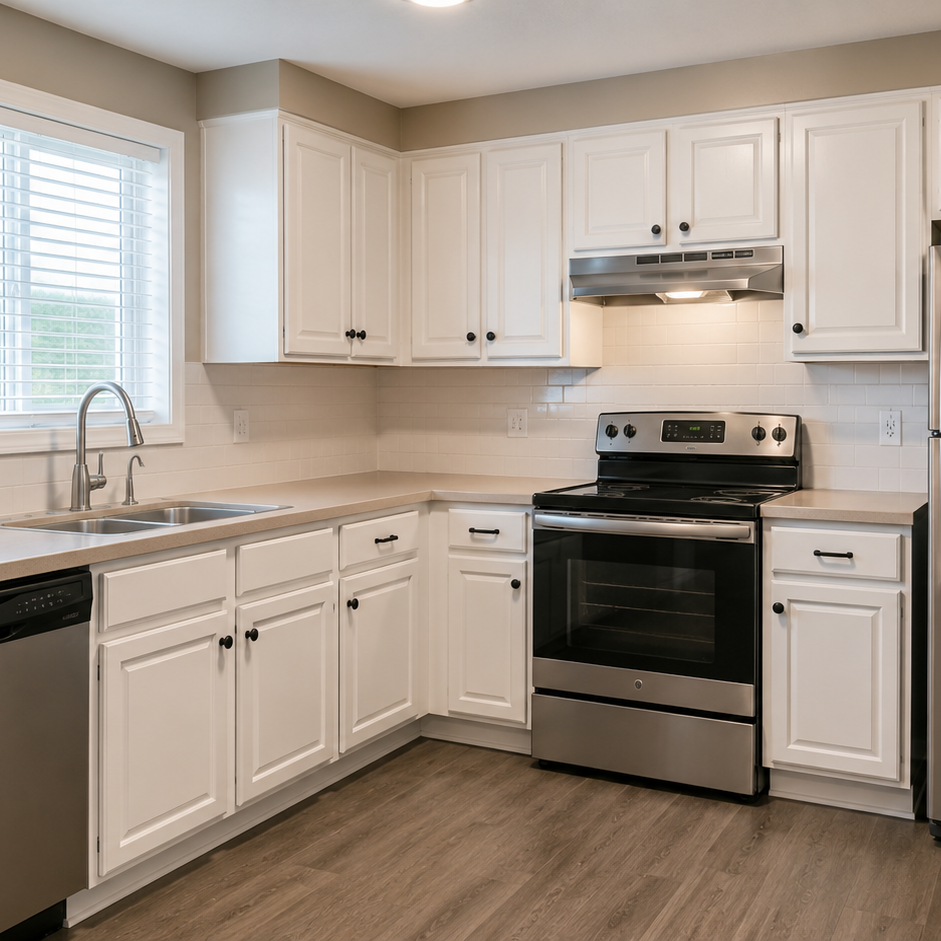
There is a reason the same job draws three wildly different per-square-foot prices, and once you see what the painter is actually charging for, the real range gets pretty narrow.The unit's been empty for nine days. The last tenants left clean. Oak doors above the dishwasher, grease shadow above the range hood, one missing pull on the trash drawer, two scuffs near the disposal. The kitchen isn't broken. It just looks tired enough that the first three showings ended with a polite pass.
A painter walked through that morning and quoted $2,800. Every day the unit sits dark costs roughly one-thirtieth of the monthly rent.
That math — the spread between a refinish bill, a vacancy day, and a rent bump — is what makes cabinet refinishing on a rental different from a refinish on an owner-occupied kitchen. Same booth, same paint, different decision tree.
The honest per-unit cost range for a rental kitchen
A rental-grade cabinet refinish in 2026 typically lands between $1,200 and $3,200 for a standard apartment or single-family rental kitchen with 15 to 25 linear feet of cabinetry. The range below covers what a landlord usually sees on a real quote, before any deep customization.
| Unit type | Linear feet of cabinets | Typical refinish cost | Days the unit is offline |
|---|---|---|---|
| Studio or 1-bedroom apartment | 8 – 12 lf | $900 – $1,800 | 3 – 5 days |
| 2-bedroom apartment | 12 – 18 lf | $1,400 – $2,400 | 4 – 6 days |
| 3-bedroom apartment or small SFR | 18 – 25 lf | $1,800 – $3,200 | 5 – 7 days |
| 4-bedroom SFR | 25 – 35 lf | $2,500 – $4,200 | 6 – 8 days |
| Duplex (per side) | 12 – 20 lf | $1,300 – $2,600 | 4 – 6 days per side |
Those numbers cover doors and drawer fronts sprayed off-site in a booth, boxes spot-sanded and rolled or sprayed on-site, prep, primer, and two topcoats of a cabinet-grade waterborne enamel. They assume solid-wood or quality-plywood boxes in sound shape. They do not include hardware replacement, soft-close hinges, or trim repair.
A homeowner refinish on the same kitchen often runs $400 to $1,000 higher because owners tend to upgrade — soft-close hinges, catalyzed varnish instead of waterborne enamel, brushed-nickel pulls. A landlord spec drops most of those line items and lets the painter focus on the finish.
What gets cut from a landlord-spec quote (and what shouldn't)
There's a version of cabinet refinishing built for rentals that costs 25 to 35 percent less than the homeowner version. There's also a version that costs 60 percent less and falls apart inside one lease. The difference between those two is which items got cut.
Acceptable rental-spec cuts. New decorative hardware swap. Custom color matching to an existing tile or backsplash — pick from three or four house colors the painter already stocks. Detailed glazing or distressing. Inside-cabinet refinish (boxes get cleaned, not painted, on the interior). Crown-molding repaint above the uppers if it's already a neutral. Drawer-box interior refinish.
Cuts that turn into callbacks. Skipping the degrease step on cabinets that have absorbed cooking film for a decade. Brushing instead of spraying the doors. Using wall paint instead of a cabinet-grade enamel. Skipping primer on stained doors that bleed tannins through white topcoat. Reusing the original hinges when half of them are loose or stripped. Each of those is the kind of "savings" that turns into a maintenance ticket six months into the next lease.
The cleanest landlord spec keeps the chemistry intact — degrease, sand, prime, spray two coats — and trims the cosmetic upgrades. That holds the finish at the seven- to ten-year life the painter promised, on a budget that pencils out at lease turn.
How vacancy days factor into the cost
The refinish quote is only half the budget. The other half is the days the unit is dark.
A 5-day refinish on a unit renting for $1,800 a month carries roughly $300 of lost rent on top of the $2,200 paint bill, if the work stretches the turn. A 7-day refinish stretches that to about $420. The vacancy number isn't a billable line, but it lands in the same column on the property's ledger.
Two ways to compress it. Schedule the refinish to overlap with carpet, paint, and appliance touch-ups so the days run in parallel. Or — for a multi-unit building — book the painter for slow-turnover months and run two or three units back to back. The per-unit price often drops 5 to 12 percent on a multi-unit booking.
A painter who works doors off-site keeps the unit closer to occupiable through the project. Boxes get a one-day spray, doors come back at the end of the week, the tenant can move in the day after install.
The repair-vs-improvement tax question
Cabinet refinishing on a rental sits in an awkward spot for tax treatment, and the answer affects whether the bill comes off this year's return or gets spread across the next 27.5.
If the refinish restores the property to ordinary operating condition — repainting tired doors, fixing a few scratches, putting the unit back to the look it had when it first rented — the bill generally qualifies as a deductible repair. The full amount comes off rental income in the year of the work.
If the refinish is part of a larger remodel that materially improves the kitchen — new layout, new countertops, refacing instead of refinishing — the cost usually has to be capitalized and depreciated over the building's recovery period (27.5 years for residential, 39 for commercial).
The distinction matters because a $2,500 deductible refinish saves a landlord roughly $550 to $925 on the tax bill that year, depending on the bracket. The same $2,500 capitalized improvement saves about $20 a year for 27.5 years — same total deduction, very different cash-flow profile.
Talk to a tax preparer before the project closes. Classification depends on facts and timing, not on what the painter writes on the invoice. Document either way: invoice, before-and-after photos, scope notes.
What a rental cabinet refinish quote should actually include
The quotes that come back fastest are also the most likely to skip steps the landlord won't see until lease three. The line items below are what a real landlord-grade quote covers.
| Line item | What it means | Typical share of total |
|---|---|---|
| Initial walkthrough and substrate assessment | Painter confirms the cabinets are paintable (solid wood, plywood, MDF — not thermofoil or vinyl-wrapped particleboard) | Included |
| Door and drawer-front removal, labeling, transport | Doors come off, get tagged, leave for the spray booth | 5 – 10% |
| Degrease and clean | Cabinets get a real solvent or TSP wash to cut cooking film | 5 – 8% |
| Sand or degloss | Two passes — break the old finish, key for primer | 10 – 15% |
| Fill, caulk, minor repair | Gouges filled, hinge holes patched, separated joints re-glued where reasonable | 5 – 10% |
| Mask and protect | Floor, counters, appliances, walls all masked before any spray | 5 – 8% |
| Prime | Bonding primer or stain-blocking primer on doors and boxes | 8 – 12% |
| Topcoat — two coats minimum | Cabinet-grade enamel or catalyzed coating sprayed on doors, rolled or sprayed on boxes | 20 – 30% |
| Reinstall, hardware, walkthrough | Doors back on, hinges adjusted, walkthrough with property manager | 8 – 12% |
Quotes that bundle "prep" into one line and "paint" into another, without breaking out the degrease and prime steps separately, often mean one or both got skipped. Quotes under $900 for a 15-linear-foot kitchen almost always indicate brushed work over unsanded cabinets, which is a 12- to 24-month finish at best on a rental that takes daily kitchen use.
ROI: rent bump, vacancy reduction, turnover savings
The argument for spending $2,000-plus on a rental cabinet refinish isn't aesthetic. It's the three numbers that change when the kitchen photographs differently.
Rent bump. Updated kitchens — the visual category most renters scan for in listings — let landlords push asking rent 3 to 8 percent in most markets without losing showings. On an $1,800/month unit that's $54 to $144 a month, or $648 to $1,728 a year. A $2,200 refinish pays for itself in 15 to 40 months on the rent bump alone.
Vacancy reduction. Listings with updated-looking kitchens fill 20 to 40 percent faster in most metro markets. Three days off a typical 14-day turn on an $1,800 unit is $180 in recovered rent — every turn, forever.
Multi-unit math: if the refinish runs $2,200 per kitchen on a six-unit building and adds $80 a month to each rent, the building's annual gross goes up $5,760 against a one-time $13,200 cost. Payback hits inside year three, and the finish should run seven to ten years.
When refinishing isn't the right call for a rental
A refinish isn't always the answer. Three situations point elsewhere.
When the boxes are bad. Particleboard boxes with delaminating veneer don't refinish well — the substrate swells, the veneer lifts, and the new paint follows the damage instead of hiding it. Those kitchens usually want stock-cabinet replacement at $5,000 to $8,000, not a refinish that fails inside a year.
When the layout doesn't work. Tenants don't tour for "good cabinets." They tour for "the kitchen works." If the real problem is no counter beside the stove or upper cabinets blocking the only window, refinishing solves nothing.
When the unit's about to sell. Refinishing 60 days before listing the building rarely returns the cost. Buyers discount cosmetic updates done right before sale because they assume the seller skipped the structural items. The refinish that earns the rent bump on a long-hold property earns very little on a flip-and-sell window.
FAQs
In most cases where the work restores the original condition — same color family, same hardware, no layout change — it qualifies as a deductible repair, and the full cost comes off that year's rental income. Bundled with a larger remodel that materially improves the unit, the same work usually has to be capitalized and depreciated. Run the project past a tax preparer before the invoice closes, because classification depends on the facts of the job, not what the painter writes.
A sprayed waterborne cabinet enamel on degreased and primed doors holds up seven to ten years on a typical rental, even with normal tenant turnover. A sprayed catalyzed finish — conversion varnish or post-catalyzed lacquer — runs ten to fifteen. A brushed wall-paint refinish, which still shows up in cheap bids, often fails inside two. The cost gap between a real spray job and a brushed job is small enough that the spray version is almost always the better landlord economics.
Some of it. Boxes sprayed on-site need the kitchen offline for two to three days with the tenant out of the cooking area, and waterborne primer smell is usually mild enough that an occupied unit works with a window fan and notice. Catalyzed coatings off-gas more and almost always require an empty kitchen. Most landlords schedule the refinish during the vacancy window between tenants for that reason.
Look at the doors. Solid wood, plywood, and MDF all refinish well. Thermofoil and vinyl-wrapped particleboard don't — a fingernail along an inconspicuous edge tells you which. If a thin film peels back, it's thermofoil and won't hold paint. Open a cabinet and look at the inside of the box; if the hinge plate is loose in crumbling material, the substrate is failing, and refinishing is a temporary fix at best.
Bulk booking usually saves 5 to 12 percent because the painter can run doors through one booth setup and amortize mobilization across the building. Staggered work spreads cash outflow but loses the discount. The decision often comes down to vacancy — a building with all units occupied can't refinish kitchens simultaneously, but a building with seasonal turnover can run two or three units through during the off-month and still capture some of the savings.
Sprayed waterborne cabinet enamel on degreased and primed solid-wood doors, with the original hardware reinstalled if still functional. That spec lands in the $1,200 to $2,200 range for a small-to-mid apartment kitchen and holds seven-plus years on normal use. Cheaper than that — brushed finishes, skipped primer, wall paint — saves a few hundred upfront and costs a re-refinish on the next turnover cycle.
The landlord math, written down
The refinish bill on a rental kitchen is only one number in the equation. The vacancy days, the rent bump, the tax treatment, and the next paint cycle's timing are the other four. A $2,200 refinish that lets the unit re-list for $80 more a month, fills three days faster, deducts as a repair this year, and holds for eight years pencils out differently than the same $2,200 spent as a capitalized improvement at the front of a remodel that drags the kitchen offline for three weeks.
Walk the kitchen before you call for quotes. Note the substrate, the layout, the hardware, the failure points. A painter who walks the unit, asks how long the lease cycle runs, and prices the work against a realistic vacancy window is the one to take seriously. The lowest bid almost never wins on a rental over the full holding period — it just wins on the first invoice.
