
Can Commercial Painting Be Done After Hours to Avoid Business Disruption
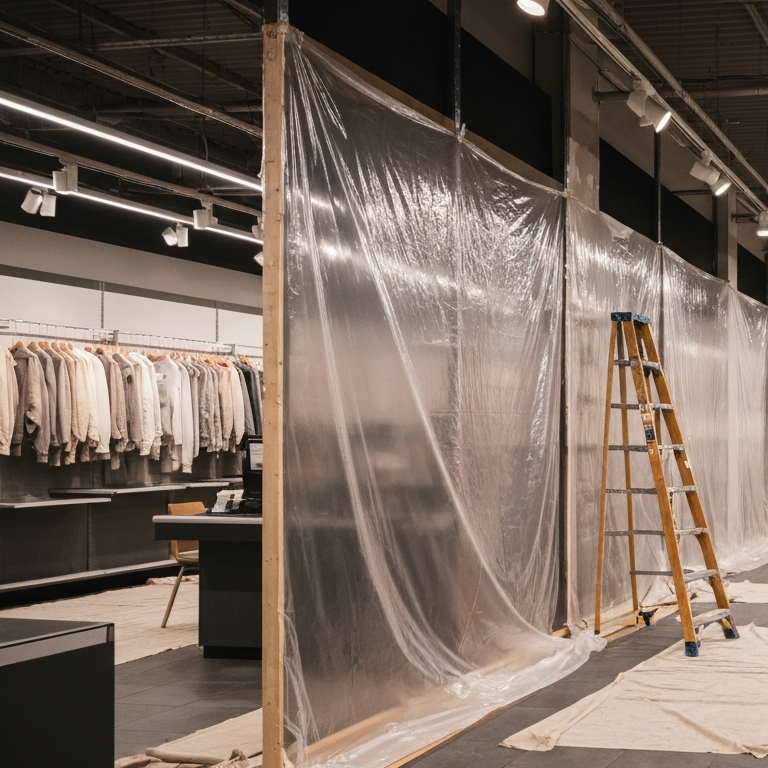
A retail store at 6:30 a.m. Half the showroom is roped off behind plastic sheeting. The opening manager edges past a ladder propped near the register, steps over a drop cloth, and tries to keep three customers from wandering into the wet wall the painter started on yesterday afternoon. The phone is ringing. The crew was supposed to be done by nine, and they aren't close.
The owner had two options on the bid: paint during business hours for a lower price, or pay 25% more to have the work done after close. He picked the lower number. By lunch he had lost two sales to customers who turned around at the door.
After-hours commercial painting exists because almost every business has a version of that morning. The work can be done — and often should be done — when the doors are locked. The question isn't really can it. The question is what it actually costs, what kinds of finishes work in the dark, and where after-hours becomes more trouble than it's worth.
What "after-hours" actually means on a commercial job
After-hours covers four different schedules, and they don't cost the same or carry the same logistics. A painting contractor who quotes after-hours work without naming which one is leaving room for misunderstanding.
| Schedule | Hours | Typical premium | Best fit |
|---|---|---|---|
| Evenings (swing shift) | 5 p.m. – midnight | 15 – 25% | Offices, retail, restaurants that close by dinner |
| Overnight (third shift) | 10 p.m. – 6 a.m. | 25 – 40% | 24-hour retail, hospitals, plants with day-only operations |
| Weekends | Fri 6 p.m. – Mon 6 a.m. | 20 – 35% | Banks, offices, schools, government buildings |
| Holiday shutdown | 3 – 7 days closed | 0 – 20% | Manufacturing plants, warehouses, restaurants with annual closure |
The premiums sit on top of a normal daytime crew rate. A 5,000-square-foot office that quotes at $14,000 during the day will land closer to $16,500 on evenings, $18,000 on overnight, or $13,500 if the work fits inside a planned holiday shutdown. Holiday weeks can come in flat to daytime pricing because the crew gets a continuous block of empty space without daily setup and tear-down.
Two scheduling details inside those numbers matter as much as the rate itself. After-hours work usually books a minimum of four hours per shift — a two-hour touch-up done after close still gets billed at the four-hour minimum because the crew mobilizes, sets up, paints, cleans, and demobilizes regardless. And prevailing-wage requirements on public-sector after-hours work (schools, municipal buildings, libraries) push the premium higher, closer to 40-50% over daytime. That's a labor-law issue, not contractor markup.
Why after-hours costs more — and when the math still works
The premium is real labor cost, not contractor opportunism. After-hours crews work shorter shifts (4-6 hours instead of 8-10), travel during off-peak hours that pay differential, and lose productivity to lower light levels and the extra setup of plastic walls and temporary barriers each shift.
Three operating costs move the after-hours number up. Workers paid time-and-a-half on weekends or overnight. Site supervision that has to be present even on a small crew, because one painter alone overnight is a safety-policy violation at most insured contractors. And portable lighting — a typical interior commercial job uses four to six stand-mounted LED work lights at 10,000-plus lumens each to match daytime visibility, which costs roughly $200-400 in rental per week plus power.
The math gets clearer when the business prices its own downtime. A coffee shop pulling $250 in revenue per business hour, asked to close for two days of painting, loses around $5,000 in sales over 16 business hours plus roughly $1,200 in wages paid to staff who can't work. The after-hours premium on a small shop repaint runs about $2,000-$3,000. It pays back the first day.
A back-office firm with no client-facing traffic, no walk-ins, and employees who can work from home for two days has near-zero downtime cost. Paying the same $2,000-$3,000 premium buys nothing.
What actually works in the dark — and what doesn't
Most paint jobs run fine after hours. A few don't, because of how paint cures, how dust settles in still air, and how some sheens punish low-light work.
Latex paints cure faster than oil-based, which is what makes overnight repaints feasible. A water-based wall paint at 70°F and 50% humidity hits dry-to-touch in one to two hours and recoat-ready in about four. That gives an overnight crew enough room to lay down two coats between 10 p.m. and 5 a.m. if they're working in zones. Oil-based primers and trim enamels take 6-12 hours between coats — they can't compress into a single overnight window without leaving wet trim for the morning crew.
Spray work runs better after hours than during business operation, but it demands more setup. Sprayed cabinet finishes, sprayed conference-room ceilings, sprayed warehouse epoxy floors — these throw a fine atomized mist that lands on every horizontal surface within twenty feet if the room isn't sealed. Doing that work overnight with HVAC off and the building empty avoids contamination of desks, electronics, and inventory. The setup itself is plastic-walling off the zone, masking vents, and shutting down return air.
A few specific situations don't fit after-hours work well. High-gloss and semi-gloss finishes on smooth surfaces are the first one. Low-angle work lights make every roller mark and brush stroke read as a shadow. The painter can't see the same defects they would catch under daylight or balanced overhead office lighting. The crew either works slower (raising cost) or comes back to fix lap marks in daylight.
Color-critical work is the second. A boutique repainting under work lights at midnight might pick the wrong tone on an accent wall. Anything color-sensitive needs at least a daylight check before sign-off.
The third is hot, fast-drying conditions on large open walls. A warehouse interior at 90°F with low humidity dries paint so fast the lap marks set before the painter can blend the edge. Cooler overnight temperatures actually help — but in a building with no climate control, surface temp can swing too far below the paint's minimum.
Stains and clear coats on millwork round out the list. Stains need slow penetration and a careful wet edge. Pushing them through a six-hour overnight window usually produces uneven absorption.
After-hours vs. phased daytime vs. shutdown
After-hours painting isn't the only way to keep a business running during a repaint. Two alternatives often work better depending on the space.
| Approach | When it fits | Cost vs. straight daytime | Disruption to staff |
|---|---|---|---|
| Straight daytime, no phasing | Empty buildings, low-traffic offices, tenant turnover between leases | Baseline | High if occupied; none if empty |
| Phased daytime work by zone | Multi-floor offices, retail with sections, schools room-by-room | +5 – 10% (longer schedule) | Moderate — staff relocate within building |
| After-hours (evenings or overnight) | Customer-facing spaces, businesses with no spare zone to relocate | +15 – 40% | Minimal — work invisible to staff and customers |
| Weekend or holiday shutdown | Banks, government, schools, manufacturing with annual closure | 0 – 20% | None if shutdown was already planned |
Phased daytime work is the option owners forget. A 12,000-square-foot office can usually paint one floor at a time while the other floor keeps working. Staff swap desks for a week. The project takes longer but costs nearly the same as straight daytime. A retail store can paint half the showroom behind a plastic wall while the other half stays open, then flip the wall and do the second half. The customer experience isn't perfect, but it's a fraction of the after-hours premium.
What an after-hours quote should specify
A commercial bid for after-hours work needs more detail than a daytime quote. The schedule itself is part of the deliverable, and ambiguity in the schedule produces overruns. Things to confirm before signing:
The exact hours the crew works each shift, including start and end. "Evenings" is not a schedule. "5:30 p.m. to 11:30 p.m., Monday through Thursday" is.
Who opens the building, who locks it, and what happens if the crew can't get in. After-hours lockout charges usually run $150-300 per incident plus the crew's lost shift time.
Where the crew loads and unloads — back door, loading dock, freight elevator availability after hours. A crew with no freight access to a fifth-floor office at 10 p.m. carries a hundred pounds of equipment up the stairs at the start and end of every shift. That time gets billed.
Lighting plan. Building lights or contractor-supplied? Building electric bills go up about 15-30% during an after-hours shift if the lighting load is significant.
Notification protocol with security or building management. After-hours alarms tripping mid-shift produce two-to-four-hour police response delays. The bid should name who at the contractor side calls in to disarm and who clears the all-clear.
Daily clean-up requirements. The space needs to look usable by 6 or 7 a.m. — drop cloths folded, ladders out, dust vacuumed, smell ventilated. Anything left out in the morning becomes a problem the contractor pays for.
FAQs
Evening shifts typically add 15-25% to the daytime quote. Overnight shifts run 25-40% higher. Weekends fall in the 20-35% range. Holiday shutdowns when the business was already going to be closed often cost the same as daytime, sometimes less, because the crew gets a continuous open block instead of daily setup and tear-down.
Yes, in most cases, when the contractor used low-VOC water-based products and ventilated the space. Water-based wall paint cures to recoat-ready in about four hours and to fully usable in six to eight hours. Lights, furniture, and people can return by 6 or 7 a.m. on a job that finished at midnight. Oil-based products, lacquers, and high-gloss enamels need longer — sometimes 24-48 hours before the space reads as fully cured.
A reputable insured contractor sends at least two people per shift even on small jobs. Single-painter overnight work violates most general liability policies — if a worker falls off a ladder alone at 2 a.m., there's no one to call for help. Crews of three to six painters are common on larger commercial jobs to compress the schedule.
Quality drops only if the lighting setup is wrong. A crew using stand-mounted LED work lights at 10,000-plus lumens per stand, positioned at the right angles, can produce work indistinguishable from daytime quality on flat and eggshell finishes. Semi-gloss and high-gloss surfaces are harder — low-angle light hides defects the painter would catch during the day. Color-critical accent walls should always get a daylight inspection before final sign-off.
Almost never. Schools paint during summer break, spring break, winter break, or evenings and weekends. The combination of paint odor, drop cloths, ladders, and active foot traffic with children is a ventilation and liability problem most administrators won't accept. Public schools also trigger prevailing-wage rules on after-hours work, which pushes the premium to 40-50% over the daytime rate.
Most use a temporary access protocol: a building-issued keycard for one named foreman, an alarm code that resets weekly, and a logged sign-in and sign-out at the security desk or a smart lock that records timestamps. Some commercial property managers prefer to have their own night staff open and close up at shift change. The bid should name who holds keys and who's responsible if access is lost.
When after-hours is the right call — and when it isn't
After-hours commercial painting works when the business loses real money during downtime and the space has a finish profile — latex wall paint, flat or eggshell sheen, water-based products — that cures fast enough to fit an overnight or weekend window. A retail store running peak revenue Friday through Sunday almost always saves money paying the weekend premium. A medical office that can't have patients walking past wet paint and exposed walls almost always saves money paying for evenings.
The premium stops paying off when the building has flexibility a contractor can use during the day — a second floor that's empty, a wing that's seasonal, a back office that doesn't see customers. Phased daytime work captures most of the operational benefit at a fraction of the cost. The premium also stops paying off when the work itself fights the schedule: oil-based trim, stained millwork, sprayed high-gloss cabinets, color-critical accent walls. Those finishes need more time and better light than an overnight shift gives.
The smart move is usually a hybrid. The customer-facing 20-30% of the space goes after hours. The behind-the-scenes 70-80% goes during the day in phases. The bid lists both rates separately and the building manager picks the split that fits revenue, staffing, and access. That conversation — with a contractor who quotes both options instead of one — is where commercial repaint jobs actually go right.
