
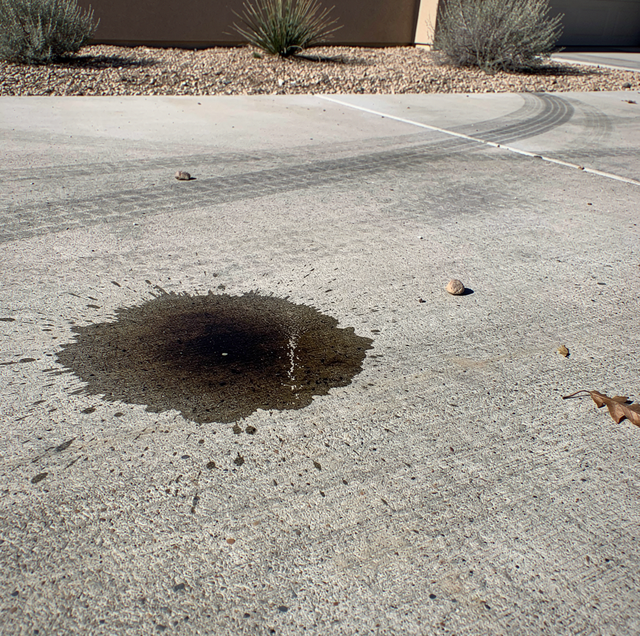
A driveway collects every drip, turn, and puddle a household produces, and a power wash does not treat those marks as one problem. Some sit on top of the concrete and rinse away. Others have moved into the slab itself, where water under pressure reaches only part of them. Knowing which kind you have before the wand comes out gives you a fair picture of the finished driveway, and keeps a clean result from feeling like a disappointment.
How Oil Soaks Into Concrete
Concrete looks solid, but it is a network of tiny pores and capillaries left behind as water in the mix evaporated during curing. Motor oil is thin enough to follow those channels. A drip that lands on bare concrete starts moving downward and outward as soon as it lands, drawn along the pores by capillary action.
A fresh drip still sits close to the surface. A degreaser can reach it there, break the oil into droplets that mix with water, and let the rinse carry it off. Time changes the picture. A stain left for months has spread through the pores well below the top layer, and the oil in it has aged: contact with air thickens and darkens it, and used motor oil already carries carbon and combustion residue from the engine.
Pressure water strikes the surface and rebounds. It has no way to pull oil back out of pores it cannot reach. An old stain responds to a cleaner that dwells and draws instead of to added force: a degreaser given time to work, applied in repeated rounds, or a poultice, a paste of absorbent powder and solvent spread over the stain that pulls oil upward as it dries and is then scraped away.
Slide a drip pan or a flattened cardboard box under any car that leaks for the days leading up to the wash. A stain that is still receiving fresh oil refills from above while the crew works on it from the surface.
Why Tire Marks Behave Differently
Tire marks look like oil stains from the curb, yet they form and come off differently. Two kinds show up on driveways.
Scuffed rubber: When a wheel turns while the car sits still, or a car pulls away hard, a thin layer of rubber rubs off onto the concrete. That smear lies on top of the slab and has not soaked in, so a degreaser worked into it and a controlled rinse lifts it well.
Chemical staining: Tires contain plasticizers and antioxidants compounded into the rubber. A warm tire parked in the same spot day after day can transfer some of those compounds onto whatever it rests on. On bare concrete, they can leave a faint brown or yellow shadow in the shape of the tread. On a driveway sealed with a film-forming sealer, the compounds migrate into the sealer, discoloring it from within. A stain within a sealer film is beyond a wash's reach. Stripping and resealing the affected area removes it, and that is a separate job from washing.
That split is why two dark patches in the same parking spot can end the day looking different: the scuff is gone, and the tread-shaped stain under the sealer remains.
How Each Driveway Stain Responds to a Wash
The table sorts six stains a driveway wash is asked about by what water and pressure do on their own, what gets applied first, and what can remain after both.
| Stain | What a wash alone does | Pre-treatment it needs | What can stay |
|---|---|---|---|
| Fresh oil | Removes the surface film; leaves oil in the top pores | A degreaser given dwell time before the rinse | A faint patch if the drip had time to spread |
| Old soaked-in oil | Cleans around it; the dark patch remains | Repeated degreaser rounds or a poultice | A faded shadow where oil sits below reach |
| Tire marks | Lifts part of a surface rubber scuff | A degreaser worked in before rinsing | Tread-shaped discoloration inside a sealer film |
| Rust | Very little, since rust does not dissolve in water | A mild acid rust remover, then a full rinse | Rust bleeding from steel inside the slab returns |
| Organic staining | Lifts loose algae, mildew, moss and debris | A cleaning solution that kills the growth | Pale leaf-tannin outlines that fade in sunlight |
| Efflorescence | Dissolves some fresh salt, and soaks the slab | Dry brushing; a mild acid cleaner for hardened crust | A white bloom that recurs while moisture moves through |
Rust, Organic Growth, and Efflorescence
Rust: Rust is iron oxide, and water does not dissolve it, so pressure alone moves very little of it. Surface sources include a metal planter, a steel tool left out in the rain, or a sprinkler that throws iron-rich water onto the slab. An acid-based rust remover dissolves the oxide so the rinse can carry it away. The same acid attacks the cement paste if it sits too long, so dwell time is measured, and the rinse is thorough. A rust stain that grows from a crack, or from a spot where nothing metal ever sat, can come from reinforcing steel corroding inside the slab or from iron-bearing particles in the stone mix. In either case, the source is within the concrete, and the stain can return after cleaning.
Organic growth: Algae, mildew, and moss grow where a slab stays damp and shaded, and leaves left on concrete leach tannins that print a brown outline of the leaf. Loose growth rinses off, but spores left alive in the pores regrow. A cleaning solution applied first and left on the surface kills what is in the pores, so the wash removes the growth rather than trimming it; a slab that stays damp and shaded can still grow a new crop later. Tannin outlines are a dye in the surface, and a pale shadow can outlast the wash.
Efflorescence: This is the white, powdery bloom that appears when water moving through concrete brings dissolved salts to the surface of the slab, where they evaporate, leaving the salts behind. Washing a fresh bloom dissolves some of it, but it also soaks the slab, and that water can dissolve salt still inside the slab and carry it up as the concrete dries. Dry brushing removes loose deposits without adding water. Salt left on the surface long enough reacts with carbon dioxide in the air and hardens into a crust that brushing will not lift, and that crust calls for a mild acid cleaner. The bloom keeps coming back while water keeps moving through the slab, from a downspout emptying onto it or from wet ground beneath it, so the lasting fix lies with the water source.
How Pressure Etches a Concrete Surface
Concrete tolerates pressure that would gouge wood siding, but it still has a vulnerable layer. When a slab is finished, troweling brings a thin paste of cement and fine sand to the surface, which gives the driveway its smooth, even color. A narrow stream held close to the surface cuts into that paste and exposes the coarse sand and stone beneath. The damage appears as pale, coarse stripes, arcs, or blotches that stand out from the surrounding slab, known as wand marks, and is permanent. No cleaner puts the paste back.
Three things decide whether a wash etches: the nozzle angle, the distance from the surface, and how long the stream lingers in one place. A zero-degree or narrow tip concentrates the pressure on a point, while a wide fan spreads it across a band. A rotary surface cleaner, a spinning bar under a round hood, holds its nozzles at a fixed height and sweeps them in overlapping circles. That fixed height is how a crew gets an even result across a whole driveway without a hand-held wand changing its distance from pass to pass. Etched concrete has also lost the dense top layer that slowed the last spill, leaving open pores waiting for the next one.
A narrow pressure-washer stream can cut through skin and force water into the tissue beneath, resulting in an injury that may look minor but requires emergency care. Leave narrow tips and degreasers to the washing crew, and keep children and pets clear.
Keeping Oily Wash Water Out of the Storm Drain
The water leaving a driveway during a wash carries whatever came off it: oil, degreaser, rust remover, and fine grit. A curbside storm drain is built to carry rain, and what enters it can reach creeks and rivers without passing through a treatment plant. Wash water carrying oil or cleaning chemicals stays out of it.
Standing oil is cleared before any water goes down; cleaners are used at the label's strength with the specified dwell time and rinsed off completely; and the rinse is kept away from the curbside drain. Residue left on the slab keeps working its way to the surface and ends up in the next storm's runoff.
What a Wash Can and Cannot Promise
A well-run wash can promise a clean, even surface: dirt, loose growth, surface rubber, and fresh oil gone, and the slab's own color back wherever nothing has stained into it. It cannot promise to remove what has moved below the surface or into a sealer film. Old oil deep in the pores can lighten with each treatment and still leave a shadow. Rust from steel within the slab and efflorescence fed by moving water can return after the driveway looks finished.
Washing a wall or a slab ahead of paint or a floor coating is a different job, judged by how well the next layer bonds; a driveway wash is judged by the bare concrete itself.
The useful moment to sort your stains is before the work starts. During a walk-through, each mark can be placed in its group: gone with a wash; gone with a pre-treatment and dwell time; likely to fade and remain faint; or fed by a car that is still leaking and needs repair or another parking spot. That walk sets the standard the finished slab gets measured against.
Frequently Asked Questions
Cover the drip with a dry, absorbent clay, such as unscented clay cat litter, grind it in under a shoe, and leave it to soak up the oil before sweeping it into a bag. Hosing a fresh drip spreads the oil across the surrounding concrete before any of it rises.
Concrete mixes are designed to reach their specified strength at 28 days of curing, and the surface paste is still gaining strength during that window. Holding off until the slab is past that mark protects the new surface from etching.
Wet concrete darkens evenly, which hides the contrast between a stain and the clean slab around it. Judge the result once the slab has fully dried, since oil held deep in the pores can also wick back toward the surface as the concrete dries out.
Yes. Heated water thins oil and grease and helps a degreaser break them up, which is why hot-water pressure washers are built for oil-heavy concrete. Heat does not change how far oil has already soaked in, so an old stain still needs dwell time.
No. Asphalt is held together by a petroleum-based binder, and a strong degreaser or solvent that dissolves oil can soften that binder as well, loosening the stone in the surface. Asphalt is washed at low pressure with a cleaner labeled safe for it.
Fertilizer granules that contain iron are one source. When granules land on concrete and get wet by sprinklers or dew, the iron oxidizes in place, leaving orange specks. Sweeping or blowing stray granules back onto the lawn before watering helps prevent staining.
Line up a driveway and sidewalk wash — we'll walk the concrete first and tell you which stains will lift, which will lighten, and which will stay. True Coat Painting serves Reno, Sparks, and Spanish Springs. Call (775) 227-0618.