
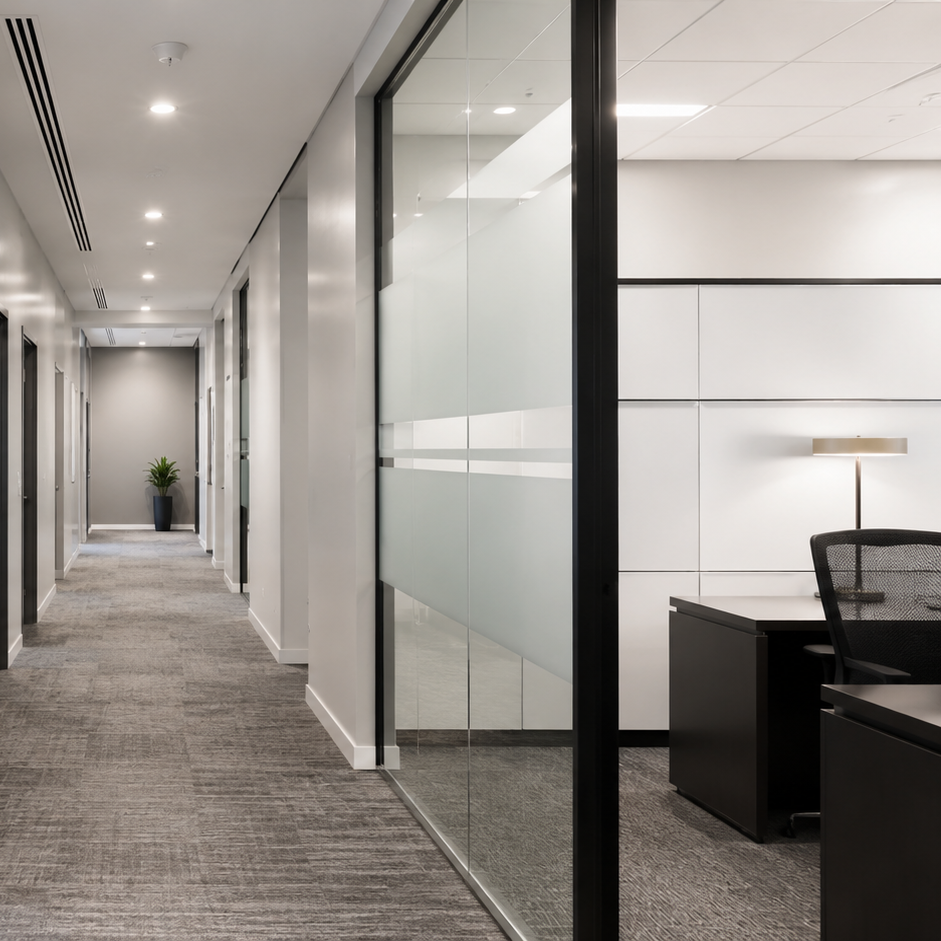
A Monday morning in an office that hasn't been painted in eight years tells the story before anyone says a word. Behind the rows of monitors, the wall holds faint rectangles where last year's whiteboard hung. The hallway between accounting and the executive suite has a black smudge line three feet up where every chair back has brushed for half a decade. The lobby looks fine from the front door — until you sit in a waiting chair for ten minutes and notice the scuff above the trim where every visitor has dragged a roller bag past.
That gap, between how the office looks at first glance and how it reads after a few minutes inside, is what drives the commercial repaint cycle. The walls are still standing. The finish is failing in pieces, on a schedule the building has been keeping, whether anyone tracked it or not.
The short answer: most commercial offices need a full interior repaint every five to seven years. High-traffic zones — lobbies, main corridors, break rooms, restrooms — need a wall-by-wall touch-up or partial recoat every two to three years. Heavy-use industries (medical, daycare, food service, fitness, training centers) compress those numbers. Quiet professional offices with low foot traffic stretch them.
The cycle by office zone, not by industry
The mistake most building owners make is treating "the office" as a single surface that gets painted on a single calendar. It isn't. A 15,000-square-foot office has at least five distinct paint zones, and each one wears at a different rate. The table below sets a baseline for a typical American office building — moderate climate, ordinary HVAC, standard ten-hour business day.
| Zone | Full repaint | Touch-up or partial recoat | What drives it |
|---|---|---|---|
| Lobby and reception | Every 3 – 5 years | Every 12 – 18 months | First impression, visitor traffic, rolling luggage scuffs |
| Main corridors and hallways | Every 3 – 5 years | Every 18 – 24 months | Chair backs, cart wheels, hand smudges at shoulder height |
| Conference rooms | Every 5 – 7 years | After any client renovation | Chair scrapes, whiteboard ghosting, monitor mount holes |
| Open work areas | Every 5 – 7 years | After major layout change | Workstation rearrangement, poster removal, ghost lines |
| Private offices | Every 7 – 10 years | At tenant change | Low traffic, slow wear, mostly cosmetic |
| Break rooms and kitchens | Every 3 – 4 years | Every 12 months on wash-prone walls | Grease film, splash, food residue |
| Restrooms | Every 3 – 4 years | Every 12 – 18 months | Moisture, cleaning chemicals, fixture replacements |
| Exterior | Every 7 – 10 years | Spot work as needed | UV, weather, signage changes |
Two adjustments shift the schedule. Tighten every interval by twelve to eighteen months if the office runs more than fifty employees per ten thousand square feet. Loosen each interval by one to two years if the office sits half-empty most days (post-pandemic hybrid offices that draw twenty percent occupancy show paint wear closer to a quiet professional space than to a packed open-plan).
What actually wears the paint in an office
Five forces work on commercial office walls, and each one leaves a different kind of damage. Knowing which one is winning in a given zone tells the owner whether the cycle needs to tighten, or whether the wear pattern is normal for the use.
Foot traffic and shoulder brush. Every person who walks down a corridor brushes the wall once or twice a week, usually without realizing it. Oils on a hand or sleeve transfer to the paint film and bind dust. After two years the line at shoulder height and chair-back height reads visibly darker than the rest of the wall.
Cart and chair impact. Office chairs roll. Mail carts roll. Cleaning carts roll. Door frames between accounting and the copy room take scrapes from chair backs and cart corners. Most office paint failures in corridors are mechanical — chipped down to drywall, not a finish failure across a whole wall.
Lighting fade. Office walls under fluorescent or LED lighting fade unevenly. A wall behind a row of overhead lights reads several shades lighter than the wall five feet to the side after three years. The fade is invisible until something gets moved — a framed certificate that came down last week leaves a darker rectangle of original paint behind it.
Cleaning chemicals. Janitorial wipes and degreasers attack the paint binder over years. Walls near restroom doors, break room counters, and behind trash cans take the most chemical exposure. The finish dulls, then thins, then starts releasing pigment when wiped.
Layout churn. Every monitor mount removed, every poster taken down, every whiteboard rearranged leaves a hole or an outline. A company that reconfigures workstations every eighteen months puts more wear on the paint through patches than through traffic.
Full repaint versus touch-up versus accent recoat
A surprising number of offices repaint everything every time, which is both expensive and unnecessary. The cleaner pattern uses three scopes on overlapping cycles.
A full repaint covers every wall and ceiling in the leased space, including doors, frames, and trim. Five to seven years on most office buildings. The job takes a long weekend or a full week of evenings to complete without disrupting business.
A touch-up cycle hits only the walls and zones showing visible wear. The crew comes in once a year and addresses corridors, lobbies, break rooms, and any spot work — patching nail holes, repainting a single wall after a layout change, recoating a hallway that has taken too many chair scrapes.
An accent recoat is for offices with branded paint colors — a logo wall, a reception accent, an executive corridor in a non-standard color. Accent walls show wear earlier because the color contrast makes scuffs more visible. Most offices need accent walls recoated every two to three years, even if the rest of the space is on a five-year cycle.
Running all three together is what makes a six-year-old office still read as new. The full repaint addresses age and fade. The touch-up addresses wear. The accent recoat protects the parts visitors look at most.
How industry and use compress the schedule
A law firm with twelve employees and three clients per day will outlast its paint cycle. A pediatric clinic with seventy-five patient visits per day burns through paint twice as fast. The pattern below adjusts the baseline cycle by industry.
Heavy-use sectors that need a tighter cycle:
Medical and dental offices. Restrooms, exam rooms, and waiting areas need a full repaint every three to four years. Cleaning chemicals attack the paint film faster than general office wear. Semi-gloss or scrubbable matte finishes extend the cycle.
Daycare and education. Cubby walls, hallways, and any surface within two feet of the floor wear quickly from children's hands and art projects. Lobby and hallway touch-ups belong on a six-to-twelve-month rhythm.
Food service offices and break rooms. Grease aerosol from kitchens deposits on walls up to thirty feet from the cooking line. Any wall behind a coffee station, microwave, or toaster collects a thin film that turns yellow in two years.
Gyms and training centers. High humidity and constant cleaning create both moisture damage and chemical wear. Three-year full repaint cycle. Restrooms and locker rooms on a two-year cycle.
Sectors that can stretch the cycle include single-tenant professional offices — law, accounting, finance, consulting — where low foot traffic and a controlled environment push the full repaint out to seven to ten years, with selective touch-up on the lobby and main hallway. Back-office data centers, server rooms, storage, and archive areas see no chairs brushing the walls, no food, no daily traffic; paint here can last fifteen years before fading or wear shows.
When lease and tenancy drive the timing
The repaint cycle does not always wait for the paint to wear out. Three lease-driven triggers pull the next repaint forward.
Lease renewal or new lease signing. Landlords typically include a fresh repaint in renewal incentives, particularly on five-year and longer leases. The repaint happens as part of the lease deal, not on the building's cycle. A tenant signing a new lease in year four of a building's seven-year cycle gets a fresh space.
Tenant changeover. An incoming tenant almost always wants the space repainted before move-in. This is a full repaint regardless of how old the existing paint is, because the next tenant's brand colors and finish preferences differ from the previous tenant's. Build the cost of a turnover repaint into the make-ready budget.
Rebrand or company change. A merger, a name change, a new logo color, or a new visual identity drives a paint refresh independent of wear. Most rebrands repaint at least the lobby, the main corridors, and the conference rooms within ninety days of launch.
A multi-tenant office building runs these triggers continuously. The building owner's repaint budget belongs in two columns — the scheduled maintenance cycle for common areas, and the per-suite turnover cycle for leased spaces.
Signs the office is past its cycle
Three patterns tell a building owner the repaint is overdue, regardless of the calendar.
Lobby walls read yellow or beige against the original color wherever a frame, sign, or piece of artwork has come down. The fade is not the wall — it is the protection that artwork gave that one rectangle for years. When the contrast is visible from across the lobby, the wall has faded past the touch-up window.
The corridor chair-back line is darker than the rest of the wall and does not come off with a damp cloth. Oils and dust have penetrated the paint film. A cleaning pass cannot reverse this; it needs paint.
The break room wall behind the coffee maker has a yellow-to-brown gradient from counter height up to the ceiling. Grease film has saturated the paint. A wash can lift the top layer but the yellowing has stained the binder. Repaint is the only fix.
When two of these three are visible, the office is past the touch-up window and a full repaint is the cheaper move. Pushing the schedule another twelve months usually doubles the labor cost of the eventual repaint, because the patching and prep get heavier the longer the wear runs.
| Room or area | Typical 2026 cost | What changes the price |
|---|---|---|
| Small bedroom (10×12) | $350 – $600 | Closet doors, ceiling included, accent wall |
| Standard bedroom (12×14) | $450 – $800 | Vaulted ceiling adds $150–$300 |
| Master bedroom (14×18) | $600 – $1,100 | Walk-in closet, tray ceiling, en suite trim |
| Living room (15×20) | $600 – $1,200 | Tall ceilings, fireplace, lots of trim |
| Kitchen (walls only, no cabinets) | $400 – $900 | Cabinet cut-ins, behind appliances, soffit |
| Bathroom (full or half) | $300 – $650 | Bathroom-grade paint costs more per gallon |
| Hallway and stairwell | $400 – $900 | Stairwell height drives this fast |
| Full 1,500 sq ft home interior | $3,000 – $6,000 | Whether trim and doors are included |
| Full 2,500 sq ft home interior | $5,000 – $10,000 | Trim is usually 20–30% of the total |
| Trim and doors per room | $200 – $500 | Type of trim, condition, latex vs oil |
FAQs
Yes, with the right scope and product choice. Low-VOC or zero-VOC paints allow staff to return to a repainted area within four to eight hours. Most commercial repaints run in evening shifts, on weekends, or in phased zones — paint the east wing this weekend, the west wing next weekend. A full repaint of an occupied office that runs without phasing usually adds three to five days to the schedule and produces lower-quality work because the crew is working around furniture and people.
Eggshell or low-sheen matte are the standard for office walls because they hide minor patching and resist light scuffing. Satin or semi-gloss belongs on trim, doors, and any wall that gets washed regularly — restrooms, break rooms, hallway kick lines. High-traffic corridors benefit from a scrubbable matte finish, which holds the look of a flat wall while taking cleaning chemistry far better than a basic flat paint.
Interior commercial repaints typically run two to five dollars per square foot of wall area, depending on prep work, surface condition, sheen, and access. A 10,000-square-foot office with standard eight-foot ceilings has roughly 8,000 to 10,000 square feet of wall area. Expect a quote in the $20,000 to $50,000 range for a full interior repaint at the lower-mid scope, with higher numbers for offices with significant patching, color changes, or after-hours work.
It depends on the lease structure. Triple-net leases generally put interior maintenance on the tenant. Full-service or modified gross leases often include interior repainting at lease renewal as part of the landlord's obligation. Most lease agreements include language about painting at turnover — tenants vacating return the space to a neutral color, or pay a deduction from the deposit. Check the lease before scheduling either party for the work.
A 5,000-square-foot office takes two to four nights of phased work. A 10,000-square-foot office takes a long weekend with a crew of four to six painters in shifts. A 25,000-square-foot office takes two weekends or a week of overnight shifts. These numbers assume sprayed walls, rolled trim, and a single color throughout. Accent walls, multiple colors, heavy patching, or wallpaper removal extend each estimate by twenty to forty percent.
Yes. Dark and saturated colors show fade, scuffs, and patching repairs faster than mid-tone neutrals because the contrast against any imperfection is higher. An accent wall in deep navy or forest green reads worn at two years where a beige neutral in the same hallway reads fresh at four. Plan an extra recoat for any accent wall, and budget for color matching from the original paint can rather than a fresh mix.
Treat the cycle as a schedule, not a project
Most building owners think about office repainting only when a partner walks the building and says it looks tired. That is the wrong trigger. By then, the office has been past its cycle for at least eighteen months, the touch-up window has closed, and the next repaint requires significantly more prep than a scheduled cycle would have. The cheaper rhythm is to build the cycle into the maintenance calendar — a full repaint every five to seven years, a touch-up pass every twelve to eighteen months on high-traffic zones, an accent recoat every two to three years on any branded wall.
Buildings that look ten years younger than the one next door are not running a more expensive contractor. They are running on a schedule, with the next visit booked before anyone notices the wall.