
Epoxy Flake vs Metallic Epoxy for a Warehouse Floor: Which Fits Your Use Case
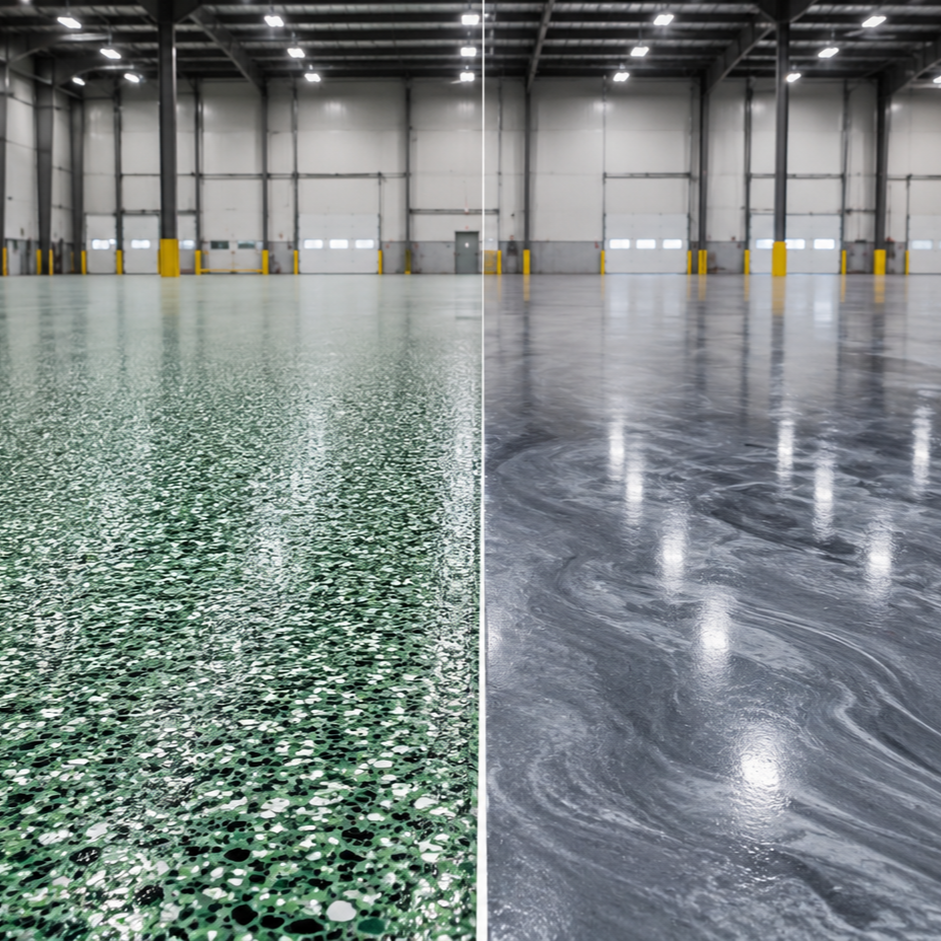
A plant manager stands in the middle of a 12,000-square-foot warehouse holding two product brochures. One shows a forest-green floor speckled with grey and black chips. The other shows a slate-blue surface that looks like polished marble, with metallic swirls catching the overhead lights. The cost difference is $40,000.
His pickers run electric forklifts down the same lanes ten hours a day. The east end is the customer-tour area where buyers come through twice a month and decide whether to sign multi-year contracts.
He's about to make the wrong call, because nobody told him these two floors aren't competing for the same job.
What an epoxy flake floor actually is
A flake floor — sometimes called a chip system or broadcast flake — is built in three layers. First a moisture-tolerant epoxy primer goes down to bond into the open pores of the ground concrete. Then a pigmented epoxy basecoat is rolled out at 10 to 15 wet mils. While the basecoat is still tacky, the installer broadcasts vinyl color chips by hand or with a hopper, throwing them up into the air so they land flat. The flakes keep landing until the surface refuses to take any more. That's called refusal, or full broadcast.
Once the basecoat cures, a crew scrapes off the loose chips, lightly sands the high points, and rolls a clear epoxy or polyaspartic topcoat at 15 to 25 mils. The topcoat encapsulates the chips, fills the gaps between them, and gives the floor its working surface.
The result is a floor with texture you can feel through a forklift tire. The chips create thousands of tiny ridges. Wet or dry, that texture matters more than people realize. It's the difference between a forklift skidding sideways on a polished slab and tracking straight.
What a metallic epoxy floor actually is
A metallic floor uses a clear or lightly tinted 100%-solids epoxy resin loaded with metallic mica pigments. These aren't paint pigments. They're tiny flakes of mica coated with iron oxide or titanium dioxide, behaving like a million microscopic mirrors suspended in resin.
The installer pours the loaded epoxy and then physically manipulates the wet film. Some pull it with a notched squeegee, then back-roll. Some use a leaf blower to push the resin into swirls. Some drop a different metallic color into the wet base and feather the boundary with a brush. The pigments shift and align with the movement, and what's underneath ends up looking like marble, a slow river, or weathered copper depending on the technique and the colors.
It's closer to an artist's medium than a tradesman's product. Two installers can pour the same resin and produce floors that look nothing alike. A clear high-build polyaspartic goes over the cured metallic basecoat — that topcoat is what gives the floor its mirror-deep gloss.
The surface is smooth. Glassy. The pigments don't add texture, only visual depth. A drop of water beads on a metallic floor the way it beads on glass.
Head-to-head — which one fits a warehouse job
The two systems serve different masters. Flake serves the work happening on the floor. Metallic serves the eyes looking at it. Here's how they line up across the categories a facility manager actually cares about.
| Performance category | Epoxy flake | Metallic epoxy |
|---|---|---|
| Slip resistance wet (DCOF) | 0.55 – 0.65 | 0.30 – 0.40 smooth / 0.55+ with aggregate |
| Forklift suitability | Excellent | Marginal without added aggregate |
| Hides scuffs and tire marks | Yes | No — shows every mark |
| Hides dirt and dust | Yes | No — highlights immediately |
| Lifespan in commercial use | 15 – 20 years | 10 – 15 years |
| Spot repairability | Easy — patch and reblend | Very difficult — swirl can't be matched |
| Material cost per sq ft installed | $4 – $8 | $7 – $15 |
| Skilled labor required | Moderate | High — finish is artist-driven |
| Best for | Picking aisles, loading docks, manufacturing | Showrooms, lobbies, customer-facing |
The table doesn't pick a winner because no single warehouse is one zone. A 40,000-square-foot building usually has at least two different use cases happening on the same slab.
Where flake earns its keep on a working floor
A warehouse floor takes abuse a residential garage never sees. Electric pallet jacks rolling the same lane fifty times a shift. Dropped tools. A wooden pallet getting dragged when somebody can't be bothered to lift the corner. Spilled hydraulic fluid, dropped boxes, the slow grind of grit tracked in from the loading bay.
Flake floors handle all of that and stay looking serviceable because of how they hide damage. A scratch in a flake floor disappears into the existing pattern — the eye can't pick a new line out of a surface that already has thousands of color transitions. A chip in the topcoat exposes the basecoat underneath, which is the same color family as the surrounding floor. Damage blends in instead of standing out.
The texture matters at least as much as the look. A loaded forklift cornering on a smooth coating can break traction in a way that nobody notices until it does. Flake's broadcast surface keeps the tire planted. OSHA's recommended minimum dynamic coefficient of friction for industrial walking surfaces is 0.5. A wet metallic floor without broadcast aggregate often comes in below that number.
Where metallic earns its keep in a warehouse
Metallic isn't a wrong choice for industrial space. It's just narrowly correct. There are zones where the visual impact pays for the floor.
A customer-facing showroom or front lobby where prospective buyers see the floor before they see anything else. The polished marble look frames the product. Floor cost lands on the marketing line, not the maintenance one.
A facility-tour route where a manager wants visitors to register "this place is well-run." A clean metallic floor signals investment in a way that flake doesn't, fairly or not. Pharmaceutical, food, and aerospace contractors often spec metallic in the public corridors and offices precisely for that signal.
An assembly area where dust and contamination need to be visible the moment they appear. Metallic's smooth surface shows every speck. Flake hides dirt, which is great in a picking aisle and terrible on an assembly line where a single missed solder bead or screw shaving could fail a unit.
A photo or video stage where the floor itself is part of the brand image — automotive shops, motorcycle dealers, high-end equipment showrooms. The floor sells the product. The chip pattern of a flake floor doesn't.
The honest reading is that metallic floors are right for maybe 10 to 20 percent of the square footage in a typical warehouse. The parts the public sees. The parts where cleanliness matters more than scuff resistance. The parts where the floor itself is the point.
The hybrid layout most large facilities actually use
Walk a well-designed distribution center and the floor changes underfoot. Picking aisles in flake. Forklift charging bays in flake. Receiving and shipping in flake. Then a metallic threshold zone at the public-facing corner of the building — the lobby, the conference room, the customer pickup area, sometimes the corporate offices.
The transition is usually clean. A 4-inch saw cut filled with flexible color-matched joint sealant, or a brass divider strip embedded during install. Both finishes get the same polyaspartic topcoat, so they age at the same rate, even when they don't look the same.
Designing this from the start costs less than retrofitting later. A single mobilization, single grind day, single moisture test, single primer pass — then the two basecoats go down in their zones, and the topcoat unifies the floor on the final day. Splitting the work into two campaigns six months apart often costs 30 to 40 percent more.
What the price difference actually buys you
The $4-to-$8-per-square-foot flake range covers most warehouse work. Three layers, hand-broadcast flake at refusal, polyaspartic topcoat, full mechanical grind underneath. A 10,000-square-foot warehouse runs $40,000 to $80,000 installed in flake.
Metallic on the same building at $7 to $15 per square foot installed runs $70,000 to $150,000. The premium is mostly labor. A metallic floor needs a finisher with the eye and the hands to manipulate the wet resin into something that looks intentional. Material cost is higher too, because metallic pigments and high-build clear polyaspartic both cost more per gallon than pigmented epoxy.
That premium buys aesthetic, not durability. A flake floor at $5 a foot and a metallic floor at $12 a foot installed to the same prep standards last roughly the same number of years in light traffic. In heavy traffic, the flake outlasts the metallic by five to ten years because of the repair story — a flake floor can be spot-patched indefinitely, and a metallic floor usually has to be ground off and started over once the damage becomes obvious enough to bother fixing.
How to read a warehouse epoxy quote that mentions both
Quotes for industrial floors get sloppy with terminology. "Metallic flake" doesn't exist as a real system. It's either a flake floor with a metallic-pigmented basecoat (still primarily flake) or a metallic floor with sparse chips broadcast for effect (still primarily metallic). Find out which.
A serious bid names each layer separately. Primer chemistry. Basecoat chemistry and color. What gets broadcast and at what rate. Topcoat chemistry and target dry film thickness. Surface profile of the prepared concrete, usually expressed as CSP 2 or CSP 3 — that's the International Concrete Repair Institute's profile number. Without those specifics, you're comparing prices on different products.
Look for the topcoat product name. A polyaspartic topcoat from a major commercial line — Sherwin-Williams ArmorSeal, PPG Aquapon, Tnemec Series 287 — costs three to five times more per gallon than a generic two-part urethane. The named product is the closest thing a commercial floor bid has to a warranty.
Watch for moisture testing. A real warehouse install includes a calcium chloride test or a relative humidity probe before any coating goes down. Slabs over 4 pounds per 1,000 square feet per 24 hours on the CaCl₂ test need a moisture-mitigation primer. Skipping the test is how warehouse floors fail in year two.
FAQs
It can look professional and clean, but it won't deliver the polished-marble visual impact. The chip pattern reads as industrial — which is fine in the warehouse proper and intentional in many showrooms. If the zone is meant to impress at first sight, metallic wins. If the zone needs to look professional five years from now without recoating, flake wins. The right move is often to use both in different rooms, separated by a clean transition.
In a high-traffic forklift zone, a metallic floor starts showing visible wear inside 18 to 36 months and may need a full recoat at the five-to-eight-year mark. That's not a defect of the chemistry. It's the nature of a smooth, glossy finish under abrasive wheel traffic. A flake floor in the same zone looks serviceable for 12 to 18 years before needing a topcoat refresh. Forklift-heavy zones aren't where metallic earns its keep.
Yes. The topcoat can be loaded with a fine aluminum oxide or polymer aggregate, or a textured polyaspartic can be substituted for a smooth one. Done correctly, that brings the DCOF into the 0.55 to 0.65 range. The catch is that the aggregate disrupts some of the visual depth that made you want a metallic floor in the first place. It still looks better than flake — just not as dramatic as the brochures showed.
A flake system — grind, primer, basecoat, broadcast, topcoat — runs four to six working days at 20,000 square feet. Metallic on the same building runs five to seven days because the basecoat manipulation slows production. Most contractors split the work into two campaigns so operations never lose more than half the floor at once.
Almost always. Cracks wider than a credit card edge need to be chased out, filled with a flexible polyurea joint filler, and feathered flush. Spalls or pitting deeper than a quarter inch need a fast-set repair mortar. Control joints either get honored — left as joints in the finished floor — or filled if the slab has stabilized. Skipping these steps is the number-one reason commercial epoxy floors look bad inside a year regardless of which finish you picked.
A well-organized crew can do both on a single mobilization, but not in the same hour. Metallic basecoat work requires focus and time that doesn't coexist with the rhythm of broadcasting chips. Most contractors run the flake zones first because they're faster and more forgiving, then come back the next day to lay down the metallic in the public-facing zones. Topcoat goes over both on the final day so the floors cure and gloss out together.
Picking the right finish for the slab in front of you
The decision isn't flake or metallic. It's which zones get which finish, and whether the bid in front of you honestly describes both. A 12,000-square-foot warehouse where the picking aisles are flake and the customer-tour corridor is metallic is almost always a better outcome than 12,000 square feet of either one on its own.
Walk the building before you sign anything. Mark where forklifts run, where wet processes happen, where visitors set foot, where dust matters. Then look at the bid and ask whether the finish in each zone matches what actually happens there. A floor that fits the work outlasts a floor that fits a brochure.
