
How Long Should a Warehouse Be Closed During Epoxy Floor Installation
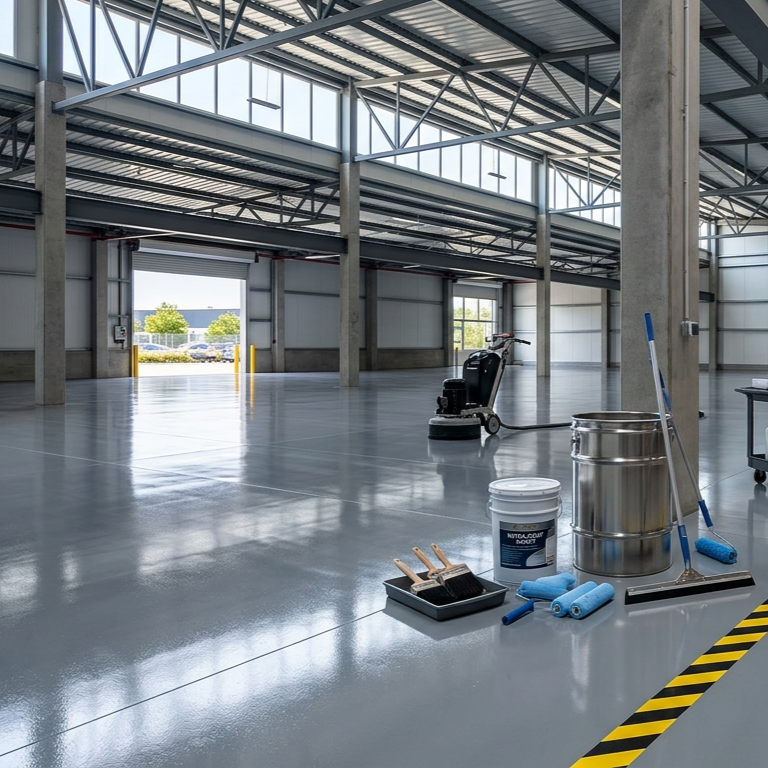
The operations manager pulls up the shift calendar on a Wednesday afternoon. The new epoxy floor goes down next month. Receiving has to keep running. The picking crew can move to the south bay for a week, maybe two. The question on the email thread is the one every warehouse owner asks before signing: how many days is the floor actually out of service?
The answer isn't one number. It's a stack of numbers that depend on slab size, system type, concrete condition, and the kind of traffic that has to roll over it on day one of reopening.
For a clean, mid-sized warehouse running a standard high-build epoxy, plan for the building to be partially or fully offline somewhere between five and ten days. The bulk of that isn't application. It's cure time — and the cure window, not the install window, decides when the forklifts come back.
The honest range, at a glance
| Warehouse size | System type | Total days offline | Foot traffic returns | Forklift traffic returns |
|---|---|---|---|---|
| Under 5,000 sq ft | Standard high-build epoxy | 4 to 6 days | Day 3 | Day 5 to 6 |
| 5,000 to 15,000 sq ft | Standard high-build epoxy | 6 to 9 days | Day 4 to 5 | Day 7 to 9 |
| 15,000 to 40,000 sq ft | Standard high-build epoxy | 8 to 12 days | Day 5 to 7 | Day 9 to 12 |
| Any size, phased install | Standard epoxy, half at a time | Building never fully closed | Same as above per zone | Same as above per zone |
| Any size | Polyaspartic fast-cure | 1 to 3 days | Same day or next | 24 to 48 hours |
The bottom row is why polyaspartic gets specified for grocery distribution centers and 24-hour fulfillment buildings. It costs more upfront and the installer has to work fast because the pot life is short, but it pays for itself when every shift of closure is worth thousands.
What's happening on each day
Skipping the day-by-day is what causes facility managers to commit to dates they can't hit. The application phase is short. The cure phase is what runs the calendar.
Day one is prep. The slab gets diamond-ground or shot-blasted to open the pores so the coating bonds into the concrete instead of sitting on top of it. Old coatings, sealers, and curing compounds come off. Cracks get routed and filled. Oil-stained patches get degreased or cut out and patched. Concrete moisture vapor emission gets tested if there's any doubt about the slab's history, because epoxy laid over a wet slab will lift off in sheets within a year. A clean, dry 10,000-square-foot slab takes a full shift to prep. A slab with old paint, oil, and surface delamination can stretch prep across two days.
Day two is primer. A moisture-tolerant epoxy primer goes down at four to six wet mils and soaks into the ground concrete. The primer needs six to twelve hours to cure before the base coat goes over it. Most crews prime in the morning and come back the next day to coat — trying to rush a base coat onto a green primer is how you get fish-eyes and adhesion problems at the worst possible spot, the corners where forklifts turn hardest.
Day three is the base coat. The pigmented epoxy goes down at ten to fifteen wet mils. If the design calls for vinyl flakes, they get broadcast into the wet base coat to refusal, the point where the floor won't accept any more. If it's a metallic system, the base sits while the topcoat is mixed with the metallic pigment. The base coat needs twelve to twenty-four hours before the next layer.
Day four is grinding and topcoat. On a flake floor, the excess flake gets scraped off and the surface is sanded smooth so the topcoat lays flat. Then a clear polyurethane or epoxy topcoat goes down at five to ten wet mils. That topcoat is the layer that takes the abuse — UV from skylights, chemical spills, forklift tire scuff, the daily routine of a working building.
Day five is the start of cure. The floor takes light foot traffic at twenty-four hours after the final coat. Office staff can walk through to set up workstations. Inspectors can walk the floor. But nothing rolls yet. No racking goes back up. No pallet jacks. No carts.
Days six through nine are the forklift wait. Vehicle traffic needs seventy-two hours minimum from the final topcoat, and most installers want a full five days before a loaded forklift turns hard on a coating. A 5,000-pound electric forklift with a 3,000-pound pallet on the forks puts enough point load through a tight turn to gouge a still-soft topcoat. The coating looks fully dry. It feels hard. It isn't fully cross-linked yet.
Day seven through ten is full chemical cure. Polymer chains in the epoxy keep cross-linking for roughly a week after the floor feels dry. Until that's done, hydraulic fluid, battery acid, or an unrinsed chemical drum can stain or soften the coating. Most warehouses run normal operations starting around day five with a soft rule of "no heavy equipment parked on the new floor for a few more days." Buildings that handle solvents or food-grade chemistry wait the full seven to ten days.
The four variables that move the timeline
The chart at the top is a clean range. Real warehouses sit on different points of that range for predictable reasons.
Square footage stretches the install phase linearly. Two crews prep and coat about 8,000 to 10,000 square feet of warehouse per working day. A 30,000-square-foot building needs three to four days of install before the cure clock even starts. The cure clock itself doesn't change with size — the last coat at the far end of the building has to cure for the same week the first coat did.
System type changes everything downstream of application. Standard high-build epoxy is the baseline. Novolac epoxy for chemical resistance cures slower and runs an extra day. Polyaspartic cures in hours and lets a building reopen for forklift traffic within forty-eight hours of the final coat. The trade-off is cost and crew skill — polyaspartic has a working time of about thirty minutes per batch and demands a crew that has installed it many times before.
Slab condition is the wild card. A slab poured in 1985 with three previous coatings and decades of forklift oil isn't going down clean on day one of prep. Removing old coatings adds a day. Patching spalled concrete adds another. If a moisture vapor test comes back high — over three pounds per thousand square feet per twenty-four hours — the installer either uses a moisture-mitigating primer or stops the project until the slab dries. A wet slab won't hold a coating.
Ambient temperature and humidity decide cure speed. Epoxy wants sixty to eighty-five degrees and humidity below sixty percent during application and cure. A warehouse with no HVAC in the middle of summer can stall a cure by a day or two. Same building in winter without heat slows the chemistry down even further. Installers won't start a job unless the climate inside the box can be held in range.
How phased installation keeps the building open
A warehouse doesn't have to be fully closed during an install. Most working buildings get coated in sections, with operations shifted to the unworked half while the new floor cures next door. Done well, the building stays open and only the affected zone is offline.
A typical phased install runs in halves or quarters. Day one, prep the south half. Days two through five, coat and cure the south half while the north half stays in production. Day six, traffic shifts to the freshly cured south side and north prep starts. Days seven through ten, the north half runs the same sequence. By day eleven, the building has a new floor across the entire slab and never lost a shift.
Phased installs cost slightly more — the crew has to mobilize twice and the seams between phases need to be cut, primed, and feathered in carefully. But for any building where shutting the whole floor costs more than the price difference, phased is the right answer. Most warehouse owners who run the numbers find the cost of two extra days of crew time is far less than the cost of two days of full closure.
The catch is racking. If pallet racks are bolted to the slab, those bolts have to come out before the floor is coated and go back in after — usually into freshly drilled new holes, since the old anchor points get coated over and lose their grip. A racking demobilization and remobilization can add days that aren't on the coating timeline. Building owners who plan a phased install need a separate racking schedule that lines up with the coating schedule.
Fast-cure systems and the cost-of-downtime math
The decision between standard epoxy and a fast-cure system like polyaspartic almost always comes down to one calculation: what does each day of warehouse closure actually cost the business?
A small distributor running one shift in a 5,000-square-foot building might lose a few thousand dollars per closed day. Standard epoxy at five days offline costs them less than polyaspartic at two days, because the system price difference outweighs the shorter closure.
A 50,000-square-foot fulfillment center running two shifts with twenty pickers and four forklifts loses far more per closed day. Even at a conservative rate, ten days of closure can mean six figures of lost throughput and overtime to catch up after reopening. The polyaspartic premium pays for itself two or three times over.
The rough breakeven sits around 12,000 to 15,000 square feet for single-shift buildings, and lower for multi-shift operations. Below that, standard epoxy usually wins on total cost. Above that, fast-cure systems pay for themselves in recovered operating days.
A bid that promises a warehouse "back in service in 24 hours" with a standard high-build epoxy is either being installed too thin or rushed past full cure. Both fail within the first year of forklift traffic. The cure clock can't be shortened by wanting it to be shorter. The chemistry takes the time it takes.
FAQs
Yes, if the install is phased. The crew coats one section while operations run from another. Full single-shot installs require the whole floor to be empty, but most working warehouses do not close completely — they shift operations zone by zone. Total project days run a bit longer, but no full shift is lost.
The standard rule is seventy-two hours minimum from the final topcoat, with most installers recommending five days before a loaded forklift turns hard on the floor. Heavy point loads on a coating that feels hard but hasn't fully cross-linked will leave permanent tire impressions. Polyaspartic systems shorten this to twenty-four to forty-eight hours.
It can. Most epoxy chemistries need sixty to eighty-five degrees Fahrenheit during application and cure. A warehouse with no heat in January can stall a cure by an extra day or two. Installers either heat the space with temporary equipment or push the project to a warmer window. Trying to coat a cold slab is the fastest way to a delamination problem.
Pallet jacks with rubber wheels and light loads can usually go on the floor at the same time foot traffic is allowed, around day three or four. Scissor lifts and powered equipment with hard polyurethane wheels should wait the full forklift window. The risk isn't the weight — it's the point load through small wheels and the torque during turns.
Anchored racking transfers concentrated load to the slab through each base plate, and a freshly coated floor under those plates can imprint or crack the coating around the anchor. Bolting new anchor holes through a green coating also pushes uncured material into the hole and weakens the bond. Wait the full vehicle-traffic window before racking goes back, and drill anchors after the floor is cured, not before.
Full chemical resistance develops over seven to ten days as the polymer cross-linking completes. Foot traffic at day three doesn't mean chemical resistance at day three. Forklift battery acid, hydraulic fluid, or solvent spills before the floor reaches full cure can soften or stain the coating in ways that don't show up until the cure finishes around it.
Plan the calendar before the bid
The day-by-day cure clock is what dictates the closure window — not the install crew's speed, not the bid price, not how much the building owner wants to be back online. Building the schedule backwards from the date the forklifts have to roll is the right way to plan a warehouse epoxy job. Pick the system based on the closure budget. Phase the work if a full shutdown isn't possible. Confirm the slab is dry and the building can hold temperature before mobilization.
A warehouse floor coated on the right schedule lasts ten to twenty years. A warehouse floor coated on a rushed schedule lasts one. The math always favors the patient plan.
