
Epoxy Garage Floors: What Actually Makes Them Hold Up
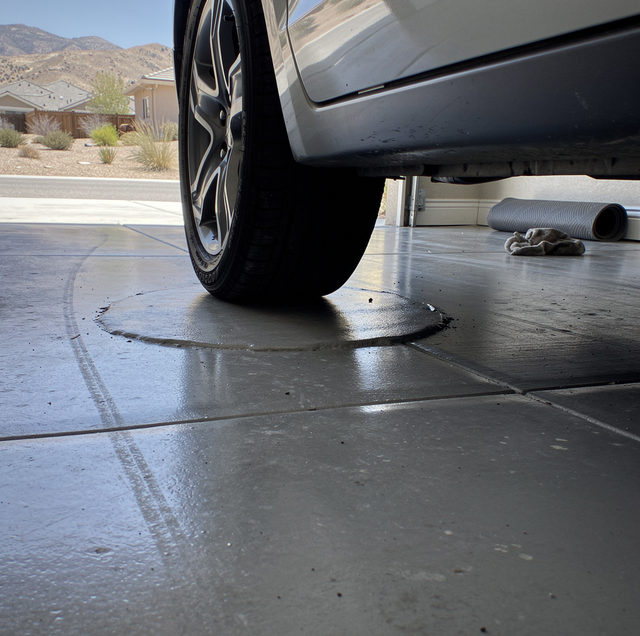
You kneel down to grab something that rolled under the car, and that's when you notice it: a dull, rough patch under the front tire, the coating lifted in a rough circle the exact shape of a wheel print. Six feet away, the floor still looks glossy and new, poured from the same batch that same afternoon. So why did one patch of a garage floor coating fail while the rest held up fine?s
A garage floor takes abuse no other coated surface in the house sees. It gets crushed under two tons of rolling weight, splashed with oil and antifreeze, hit with de-icing chemicals tracked in on tires, and it sits on a slab that's constantly pushing moisture up from underneath. Interior wall paint never has to survive any of that. Understanding what's actually attacking the coating explains why some epoxy jobs look brand new after a decade, and others start failing within the first year.
The Four Things Working Against the Coating at Once
Heat cycling from tires: A car that's been on the highway can have tire surface temperatures well above what the garage floor around it ever reaches. Park it, and that heat transfers into the coating directly under the tread for hours while the vehicle cools.
Chemical exposure: Motor oil, transmission fluid, brake fluid, gasoline, and de-icing chloride all sit on the surface at different times, and each one attacks a coating's resin differently. A cheap coating that shrugs off water can still soften under a gas spill.
Moisture vapor from below: Concrete slabs are porous, and ground moisture moves upward through them constantly, especially before a slab has fully cured or if there's no vapor barrier underneath. That moisture has to go somewhere, and if a coating blocks it entirely without the slab being ready, it builds pressure under the film.
Mechanical abrasion: Dragging a rolling tool chest, dropping a wrench, or scraping a jack stand across the surface wears through a thin film fast in the same few traffic lanes every time.
Why So Many Epoxy Jobs Fail Within the First Year
Most early failures trace back to prep, not the coating itself. A few patterns show up again and again:
No moisture testing beforehand: Concrete that's still releasing vapor from below will push a coating loose from underneath even if the top looks fine for months. Contractors test for this with a calcium chloride kit or a relative humidity probe before committing to a fully sealed system.
Coating over old paint or a sealer: New epoxy needs to bond to raw, textured concrete. Rolling it over an old sealer or a previous coat of paint means it's only bonding to that old layer, and old layers let go.
Skipping the mechanical profile: Smooth, troweled concrete is basically slick to a coating. Without some form of grinding or etching to open the surface, adhesion depends more on hope than on chemistry.
Rolling it on too thin: A coating applied at the manufacturer's recommended thickness wears through in high-traffic lanes within a couple of years, rather than a decade-plus.
Three Coating Systems, Side by Side
Not every epoxy product is built the same way, and the differences show up fastest in a garage.
| System | How it's applied | Time to vehicle traffic | UV stability | Typical weak point |
|---|---|---|---|---|
| Single-component epoxy paint | Rolled straight from the can, thin film | Roughly 3 days | Poor: ambers and chalks where sun hits the floor near the door | Often wears through in tire lanes within roughly 2-3 years, as a general estimate |
| Two-component 100% solids epoxy | Mixed on site, self-leveling, often with a broadcast flake layer | About 24-72 hours for light traffic | Fair, but will amber near the door without a topcoat | Yellows at the sunlit threshold if left uncapped |
| Polyaspartic or polyurea topcoat system | Applied as a fast-curing final layer over a base coat | Often same-day for light foot traffic | Strong resistance to UV yellowing | Requires the base coat underneath to be done right, or it just seals in the same problem |
The single-component paint is the thinnest and least durable of the three; it's a step above bare concrete, not a long-term floor system. The two-component epoxy is where most durable garage floors start, and a polyaspartic or polyurea layer on top is what keeps that base coat from breaking down at the garage door where sunlight hits hardest.
How Hot Tire Pickup Actually Happens
"Hot tire pickup" is the technical name for that lifted, tacky patch under a wheel print, and it's a chemistry problem, not a workmanship one. A tire that's been driven on the highway carries real heat into the rubber. Park it on a coating, and that heat, combined with the weight of the vehicle, can soften the resin enough for the tire's tread pattern to press into it. As the tire cools over the next several hours, it can pull a thin layer of the coating up with it when the car finally moves.
Coatings with a higher cross-link density, meaning the resin molecules are bonded more tightly to each other, resist this softening better. That's why polyaspartic and quality two-component epoxy systems handle hot tire pickup far better than a single-component paint, which has a looser molecular structure to begin with.
Getting the Prep Right the First Time
The prep work is where a floor's lifespan actually gets decided, long before the first coat goes down.
Mechanical profiling: Diamond grinding opens the concrete surface to a specific texture, often described by contractors on a numbered profile scale, giving the coating something to physically grip rather than just sit on a slick surface. Acid etching can work on some slabs but doesn't open a heavily sealed or troweled floor as reliably.
Moisture testing: A calcium chloride test or an in-slab relative humidity probe measures how much vapor is moving through the concrete. Slabs that are still releasing significant moisture may need a vapor-mitigating primer built into the system rather than a standard coating.
Patching before coating: Spalled corners, control joints, and hairline cracks get filled with a semi-rigid epoxy filler first. Coating over a crack without addressing it just telegraphs that crack straight through the new finish.
Full degreasing: Any oil residue left in the concrete's pores, even from years-old stains, must be removed with a degreaser and rinsed before the coating goes on, or it will bleed back through the film later.
Why Application Technique Changes the Outcome
Even the right coating system can underperform if it's applied incorrectly. Two-component epoxy has a limited working time, often 20 to 30 minutes once the resin and hardener are mixed, called the pot life, so a contractor works in sections rather than mixing one big batch for the whole floor. Applying it too slowly means fighting a product that's already thickening.
Coverage gets checked with a wet-film thickness gauge, a small notched tool pressed into the wet coating that shows exactly how many mils thick the film is at that spot. Back-rolling, going over a squeegeed section a second time with a roller, pushes the material into the concrete's open pores and knocks down bubbles before they can cure in place. Anyone walking across the wet coating to keep working typically wears spiked shoes so foot traffic doesn't leave permanent dimples in a film that's still soft.
Living With the Floor Day to Day
Even a well-installed floor has a curing window that matters. Light foot traffic is usually fine within about 24 hours; vehicles can typically go back on around 72 hours, and full chemical cure, meaning the coating has reached its final hardness and chemical resistance, often takes 5 to 7 days. Parking on it too soon with a hot tire, before it's fully cured, is one of the more common ways a brand-new floor gets its first hot tire pickup mark.
Day-to-day, a soft-bristled broom and an occasional damp mop keep the surface clear of the grit that causes scratching. Rubber pads under jack stands and rolling tool chests protect the film from point-load scuffing, and promptly wiping up chemical spills, rather than letting them sit, keeps the resin from ever having to prove its chemical resistance the hard way.
Frequently Asked Questions
Yes, significantly. The 24-hour, 72-hour, and 5-to-7-day windows described above generally assume a shop somewhere around 70 degrees. Below about 55 degrees, the resin chemistry slows down enough that cure time can stretch to nearly double, which is why contractors doing a winter install often bring in a space heater or hold the garage a few degrees warmer than it would otherwise sit, just to keep the reaction on schedule.
Not reliably. The new coating would only bond to the old paint or sealer layer, and that old layer is the weak point that lets go first. A contractor will usually strip or mechanically grind off the existing coating down to bare, profiled concrete before recoating.
Beyond looks, a broadcast flake layer adds texture that hides everyday dirt, tire marks, and minor scuffs far better than a smooth solid color, and the texture itself adds some slip resistance. A solid color floor shows every mark clearly, which some owners actually prefer for spotting spills quickly.
It's required on a flake system, not optional. The decorative flakes are broadcast onto the wet base coat and remain loosely embedded until a clear topcoat is rolled over them; skip that step, and the flakes stay loose enough to be swept or scraped off the surface within the first few weeks of foot and tire traffic. On a solid-color floor with no flake, a topcoat is still worth adding for UV protection, but it doesn't hold physical material in place the way it does on a flake floor.
That usually means the slab is still moving seasonally at that spot, often where a garage door track crosses the floor or where two separate pours meet. Rather than patching it flat again and hoping the new coating holds, some contractors will saw-cut a fresh, straight relief joint at that location and fill it with a flexible sealant instead of a rigid epoxy filler, giving the slab a defined place to keep moving instead of letting it crack the new coating somewhere unpredictable.
Contractors broadcast a fine non-slip additive, often an aluminum oxide grit in a specific mesh size, into the final coat before it cures. It adds a texture you can feel underfoot without looking gritty, and it's a standard add-on for any floor that might see water tracked in from outside.
That lifted patch under the tire print from the start of all this usually traces back to one of a handful of decisions made weeks before a car ever pulled back into the garage: a moisture test that got skipped, a coat stretched too thin, a slab parked on before it had time to finish curing. A floor that's ground, tested, primed, and coated to spec doesn't care how hot the tires run or how many winters of de-icing salt it sees. That's the real gap between a floor still glossy at year ten and one already showing wear at year two.
Schedule a free epoxy floor estimate — we'll match the coating system to how hard your garage actually works. True Coat Painting serves Reno, Sparks, and Spanish Springs. Call (775) 227-0618.
