
How Long Does a Commercial Epoxy Floor Actually Last
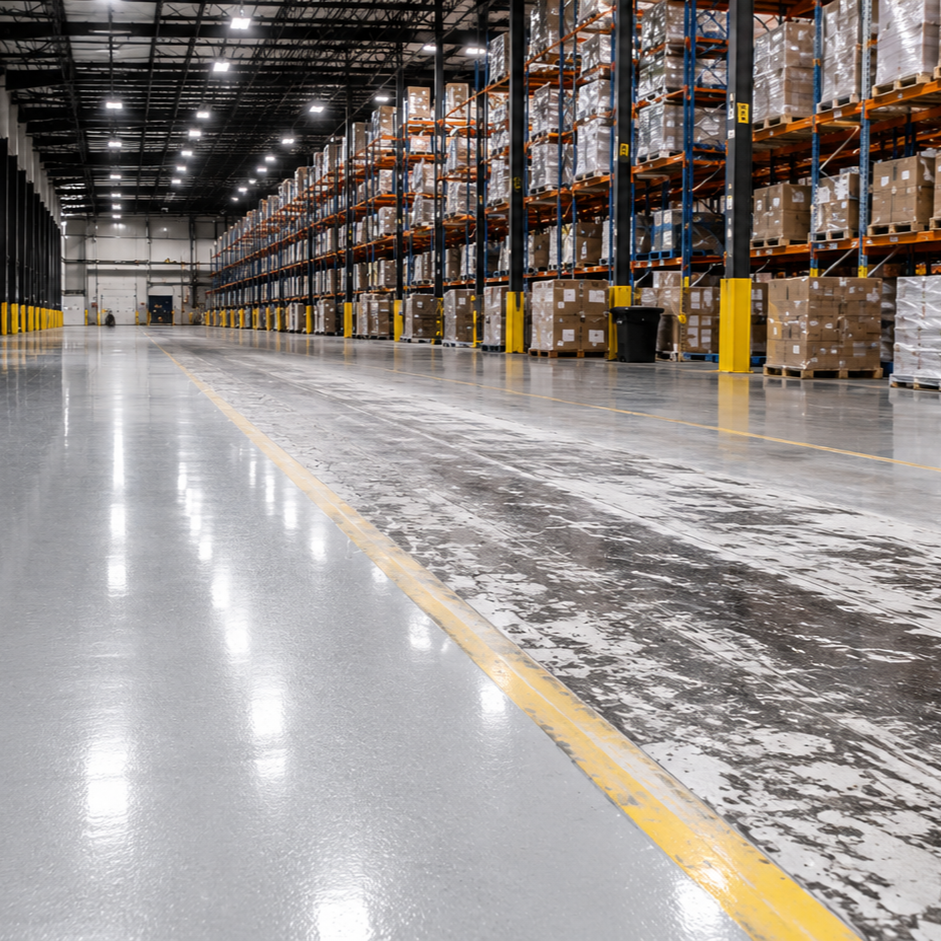
The forklift driver swings into the receiving bay, wheels squealing across a glossy band of floor still holding up after seven years. Twenty feet in, the same floor is gouged down to gray concrete in a stripe that tracks every load from dock door to rack lane. Same install. Same crew. The two zones look like different floors.
That's the honest answer to how long a commercial epoxy floor lasts. It depends on what's rolling across it, what's spilling on it, what was under it before the coating went down, and which system the installer chose.
The range runs from five years to twenty-plus. Where any one floor lands on that scale comes down to four variables a facility manager can evaluate before signing.
The honest range, by environment
A "commercial epoxy floor" isn't one thing. A 12-mil pigmented epoxy on an office lobby and a 60-mil novolac on a chemical-storage slab are both called epoxy, and they have nothing in common in how long they'll last. Below is what each environment realistically gets from a well-installed system.
| Environment | Typical traffic | Realistic lifespan | First failure point |
|---|---|---|---|
| Heavy industrial (foundry, steel fab) | Hot metal, impact, chemicals | 3 – 7 years | Pitting, thermal cracking near hot work |
| Warehouse with forklift traffic | Hard wheels, racking, dock plates | 5 – 10 years | Wheel-path gouging, dock-door wear |
| Commercial kitchen / food prep | Grease, water, sanitizer, hot spills | 5 – 10 years | Delamination at floor drains, chemical etching |
| Auto shop / fleet maintenance | Hot tires, oil, brake cleaner | 7 – 12 years | Hot-tire pickup, solvent softening |
| Manufacturing / assembly floor | Pallet jacks, light forklift, dropped tools | 8 – 12 years | Wear in primary aisles, impact chips |
| Retail back-of-house loading area | Pallet jacks, carts, cleaning crew | 10 – 15 years | Sheen wear in walking lanes |
| Showroom / car dealership | Tire prints, public foot traffic | 12 – 18 years | UV ambering near glass, tire-rubber stains |
| Office lobby / common area | Foot traffic, occasional cart | 15 – 20+ years | Sheen loss in entry zone |
| Medical / lab / clean room | Carts, cleaning chemistry, foot traffic | 15 – 20+ years | Chemical attack at spill points |
| Self-storage hallway | Carts, dollies, foot traffic | 15 – 20+ years | Scuff buildup, joint movement cracks |
Two facilities running the same product at the same thickness can land at opposite ends of these ranges. A warehouse running 12 hours a day with steel-wheeled pallet jacks burns through a coating system about three times faster than the same warehouse running rubber-wheeled electric jacks two shifts a week. The warranty number is the system's potential, not its guarantee.
The four things that actually determine how long it lasts
Why does the same product perform completely differently in two facilities? Four variables explain almost all of it. None of them are the color, the flake pattern, or the brand on the bucket.
The first is substrate preparation. A concrete slab has to be mechanically profiled before any epoxy goes down — either diamond grinding or shot-blasting until the surface looks like medium-grit sandpaper. That profile gives the epoxy something to lock into. Skipping the grind and acid-etching instead leaves a smooth slab that the epoxy bonds to with about half the strength. The floor looks identical for the first year. By year three, sections start lifting in tire-traffic zones, and the failure pattern is unmistakable: the coating peels off in sheets with the back side perfectly smooth, no concrete attached.
The second is moisture vapor management. Concrete is permeable. Water vapor from the ground, from a green slab, or from a slab without a vapor barrier travels up through the concrete and pushes against the underside of the coating. If the vapor emission rate is above what the epoxy can handle, the coating blisters within months. A real installer runs a calcium chloride or relative-humidity test before quoting and picks a vapor-tolerant primer if the numbers come in hot. An installer who skips moisture testing is gambling with the customer's money.
The third is the coating system itself. A single-coat 100% solids epoxy is a different animal than a multi-coat system with a urethane or polyaspartic topcoat. The base epoxy is hard and chemically resistant but brittle and prone to UV ambering. The topcoat takes the abrasion, the tire heat, the cleaning chemistry, and the daylight. Without one, every scuff and tire mark goes straight into the structural layer. Two systems with the same total film thickness but different topcoat strategies can have a 2x difference in service life.
The fourth is film thickness. A 6-mil pigmented epoxy on a slab that sees forklift traffic is on borrowed time the day it cures. A 20-mil system with a primer, base coat, broadcast flake, and urethane topcoat is in a different league. Most under-spec'd commercial floors fail because the quoted thickness was based on light-duty assumptions and the actual traffic was something else.
| Factor | Impact on lifespan | What to look for in the bid |
|---|---|---|
| Substrate prep method | 2–3x difference (grind vs etch) | "Diamond grinding" or "shot-blasting" by name, not "acid etch" |
| Moisture vapor test | Prevents 6-month failures | Calcium chloride or RH probe results before quote |
| Topcoat system | 30–50% lifespan extension | Named urethane or polyaspartic topcoat in the scope |
| Total film thickness | 2x difference between 6-mil and 20+ mil | Mil thickness or product system named, not "epoxy" alone |
| Joint and crack treatment | Prevents joint failure within 2 years | Static cracks routed and filled, control joints honored |
| Substrate age at install | Less than 28 days = bad bet | Slab age confirmed; new slabs need vapor testing |
What actually kills a commercial epoxy floor
Coatings fail in specific ways for specific reasons. Knowing the failure mode tells you what part of the system gave up first.
Hot-tire pickup hits auto shops and dealership service bays. Tires heat to 150°F or higher under braking, and that heat softens cheaper epoxy resins. When the tire stops, the soft coating bonds to the rubber and lifts off when the car moves. The fix is a topcoat with higher heat tolerance — polyaspartic or aliphatic urethane that doesn't soften at tire temperatures.
Delamination from moisture vapor hits warehouses on slab-on-grade construction without a vapor barrier. Water vapor pushes up through the concrete, finds the weakest bond line, and blisters the coating into circles that grow over months. The blisters pop, the edges peel, and the floor needs a vapor-tolerant primer underneath. There's no surface fix.
Chemical etching shows up in food-prep facilities and plating shops. Standard epoxy resists most household chemistry but loses to industrial-strength sanitizers with weekly exposure. The floor goes dull in spill zones first, then soft, then pitted. The fix is a novolac epoxy or a urethane-mortar system rated for the actual chemistry in the building.
Wheel-path gouging is the warehouse story — narrow stripes of bare concrete in the lanes where the forklift runs the same path every day. Hard polyurethane wheels concentrate massive load over a small contact patch, and even a 20-mil coating wears through eventually. Recoating the stripes every few years extends the rest of the floor by a decade.
UV ambering happens near overhead doors, skylights, and storefront glass. Standard bisphenol-A epoxy yellows under UV — the polymer slowly oxidizing. The color shift is cosmetic, but it makes a five-year-old floor look ten. Aliphatic urethane and polyaspartic topcoats don't amber and are the standard fix for any zone with daylight.
What pushes a commercial floor toward the long end of the range
The same system can land at year seven or year fifteen, depending on five habits the installer can't do for the facility after the truck leaves.
Sweep daily. Grit on a coated floor acts like sandpaper under every wheel and shoe. A daily push-broom in the high-traffic lanes adds years to the system.
Use neutral-pH cleaners. Acids and alkalines etch the topcoat each pass, and the etch is cumulative. A pH 7 to 8 cleaner is what every epoxy manufacturer recommends in the spec sheet, and almost no facility reads the spec sheet.
Address spills within the hour. Battery acid, hydraulic fluid, brake cleaner, and bleach all attack coatings on contact. A spill kit at every workstation prevents the slow chemical wear that takes years off the floor.
Pad static equipment. Pallet rack feet, machine bases, and rolling carts compress the coating over months and leave permanent indents. Steel plates or rubber pads keep the film at full thickness.
Recoat the wear stripes before they fail. A urethane or polyaspartic recoat over the forklift lanes at year five or six — before the topcoat is fully worn through — is a fraction of the cost of a full re-application and resets the wear clock on the high-traffic zones. Facilities on a recoat schedule get fifteen to twenty years out of a system rated for ten.
When the floor is actually done
Coatings show wear long before they fail. A worn floor still works; a failed floor is a slip-and-fall waiting for a shift change.
A floor that's worn but sound has dull patches in the walking lanes, faded color in the daylight zones, and a sheen that no longer matches the back-of-house. The coating is still bonded and still wipeable. A urethane recoat restores it.
A failed floor has any of five things going on. Sheet delamination where the coating lifts with no concrete on the back. Bare concrete in traffic stripes wider than the wheel path. Soft spots underfoot. Cracks across coated areas that weren't there at install. Blisters that grow and pop. Any of those means the floor is past recoat — it has to come off and go back down. Coating over a failed floor traps the failure, and the new system inherits the old failure mode within a year.
FAQs
Yes, if the underlying coating is still bonded. A worn topcoat over a sound base layer can be lightly sanded and recoated with fresh urethane or polyaspartic for a fraction of the replacement cost. The recoat usually adds five to eight years. If the base coating is delaminating, blistering, or pulling off in sheets, recoating won't work — the floor has to be ground back to concrete and rebuilt.
The clearest signs of a good install show up in the first year. The floor cures hard within seven days, has no blisters or bubbles, no fish-eye craters from contamination, no thin patches where concrete texture telegraphs through, and stays bonded around floor drains and dock plates. A floor that looks great at year one usually performs to the long end of its range. A floor that shows hairline issues in the first six months almost always fails inside three years.
Less than the install does. Most reputable industrial coating manufacturers — Sherwin-Williams, PPG, Tnemec, Sika, Dur-A-Flex — make systems that perform similarly when installed correctly. The brand on the bucket matters less than the prep, the moisture testing, the system spec, and the application. A premium product over an unprepared slab fails faster than a mid-tier product over a ground and primed one.
A thin-film coating (under 10 mils total) in a commercial environment usually lasts three to seven years. A high-build system (20 to 60 mils with a topcoat) in the same environment lasts ten to twenty. Thin-film costs less up front and is right for light office back-of-house or occasional-use storage rooms, but it's the wrong choice for any space with daily wheel or cart traffic. Most "epoxy failed" complaints come from thin-film put into high-build environments.
A floor that goes a year without sweeping in a dusty warehouse wears like a floor that's seen three years of normal use. A floor that gets bleach spilled on it weekly won't see its rated chemical resistance. Daily sweeping, neutral cleaners, and prompt spill cleanup move the floor from the low end of its range to the high end.
Almost never, but it happens with slabs that have failed structurally — major cracks across the floor, settling, sections that have dropped. If the slab is moving, no coating will hold. Slab replacement runs ten to twenty times the cost of a recoat. For most commercial floors, the slab is fine and the coating is the part to address.
What a long-lasting commercial floor actually requires
The floor that lasts isn't always the most expensive system. It's the one specified for the actual traffic and chemistry in the building, installed over a ground and moisture-tested slab, finished with a topcoat that matches the use case, and maintained on a routine that respects the coating chemistry. Right spec, right prep, right finish, right maintenance — those four separate the seven-year floor from the twenty-year floor.
The number a facility manager hears from the installer matters less than the questions the installer asks before quoting. A bidder who walks the slab, asks about forklift traffic and chemical exposure, runs a moisture test, and proposes a thicker system than the cheapest competitor is doing the math the right way. A bidder who emails a square-foot price after looking at a photo is selling a coating, not a system.
