
How Much Does an Epoxy Garage Floor Cost Installed
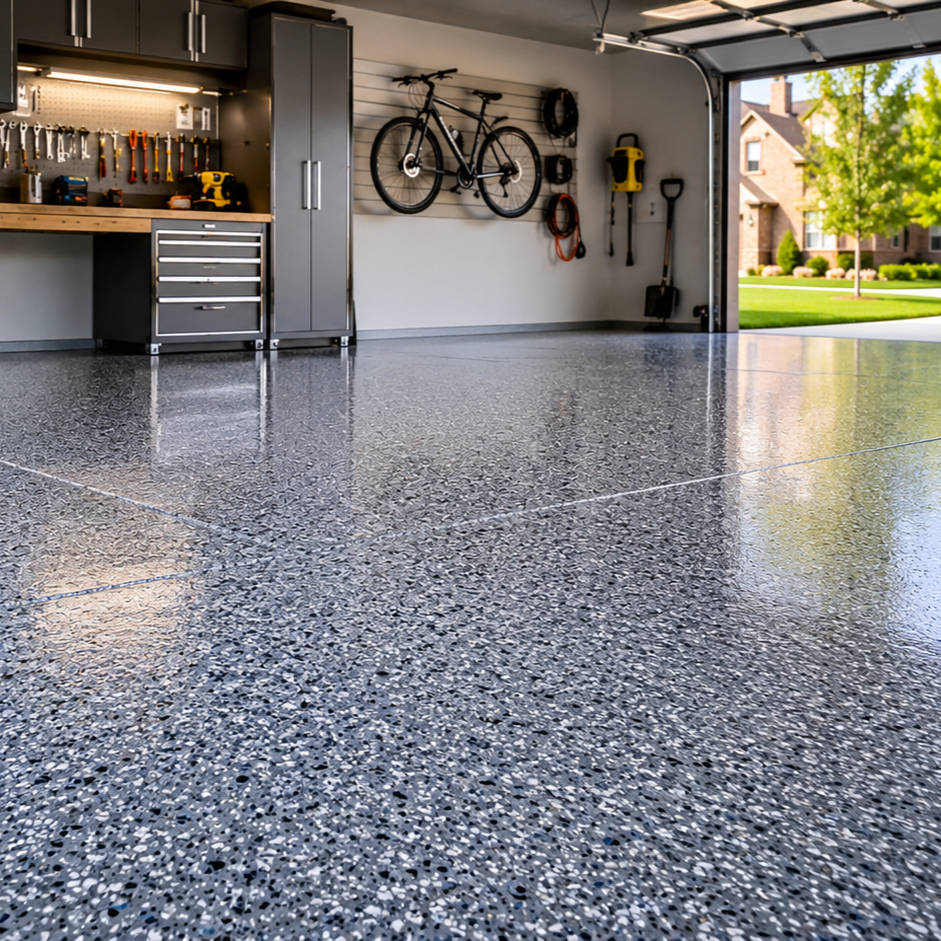
You squat down on the cold concrete with your phone flashlight angled across the surface. Old oil stain near the workbench. Hairline cracks fanning out from the door track. A patch by the side wall where someone spilled solvent twenty years ago and the slab has been thirsty about it ever since. Two installers have quoted the floor this week — one at $2,800, the other at $5,200. Both said they could be there next Saturday.
The number on the cheap bid might still be the right number. It might also mean the work that has to happen between bare slab and finished floor never made it onto the page.
There's a reason quotes on the same garage can differ by 2x, and once you see what the higher bid is paying for, the spread stops looking like markup.
What an installed epoxy garage floor actually costs in 2026
For a professional installation, expect to land between $3 and $12 per square foot. The range comes from real differences in what's going down, not from contractors picking numbers off a dartboard.
A standard two-car garage runs 400 to 500 square feet. That puts most pro installations in the $2,000 to $6,000 band, with premium systems and rough concrete pushing toward $7,500 once repairs and high-end topcoats get added.
| Garage size | Typical floor area | Standard pro install (2026) | Premium system or rough slab |
|---|---|---|---|
| One-car | 200 – 280 sq ft | $1,200 – $2,500 | $2,500 – $3,800 |
| Two-car | 400 – 500 sq ft | $2,000 – $4,500 | $4,500 – $7,000 |
| Three-car | 600 – 750 sq ft | $3,000 – $6,500 | $6,500 – $10,500 |
| Detached shop (about 1,000 sq ft) | 900 – 1,100 sq ft | $4,500 – $9,500 | $9,500 – $14,000 |
The per-square-foot rate drops a little as the floor gets bigger because mobilization, grinder rental, and crew setup are fixed costs that spread over more area. And every range above assumes the concrete is solid — a slab with serious cracking, deep spalling, or active moisture issues moves into custom-quote territory fast.
What you're actually paying for in a real install
A finished epoxy garage floor isn't one product. It's a system of layers built over one to three days. The price feels high because you're picturing a guy with a paint roller. The actual work is closer to laying a new floor.
A pro install runs four phases.
The first is mechanical surface prep. The slab gets shot-blasted or diamond-ground to a CSP 2 or CSP 3 finish — the single biggest variable in whether the floor stays stuck. A quick acid etch from a homeowner kit doesn't open the concrete the way a 250-pound grinder does. This phase alone runs $1 to $2.50 per square foot of the bid.
The second is repair. Cracks get chased out with a diamond blade and filled with a fast-cure polyurea or epoxy crack filler. Spalled areas get patched with a polymer-modified mortar. Old oil and grease stains get scrubbed and degreased, sometimes twice. A few hairline cracks add maybe $150 to the bid. A network of working cracks and a missing chunk near the door can add $500 to $1,000.
The third is the coating system. A real garage-grade install is usually three layers: a primer (often a moisture-tolerant epoxy), a broadcast of colored vinyl flakes for slip resistance and depth, and a clear polyaspartic or polyurethane topcoat. That stack is the difference between a one-day kit and a fifteen-year floor. Materials alone for the three-layer system run $2 to $6 per square foot.
The fourth is cure and cleanup. Each layer needs hours to cure between coats. Edges get cut by hand. Excess flake gets blown off and the surface buffed before the topcoat goes on. Two-car garages are usually a one- to three-day job from grind to walk-on, with vehicles back around day five to seven.
| Phase | What it covers | Share of the bid |
|---|---|---|
| Mechanical prep | Diamond grinding or shot-blasting, dust collection, edge prep | 20 – 30% |
| Concrete repair | Crack chasing, spall patches, grease cleanup, stain treatment | 5 – 15% |
| Coating system | Primer, color base, flake broadcast, polyaspartic topcoat | 35 – 50% |
| Labor and cure | Crew time, cut-in, knockdown, cleanup, final inspection | 20 – 30% |
When two bids on the same garage come in at $2,800 and $5,200, the gap usually traces to two of those four phases — an acid etch instead of a grinder, or a skipped polyaspartic topcoat replaced with a thin, clear epoxy that yellows under sunlight and chips in the wheel tracks inside a year.
DIY kits versus pro installs — the lifespan gap
Box-store kits exist for a reason. They're inexpensive, look fine the day they cure, and for a low-traffic garage that mostly stores boxes and a bike, they can earn their keep.
The trade is durability. A typical DIY kit covers 250 to 500 square feet for $80 to $200 — roughly $0.50 to $1.50 per square foot in materials. Add a weekend of cleaning, etching, rolling, and curing, and the slab goes from bare to glossy in two days.
What the kit can't replicate is the prep, the solids content, and the topcoat. Most kits run 30 to 50% solids in the can — half of what gets rolled on evaporates. A pro-grade 100%-solids epoxy stays put and builds film thickness fast. DIY kits also live or die on whether the slab was perfectly clean and dry, which is hard to confirm without a moisture meter. Most DIY failures hit around 12 to 24 months as peeling at the door track or hot-tire pickup, where a tire pulls the coating right off the slab.
| Install type | Upfront cost (two-car) | Typical lifespan | Most common failure |
|---|---|---|---|
| DIY water-based kit | $200 – $500 | 1 – 3 years | Hot-tire pickup, peeling at wet zones |
| Pro one-coat solid epoxy | $1,500 – $2,800 | 4 – 7 years | Yellowing, chipping in wheel tracks |
| Pro flake + polyaspartic | $3,500 – $6,500 | 10 – 20 years | Surface wear in heavy commercial use |
| Polyaspartic-only system | $4,500 – $8,000 | 15 – 25 years | Limited color and pattern options |
Spread upfront cost over the floor's working life and the math gets interesting. A $400 DIY kit redone every two years runs about $200 a year. A $4,500 flake-and-polyaspartic system holding 15 years runs about $300 a year — and never gets stripped or re-coated in between.
What changes the per-square-foot number
Two garages with the same square footage can land at opposite ends of the $3-to-$12 range. The differences are almost always in the concrete, the system, and the access.
The biggest single variable is concrete condition. A newer slab with no spalling, no working cracks, and no heavy staining grinds and coats fast. An older slab with hairline crack mapping, an old coating that has to come off, oil soaked deep into the surface, or rebar showing near the door takes hours of extra prep — and prep is the most expensive labor on a coating job. A two-car garage with a clean slab might run $3,800. The same garage with an old coating that has to be stripped first can run $5,800 before color goes down.
The system is the second variable. Solid-color epoxy with no flake and no topcoat sits at the low end, looks decent the first year, and dulls fast. A flake-broadcast system with polyaspartic sits in the middle. Metallic epoxy with a clear topcoat — the kind that looks like a marbled swirl — sits at the top, partly because metallic pigments cost more and partly because the application takes a skilled installer working slowly. Quartz-broadcast systems push higher still.
Access and complexity is the third. A standard attached garage with one wide door and a flat slab is the easiest install going. Detached shops where stored equipment has to come out, sloped slabs that need leveling at the apron, tight basement stairwells, and in-floor drains that have to be masked all add time. Heating the space in cold weather or dehumidifying in damp conditions is sometimes a separate line item.
Crew level matters too. A regional contractor with a two-truck crew, a moisture meter, a 250-pound grinder, and a dust collection rig charges more than a one-person operation working from a pickup with a rented buffer. Both can pour a floor. Only one is set up to pour the floor that holds.
| Cost driver | What it adds | Why |
|---|---|---|
| Concrete prep (etch → full diamond grind) | +$1 to +$2.50 per sq ft | Grinding takes hours; etching takes minutes |
| Crack and spall repair | +$150 to +$1,200 total | Materials and labor scale with damage |
| Coating system upgrade (solid → flake) | +$2 to +$4 per sq ft | Flake material, broadcast labor, second-day return |
| Polyaspartic topcoat | +$1.50 to +$3 per sq ft | UV stability, abrasion resistance, faster cure |
| Metallic or designer finish | +$3 to +$6 per sq ft | Artistic application and premium pigments |
| Moisture testing and mitigation | +$200 to +$1,500 total | Required on basements and high-moisture slabs |
| Stripping a failed prior coating | +$1 to +$3 per sq ft | Adds a full day before color goes down |
What gets left out of the lowest bid
A cheap bid isn't always a bad bid. It usually just means something didn't make it into the price.
Things regularly left out of low bids: diamond grinding (replaced with acid etch), crack and spall repair, moisture testing where needed, the polyaspartic topcoat (swapped for thin clear epoxy), a second flake broadcast, full perimeter cut-in, dust collection, and any move-out / move-back-in for whatever is parked on the floor. Each shaves real dollars off the bid. Each also shows up later as a problem.
The question that separates good bidders from bad ones isn't "how much" — it's "what's not included." A bidder who can answer clearly has walked the slab. A bidder who waves it off with a vague "whatever we find, we'll handle" is the bidder whose change orders land on day two.
FAQs
A one-day polyaspartic floor — single coat, no underlying epoxy primer — looks great the day it goes down and lets you park on it the next morning. The trade is the bond. Polyaspartic cures so fast it doesn't always grip concrete the way a slower-curing epoxy primer does. On a clean, freshly ground slab it usually holds. On a slab with any moisture or contamination, the failure rate runs noticeably higher. For a residential garage with daily traffic, a primer-and-topcoat system tends to last longer.
For anything past a budget DIY kit, you want mechanical grinding. Acid etching opens only the top few thousandths of an inch and leaves laitance, sealer residue, or old coating in place. A diamond grinder removes that top layer entirely and gives the new coating a real mechanical key to bond to. The difference shows up in years, not days. Floors that peel in the first two years are almost always floors that were etched, not ground.
Most full-system installs are walk-on at 12 to 24 hours, light traffic at 48 hours, and full vehicle return at 5 to 7 days. Polyaspartic-only systems are faster. The wait isn't just about hardness — it's about the coating reaching full chemical cure. A car parked on a not-quite-cured floor can lift the coating in the tire footprint within minutes. Stick to the cure schedule even if the surface feels solid underfoot.
Yes, with the right system. A 100%-solids epoxy with a polyaspartic topcoat handles dropped wrenches, jack stands, floor jacks, hot tires, road salt, and most automotive fluids without staining or chipping. Sharp corners on dropped steel can occasionally divot the surface in heavy-use shops, but those divots are repairable. The floor that fails fast is the thin-build kit, not a real system.
Yes. Epoxy and polyaspartic both stay stable through freeze-thaw cycles once fully cured. The catch is install temperature itself: most coating systems need the slab and the ambient air above 50°F during cure, and some need above 60°F. Installing in a cold garage means heating the space — which adds cost — or pushing the project into spring or fall.
Plan on two to three weeks from first walk-through to finished floor. The site visit and quote usually happen within a week of a call. Scheduling runs one to two weeks out. The install itself is one to three days on-site. After install, the floor needs about a week of cure before vehicles return. Total from quote to first car back in: roughly 14 to 21 days for a standard residential job.
What a good epoxy quote looks like
The bid worth choosing isn't always the lowest. It's the bid where every layer is named, every prep step is itemized, every excluded thing called out in writing, and the contractor has actually put a grinder on the slab — or at least a moisture meter — before naming a number.
A solid quote breaks the work into prep, repair, system, and topcoat as separate line items; names the products going down (manufacturer, solids percentage, topcoat type); calls out the cure schedule and when the vehicle can return; lists what's included for crack repair and how anything beyond scope gets billed; and includes a written warranty against peeling and hot-tire pickup for at least a year. A quote like that is one you can compare to another without doing mental math.
The installer worth hiring walked the garage, checked the slab corners for moisture, and quoted what they actually saw — not a per-foot number from the truck.
