
How Long Does Exterior Paint Last in High Sun Climates
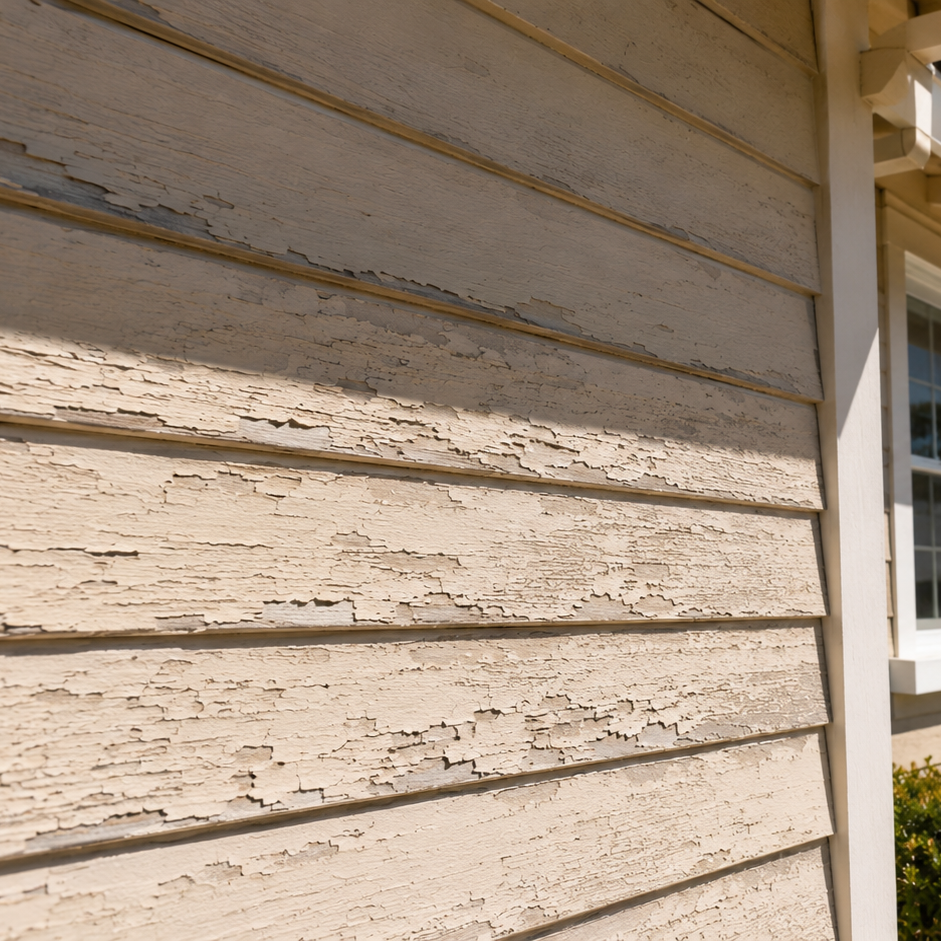
The south wall is dull, where the rest of the house still looks sharp. You ran your hand across it last weekend and your palm came away with a thin film of white powder. The trim above the front window is checked into little squares you can feel through the paint. The north wall looks five years younger than the south wall — same house, same paint, same painter.
That's the high-sun signature.
Exterior paint doesn't fail evenly. It fails on the side the sun hits all afternoon, and once you know what the sun is doing to the coating, the numbers stop feeling random.
How long exterior paint actually lasts under high sun
Most jobs in a high sun climate land in a tighter band than the broad "5 to 10 years" you'll see online. The 10-year end assumes a mild coastal or northern climate. Under desert sun, high-elevation UV, or long west-facing exposure, the same paint runs shorter.
| Surface | Typical lifespan, mild climate | Lifespan under high sun |
|---|---|---|
| Wood siding (cedar, lap, T1-11) | 7 – 10 years | 5 – 7 years |
| Stucco | 10 – 15 years | 7 – 10 years |
| Fiber cement (Hardie) | 10 – 15 years | 8 – 12 years |
| Vinyl siding (painted) | 8 – 12 years | 6 – 9 years |
| Painted brick | 10 – 15 years | 8 – 12 years |
| Trim, doors, shutters | 5 – 7 years | 3 – 5 years |
| South and west walls specifically | — | 60 – 70% of north/east lifespan |
The siding number is the front-of-mind one. The trim number is the one most homeowners forget. Trim sits in a thin band that absorbs sun, holds heat, and rides wood that moves more with temperature swings than the wall behind it. Trim almost always needs touching up before the body does.
Plan for the south and west elevations to need attention three to five years before the north and east walls. That's not a defect in the paint or the painter. It's a fixed property of UV exposure.
What ultraviolet light actually does to paint
Paint is two things in one film: pigment (the color particles) and binder (the resin holding pigment together and gluing the sheet to the wall). The binder is the structural part. When the binder gives up, the paint fails.
UV wrecks the binder in two ways. The first is photochemical: ultraviolet photons carry enough energy to break the chemical bonds in the binder's polymer chains. The chains fragment over millions of micro-events. The film loses flexibility and grip.
The second is thermal cycling. A south-facing wall in summer can swing from 60°F at sunrise to 140°F by 3 p.m. Paint expands when the wall heats and contracts when it cools, every day, all summer. A binder already chewed up by UV doesn't have the elasticity to ride those swings. It cracks around nail heads, at trim joints, at corners where two pieces of siding meet.
Once the binder fails, the pigment particles have nothing holding them to each other or to the wall. They sit on the surface as loose dust. That's the white powder on your palm. Not dirt. Your paint, dismantled.
High-elevation sun speeds both processes up. UV intensity climbs 10 to 12 percent per 3,000 feet of elevation gain. A coating rated ten years at sea level might see seven at 4,500 feet — and five on a south wall under unobstructed afternoon sun half the year.
Why dark colors and cheap paint don't survive
The lifespan numbers above assume mid-grade exterior paint in a mid-tone color. Two variables move that number more than anything else: color and binder quality.
Dark colors absorb more heat. A near-black south wall can hit 170°F at the surface in summer — hot enough to accelerate every degradation mechanism the sun was already running. The same wall in light beige tops out at 110°F. That 60-degree gap shows up in the field as dark colors needing repaint in three to five years where the lighter version would have made eight.
Dark colors also have a pigment problem. The organic pigments behind deep saturated colors are more vulnerable to UV than the inorganic pigments behind earth tones. A deep red on a south wall fades to chalky rose in two summers. The same red on a north wall might hold for ten.
Paint quality is the other lever. The exterior coatings market splits roughly four ways:
| Tier | Typical 2026 price | Realistic lifespan, high-sun south wall |
|---|---|---|
| Builder-grade / contractor pack | $25 – $35 / gal | 3 – 5 years |
| Mid-grade exterior latex | $45 – $60 / gal | 5 – 7 years |
| Premium 100% acrylic | $70 – $95 / gal | 7 – 10 years |
| Elastomeric or fluoropolymer | $90 – $130 / gal | 10 – 15 years |
The price gap between mid-grade and premium is usually a few hundred dollars on a typical repaint. The lifespan gap is two to four years. Premium acrylics carry higher pigment loads, more durable binders (100% acrylic rather than a vinyl-acrylic blend), and UV stabilizers that slow the photochemical breakdown. On a south wall, that's the difference between repainting on your schedule and repainting because you have to.
Stepping trim paint up one tier above the body is one of the cheapest moves a homeowner can make — maybe forty dollars across the whole house, often two years of added life.
What pushes lifespan down further than the table suggests
The table numbers assume an honest baseline: clean substrate, two topcoats over primer where bare wood is exposed, dry weather during application, and a wall that wasn't already failing before the new coat went on. Real repaints have shortcuts. Each one subtracts years.
| Shortcut | Years it costs you | Why |
|---|---|---|
| Painting over a chalky surface without washing | 2 – 4 | New paint bonds to the loose pigment, not to the wall. Peels in sheets after the first wet season. |
| Skipping primer on bare wood spots | 2 – 3 | Topcoat soaks into the grain unevenly, never builds a film thick enough to block UV |
| One coat instead of two | 2 – 4 | A single coat is roughly 1.5 mils thick. UV blocks at 3 to 4 mils. |
| Caulking gaps and joints poorly | 3 – 5 | Water gets behind the paint at the seams; lifts the film from below |
| Painting in direct sun on hot siding | 1 – 2 | Paint skins over before it bonds; weakens adhesion |
| Painting on wood with high moisture content | 2 – 5 | Vapor pressure pushes the new film off as the wood dries |
The first row is the biggest predictor. A chalk-covered south wall has thousands of square feet of loose pigment that new paint sticks to but the wall doesn't. The film looks fine for a season, then comes off in sheets the size of paperback books. A power wash plus a chalk-binding primer on the sun-hit walls costs a few hundred dollars more — and doubles the life of the repaint.
What stretches lifespan out
Most of what extends exterior paint life isn't more paint. It's catching small failures early, and giving the south and west walls maintenance the north walls don't need.
A walk around the house each spring catches what drops years off a paint job if ignored. Small caulk failures at trim joints. Hairline cracks in stucco. Bare wood under a cracked piece of trim. A gutter overflowing onto a wall during the last rain. Each is a fifteen-minute fix in year three and a full wall strip in year six.
A once-a-year rinse with a garden hose and a soft brush pulls off the surface chalk and dust that accelerates UV damage by sitting on the film and trapping heat. A clean light-colored wall reflects more sun than a dirty one of the same color.
The third lever is a mid-life touch-up: around year four or five, repaint just the south and west elevations and the trim. Cost runs 40 to 50 percent of a full repaint. The full repaint gets pushed out two to four years past where it would have landed otherwise.
How to tell paint is at the end of its life
The clear end-of-life signs show up in this order on a high-sun home:
| What you'd see | What it means | Urgency |
|---|---|---|
| Chalky white film on your hand when you rub the wall | Binder is degrading; pigment is unbound | Plan repaint in 1 – 2 years |
| Color is visibly different on south vs north wall | Pigment has faded under UV | Plan repaint in 1 – 2 years |
| Hairline cracks across surface in a fine grid | "Checking" — paint film has lost elasticity | Repaint within 1 year |
| Paint lifting at edges of boards or trim joints | Adhesion failing; moisture getting under film | Repaint this season |
| Bare wood visible at high points and trim ends | Coating has worn through; substrate is exposed | Repaint this season; rot risk if delayed |
| Peeling in sheets larger than your palm | Catastrophic adhesion failure | Strip-and-repaint scope, not a routine job |
Chalking and fading are the early signs. The binder is breaking down and the film is thinning, but the wall is still sealed against water. A repaint at this stage is normal — power wash, spot prime, two coats.
Cracking and lifting mean water is reaching the substrate. Trim that lifts at the corners lets rain into the end grain every winter. Left for a season, the trim softens and the bid jumps from a repaint to carpentry plus a repaint. Catching it at the lift stage is the difference between a $500 trim refresh and a $3,000 wood repair.
FAQs
Look at where the failure is concentrated. Paint failure is fairly uniform across a sun-hit elevation — chalking, fading, light cracking spread evenly. Siding failure concentrates at the bottom edges of boards, at corners, and around fasteners. If you push on a piece of trim and it gives under your finger, that's wood rot under the paint. If the south wall looks dull but the trim feels solid, that's paint at the end of its life and siding with years left.
Slightly, in practice. Single-story walls under deep eaves stay shaded for more of the day, which reduces UV exposure. A two-story home has more wall area above the soffit line catching direct sun all afternoon. Same paint chemistry, harsher exposure. The upper-story south wall often needs a faster cycle than the lower walls.
The "25-year" number on the can is a marketing number, not a field number. The warranty often covers manufacturing defects in the film, not UV-driven fade or chalking, and no consumer-grade paint sees 25 years under direct desert sun. Premium 100% acrylics with strong UV packages do outlast mid-grade paints by two to four years on a south wall, and that gap pays for itself. Buy the premium tier. Just don't plan around the warranty number.
Three reasons. What's on the wall — premium acrylic versus builder paint. What the painter did first — power wash, prime, caulk, two full coats versus one coat over chalk. And exposure — a deep front porch on the south side shades the main elevation most of the day, while a neighbor's south wall stares straight at the sun from May through September.
Yes, more than most people expect. The difference between a light beige and a deep navy on a south wall is roughly 60 degrees of surface temperature in summer and three to five years of paint life. If you want a dark exterior in a high-sun climate, put the dark color on shaded elevations and trim only. Some premium lines also carry "infrared-reflective" pigments that let a dark color reject more heat than its visual color suggests.
Yes, and it's the underused move in high-sun climates. A south-and-west-only repaint at year four or five resets the clock on the failing elevations without paying for walls that still look fine. The cost runs 40 to 60 percent of a full repaint, and a careful crew can color-match closely enough that the difference isn't visible from the curb. Two or three targeted resets can keep a house looking sharp without a full repaint at year six or seven.
The realistic lifespan, and how to plan around it
Most high-sun homes get five to seven years out of the south and west elevations and eight to twelve years out of the north and east walls if the paint is decent and the prep was honest. The two ways to bend those numbers in your favor: premium paint on the south side, and a mid-life touch-up around year four. Neither is expensive on the scale of a full repaint. Both get skipped on most jobs.
The wall tells you when it's ready. Run your hand across the south side this spring. Clean palm, another year or two. White palm, start getting bids.
