
How Long Does Deck Stain Last Before You Need to Restain
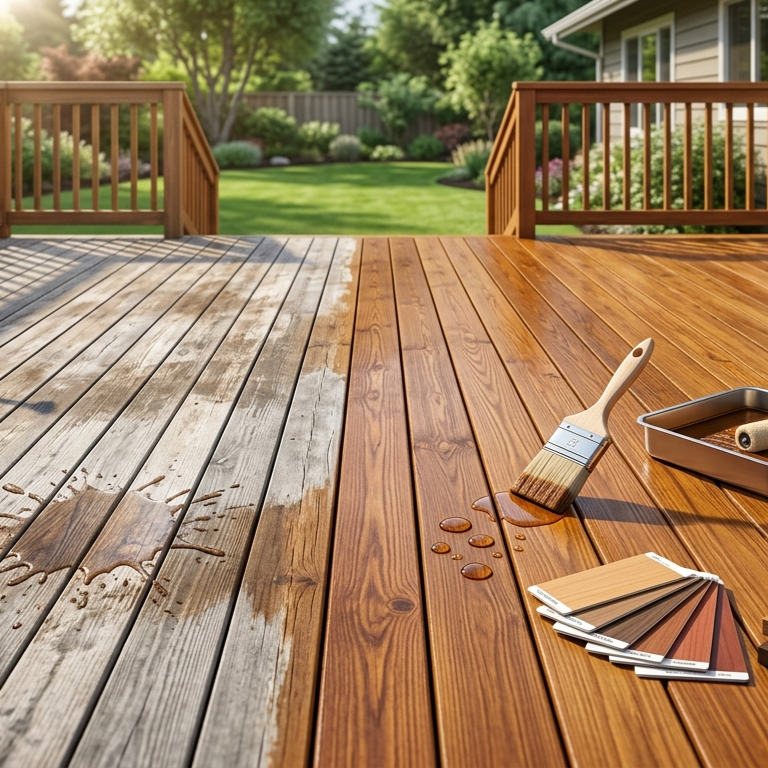
It's the first dry weekend after the spring thaw, and you're hauling the patio chairs back onto the deck. You set down the watering can, and a little water sloshes over the rim. Instead of beading up on the boards and rolling off the way it used to, the water just spreads. The wood drinks it. Within a minute, the wet patch has soaked in and gone darker than the boards around it.
That's the moment most homeowners figure out the stain is done. The deck looks roughly the same as it did last year — same color, mostly — but the protection is gone. Water is going into the wood now, not running off it. Once that happens, the clock is running differently. Faster.
How long a stain actually lasts depends on the type of stain, the exposure, and how the prep and application went last time. Manufacturer ratings give you the wide end of the picture. The lived-in numbers are tighter.
How long does each type of deck stain actually lasts
The pigment in a stain is what blocks UV. Clear sealers have almost no pigment, so they protect the wood from water but barely from sun — sun is what bleaches and breaks down wood fibers. Solid stains have so much pigment they essentially form a colored film on top, which blocks the most UV but covers the grain completely. Everything in between is a trade-off: more pigment buys you years, less pigment buys you a view of the wood.
| Stain type | Typical lifespan | What fails first | Best fit |
|---|---|---|---|
| Clear sealer | 1 – 2 years | UV bleaches the wood through it | New wood you want to show off |
| Transparent stain | 2 – 3 years | Mild pigment can't block enough UV | New or near-new hardwoods |
| Semi-transparent stain | 3 – 4 years | UV plus foot traffic | Decks with grain still worth showing |
| Semi-solid stain | 4 – 6 years | Wear at high-traffic zones | Aging pressure-treated lumber |
| Solid stain | 5 – 7 years | Cracking and peeling as wood swells and shrinks | Old or repaired wood |
| Deck paint | 3 – 6 years | Peeling at edges as water gets under it | Last-resort coverage; not recommended on flat surfaces |
Those ranges are the realistic ones. The packaging on a can of solid stain will often promise eight or ten years. That number applies to a vertical surface in a mild climate with no foot traffic and full overhead cover — fence rails, basically. On a horizontal deck floor in full sun, the same product gives you five years if you got the prep right and four if you didn't.
Oil-based stains penetrate deeper into the wood and tend to last a year or two longer than water-based stains at the same pigment level. Water-based stains dry faster, clean up with water, smell less, and resist mildew better. Modern water-based formulas have closed most of the gap on lifespan, especially at the semi-solid and solid end.
What cuts a stain's life in half
Two decks stained the same day with the same product can fail two years apart. The variables aren't mysterious. They're just the conditions the deck has to live through.
A south- or west-facing deck takes the most UV hours per year. The polymer chains in the stain literally break apart faster under direct sun. A north-facing or shaded deck of the same age can hold the same finish twice as long.
A deck with no overhead cover takes the full hit of rain, snow, and freeze-thaw cycles. Water gets under the surface, expands when it freezes, and pushes the finish off in micro-flakes you can't see until they add up. Decks with pergolas, awnings, or trees that drop a partial shade hold their stain noticeably longer.
Standing water spots — anywhere the deck doesn't drain because the joists settled or the planks pool slightly — eat the binder in the stain from below. You'll see the failure as a dark ring or a fuzzy patch right where the puddle sat. That's where rot starts later.
Concentrated foot traffic kills stain in lanes. The path from the back door to the grill wears through first. The corners under the chairs hold the finish for years. If a deck shows a pale stripe through the middle and full color around the edges, the stain isn't failing — it's just been walked off the busy zone.
Pressure-treated lumber stained too early traps factory moisture under the finish. The moisture pushes back out as the wood dries through the next season, and the stain lifts in patches. Wait three to twelve months on new pressure-treated boards — until water poured on the surface soaks in instead of beading.
The other big one is mismatched product. Oil-based stain applied over water-based (or the reverse) without stripping the previous coat almost always fails at the first freeze-thaw cycle. The two binders don't bond. The new finish lifts off the old one in sheets the following spring.
What gets you to the long end
The favorable factors are the opposite of the failure list, plus a few details that matter more than people expect.
Hardwood — mahogany, ipe, or thermally modified pine — holds finish considerably longer than soft pressure-treated wood, because the surface is denser and absorbs less variable amounts of stain per square foot. A semi-transparent stain that gets three years on pressure-treated boards can get five on ipe.
Two coats applied within the manufacturer's recoat window (usually 24 to 48 hours) bond chemically as if they were one thicker film. A second coat applied a week later sits on top of the first one and wears separately, which doesn't add the same lifespan.
Application temperature matters more than the can lets on. Stain applied below 50°F or above 90°F doesn't fully cure. Below 50, the binder doesn't cross-link. Above 90, the surface dries before the stain penetrates, leaving a thin film instead of a soaked-in coating. Both shortcuts shave a year or two off the lifespan.
Annual maintenance — a spring sweep, a gentle rinse, a wipe-down with a deck cleaner if mildew appears — buys a stain another season or two without any restaining at all. The deck that looks good at year 12 isn't the one with the magic stain. It's the one whose owner cleared the leaves off the corners every November.
The five signals you're due
The signals appear in a specific order, and reading them tells you not just whether you're due but how bad the prep is going to be.
The water test fails first. Splash a cup on the boards. If it beads up and rolls, the sealer is doing its job. If it spreads and soaks in within a minute, the protection is gone — regardless of how the color still looks.
Color fades second, especially on the sun-exposed planks. The boards near the railing on a south-facing deck go from rich brown to driftwood gray about a year before the rest. That's a tell that UV has eaten the pigment.
A chalky feel comes third. Rub a fingertip across a sun-exposed board. If your finger comes back with a powdery dust, the binder has broken down at the surface. That's a few months from full failure.
Lifted wood fibers come fourth. Run a hand across the boards barefoot. If they feel rough or fuzzy instead of smooth, the wood itself is starting to weather because the finish is no longer sealing it.
Outright peeling, cracking, or color blotching is fifth. By the time you can see the finish itself failing, you're well past the easy restain. The job now involves sanding or stripping back to bare wood.
When restaining gets harder, the longer you wait
The same deck costs wildly different amounts to restain depending on which signal you're at. Catch it at the water-test stage and the job is a power wash, a dry day, and two coats — call it $600 on a 250-square-foot deck. Catch it at the color-fade stage and add a light sanding for $200 to $400 more. Catch it at the fuzzy-fiber stage and the entire deck needs sanding to bare wood before stain will grip again. Catch it at the peeling stage and you're stripping with chemicals or aggressive sanding for two days before the new stain even comes out of the can.
Same physical deck. Same square footage. A two-year delay turns a $600 job into an $1,800 job. The labor genuinely tripled.
When pros plan the recoat
The cleanest schedule is restaining one season before the calendar tells you to. If a solid stain is rated for five to seven years, a homeowner who books the work at year four ends up with a clean-and-recoat job every time. At year five the wood is starting to weather. At year six the prep is a real sanding job. At year seven the deck has likely lost its finish in patches and gained mildew in the shaded corners.
The other timing rule worth knowing: avoid restaining in fall if you can help it. Spring and early summer give you four to six weeks of dry, warm weather to let the stain cure fully and harden. Fall restains often get caught by rain within the cure window and never harden the way they should. Those are the decks that look fine in November and start lifting in March.
A railings-only restain is its own scheduling thing. Railings outlast the deck floor by one to two years on average because no one walks on them and they dry faster after rain. On a deck that's been kept up, restaining just the railings every other cycle is reasonable. The floor is what fails first and gets recoated first.
FAQs
Use the water test as the primary signal. Pour a cup of water on a few different spots — including a sun-exposed area and a shaded one — and watch what happens. Beading and rolling means the sealer is still doing its job. Spreading and soaking in within a minute means the protection is gone, even if the color still looks fine. Color fading and fuzzy-feeling boards are the second and third confirmations.
Yes, by a lot. Hardwoods like mahogany and ipe hold a finish about twice as long as softer woods like pressure-treated pine because their denser surfaces absorb stain more evenly. Cedar and redwood sit in the middle. Pressure-treated pine is the most common deck wood and the one that needs the most frequent recoating — every two to three years on a transparent or semi-transparent finish.
This pattern is common and it means foot traffic has worn the floor finish faster than UV has worn the railings. Restain both at the same time if you can, because matching color between an old railing finish and fresh floor stain is harder than just doing the whole deck. If budget forces a split, do the floor — it's the surface taking the most beating and the place water sits longest.
No, and often less. A third coat sits on top of the previous two and can't soak in because the wood is already saturated. That extra layer wears separately, peels, and traps moisture underneath. Two coats applied within the recoat window is the maximum that bonds into a single stable finish.
Only after fixing what caused the original failure. If the wood was too wet, you have to wait until it dries fully. If the previous finish was incompatible with the new one, both have to come off. If the stain failed because it was applied below 50°F or above 90°F, the surface needs sanding or stripping to bare wood. Applying a second coat on top of a failed first coat without fixing the cause produces another failed finish.
No, not if the previous stain is the same type and is mostly worn rather than peeling. Clean the deck, let it dry, and recoat. Stripping is needed when the old finish is peeling, when switching between oil-based and water-based products, or when going from solid stain back to transparent. Stripping when you don't need to wastes labor and removes pigment that's still doing its job.
What the lifespan rating really tells you
The "lasts five to seven years" number on a can of solid stain is the upper end of what's possible — a well-prepped deck in moderate conditions, applied at the right time of year, recoated before the previous finish failed. Most decks won't hit the top of that range, because most decks weren't perfectly prepped, didn't get stained in ideal weather, or got missed during the spring inspection.
Aim for restaining at 70 to 80 percent of the rated lifespan and the deck keeps its protection indefinitely. The deck still in good shape at year 15 isn't the one with the magic stain. It's the one whose owner watched for the water test, recoated one season early, and never let the wood get to bare-and-fuzzy.
