
How Much Does Exterior House Painting Cost by Home Size
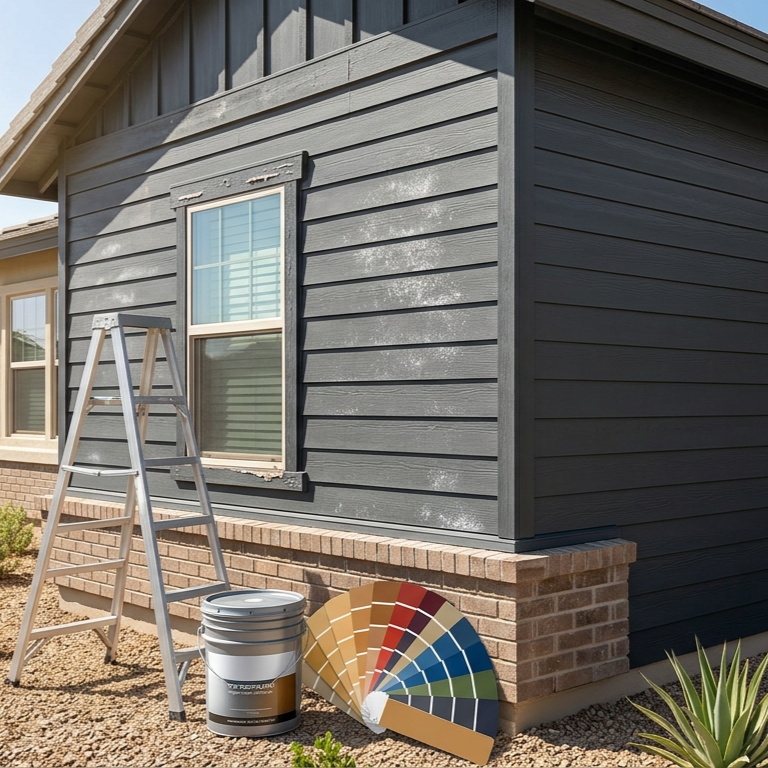
You are standing at the end of the driveway with a coffee, looking up at the south-facing wall. The paint above the front door is fine. The wall to the right of the garage has a chalky white film that comes off on your fingernail. The trim above the window is cracked where it meets the siding. Three painters have walked the property this week, and their quotes ranged from $4,200 to $11,500.
Same house. Three numbers that aren't close.
There's a reason an exterior repaint draws bids that wide, and once you know what each painter actually counted, the real range gets a lot tighter.
What an exterior repaint costs by home size in 2026
For most U.S. homes in 2026, a full exterior repaint with body, trim, soffit, and fascia included lands in a predictable band by home size. The numbers below assume a single body color, one accent color on the front door, normal surface condition, mid-grade exterior paint, and standard crew-spray-and-brush application.
| Home size (floor area) | 2026 exterior repaint cost | Rough crew time |
|---|---|---|
| 1,000 sq ft (small ranch, bungalow) | $2,500 – $5,500 | 2 – 4 days |
| 1,500 sq ft (typical single-story) | $3,500 – $7,500 | 3 – 5 days |
| 2,000 sq ft (single-story or small two-story) | $4,500 – $9,500 | 4 – 6 days |
| 2,500 sq ft (mid-size family home) | $5,500 – $11,500 | 5 – 8 days |
| 3,000 sq ft (larger two-story) | $7,000 – $14,000 | 6 – 10 days |
| 4,000 sq ft (large two-story, custom) | $9,000 – $18,000+ | 8 – 14 days |
The low end of each row is a same-color refresh on a home in good shape with smooth siding and a small trim count. The high end is the version with peeling south walls, two stories, a wraparound porch, a color change, and a full trim and door repaint. Most well-maintained homes between 1,500 and 2,500 square feet land in the $5,000 to $9,000 zone for the version that actually includes everything an exterior repaint needs to include.
Per square foot, that translates to roughly $1.50 to $4.50 against floor area, or $2 to $6 against actual wall surface. A bid below that band almost always excludes something. A bid above usually includes carpentry work, lead-paint containment, or a complete color change with extra primer coats.
Why floor area alone doesn't tell the story
The home-size table above is a starting point, not the answer. Two homes that show the same square footage on the tax record can end up at opposite ends of the range, and the biggest reason is story count.
A 2,000-square-foot single-story ranch and a 2,000-square-foot two-story Cape have the same floor area. The ranch can be painted off extension ladders for most of the work — eight-foot eaves, accessible gutters, soffit reachable in two passes. The Cape needs scaffolding or a boom lift on the second story, longer ladders on the gables, and a slower production rate because every move takes more setup. Same square footage. Thirty to fifty percent more on the bid.
A two-story repaint is the painting version of moving a couch up a spiral staircase. The actual work is the same. The setup eats the day.
Add dormers, gable ends, a steep grade on one side of the lot, or a wraparound porch with two-story posts, and the access premium climbs higher. A 2,200-square-foot two-story with a walk-around deck and a steep backyard slope routinely costs as much as a 3,000-square-foot single-story on a flat lot.
What surface material does to the number
Siding type has a bigger effect on the bid than most people expect. Two identical floor plans with different cladding can land 30 to 50 percent apart, and the spread isn't markup. It's how much paint the surface absorbs and how slowly the crew has to work to cover it.
| Siding type | Relative cost | Why |
|---|---|---|
| Vinyl siding | 0.8 – 0.9× baseline | Smooth, fast washing, minimal prep, paint covers well |
| Wood lap siding | 1.0× (baseline) | Standard sanding, spot priming, caulking |
| T1-11 plywood | 1.0 – 1.2× | More texture; sealant in grooves slows the crew |
| Fiber cement (Hardie board) | 0.9 – 1.1× | Smooth, factory-primed; easy if undamaged |
| Stucco | 1.1 – 1.4× | Texture eats paint; cracks need patching; specialty topcoat |
| Painted brick | 1.0 – 1.3× | Mortar lines are slow; brick drinks paint |
| Cedar shake or shingle | 1.4 – 1.8× | Hand-brushed in tight rows; the slowest siding to repaint |
Stucco is a sponge for paint. The texture pulls product into every micro-crater on the wall, so a gallon that covers 350 square feet on smooth vinyl barely covers 220 on stucco. Stucco repaints also usually call for an elastomeric topcoat at $50 to $80 per gallon versus $40 to $60 for standard exterior latex, and any cracks wider than a hairline need a bridging coat before the topcoat goes on.
Cedar shake is the slowest siding of all. Every shingle gets cut in by hand, the gaps between shingles need brush work, and a six-person crew on a cedar-shake home covers maybe a third of the square footage per day they'd cover on vinyl. The bid reflects that.
What pushes the price up on an exterior job
The home-size table assumes a clean baseline. Most homes aren't quite that clean. The line items below are the ones that move an exterior bid most often, in the order they show up.
| Cost driver | What it adds | Why |
|---|---|---|
| Surface condition (peeling, chalking, weather-checked) | +$1,500 – $4,000 | Scraping, sanding, priming bare wood before paint goes on |
| Story count (two-story vs single-story) | +30 – 50% on body labor | Scaffolding, longer ladders, slower production above 8 ft |
| Color change (light → dark, or dark → light) | +$800 – $2,500 | Primer coat plus two topcoats for clean coverage |
| Trim, soffit, fascia, garage doors as separate scope | +20 – 30% of body cost | Hand-brushed, slow work, often a different paint product |
| Wood repair or carpentry replacement | +$200 – $1,500+ | Rotten trim, soft fascia, damaged siding boards |
| HOA color approval, landscape protection, complex masking | +$300 – $1,000 | Documentation, mock-up panels, extra prep |
Surface condition is the single biggest swing. A home that was last painted six years ago with quality paint and good prep needs a power wash, a quick scrape of any loose spots, caulking touch-ups, and paint. A home that was last painted twelve years ago with builder-grade paint and skipped prep needs a full scrape down to bare wood on the south wall, sanding, spot priming everywhere primer is showing, caulk replacement, and minor carpentry where the trim has soft spots from water sitting in cracked corners. Same house. Three times the labor.
Cheap bids are almost always cheap because they assumed the walls were ready for paint. The expensive bids are usually the ones from painters who walked the south side, checked the soffit, and added line items for what they found.
What the bid should actually include
"Exterior repaint" is one of those phrases that means different things to different painters. One bid covers just the body. Another covers the body plus trim. A third covers the body, trim, soffit, fascia, every door, the garage doors, the shutters, and the porch ceiling. The bids can be hundreds of dollars apart for the same square footage, and both numbers can be right — they're just quoting different work.
| Scope item | What it covers | Typical share of total |
|---|---|---|
| Body (siding, stucco, main walls) | Field walls on all four elevations | 50 – 65% |
| Trim, fascia, soffit, window casings | Trim boards, eaves, soffit, around windows | 20 – 30% |
| Doors (front, side, garage) | Door slabs both sides; garage door panels | 5 – 10% |
| Shutters, decorative accents | Often shop-sprayed off the house | 3 – 5% |
| Power wash and surface prep | Pre-paint wash, blow-down, caulking | 5 – 10% |
| Wood repair, carpentry replacement | Soft fascia, rotted trim, damaged siding boards | Variable |
A walls-only bid runs roughly 50 to 60 percent of a full-scope bid. That gap is what makes one painter look like a bargain, and another look expensive when they're really quoting different projects. Read every exterior bid by line item, not by the bottom-line total.
FAQs
Yes, usually 15 to 30 percent more per square foot of actual wall surface. Prep is heavier on exterior — power washing, scraping, sanding, caulking, spot priming — and access is harder because most exterior work happens off ladders instead of step stools. Exterior paint itself costs more per gallon because of the UV stabilizers and mildewcides built into the formulation. Weather windows are also tighter, and a crew can lose half a day to wind or unexpected rain. Interior runs $2 to $6 per square foot of wall surface. Exterior runs $2.50 to $8.
Sometimes. Always read the line items. A "full exterior" bid that doesn't break out soffit, fascia, and trim is a bid worth questioning. Soffits and fascia are the boards along the underside and edge of the roof, and they take the worst of the UV and rain on most homes — they're usually the first thing to peel. Gutters are sometimes painted to match the trim and sometimes excluded entirely. A clear bid says which.
A standalone trim and door repaint on a 2,000-square-foot single-story runs $1,500 to $3,500 depending on linear footage of trim, condition, and how many doors are included. Trim work is slow because every inch is brushed by hand, and most trim takes two coats with sanding between. The per-day labor rate is the same as a full repaint — there's just less square footage to spread the mobilization cost across.
Stucco is textured, which means more surface area per square foot of wall — a single roll covers less ground than on smooth siding. Most stucco repaints also need an elastomeric paint or topcoat, which runs $50 to $80 per gallon versus $40 to $60 for standard exterior latex. Cracks in stucco have to be patched before paint goes on, and larger cracks need a bridging coat that adds another layer of labor.
On a well-prepped home with mid-grade exterior paint, expect 7 to 10 years on north-facing walls and 5 to 7 years on south-facing walls in high-UV areas. Premium 100% acrylic exterior paint can stretch the south wall to 8 to 10 years if the prep was done right. Cheap paint or skipped prep can fail at 3 to 4 years — the wall starts chalking, then fading, then the paint releases from the substrate in sheets.
Sometimes, but usually less than people hope. The fixed mobilization cost — driving out, setting up, masking, cleaning brushes at the end — is the same for a quarter-house job as for the whole house, so the per-square-foot cost on a partial repaint lands close to the per-square-foot cost on a full one. You also end up with a clean front and a tired back that won't match for the next several years. The only place a partial repaint reliably saves money is when a single elevation has a specific problem, like a south wall that's failed early or a wood-trim accent on the front that needs a refresh between full repaints.
A good exterior bid reads like a walk around the house
The bid worth choosing is the one where the line items reflect what the painter actually saw when they walked the property. Body wall area in square feet. Trim linear footage. Soffit and fascia broken out. Any wood repair flagged. A note about which paint and finish goes on each surface. A separate power-wash line. A clear scope for the unexpected — what happens if the crew finds soft wood behind a downspout, what the change-order rate is, how color approval gets handled before the paint hits the wall.
A bid that throws one number at "full exterior repaint" leaves you guessing what the painter included. The painter you want is the one who walked the south-facing wall, scraped at the chalk with their fingernail, climbed a ladder behind the garage to check the soffit, looked at the trim around every window, and gave you a number that reflects what they saw. The bid that came in lowest without that walk is usually the bid that grows on installation week.
