
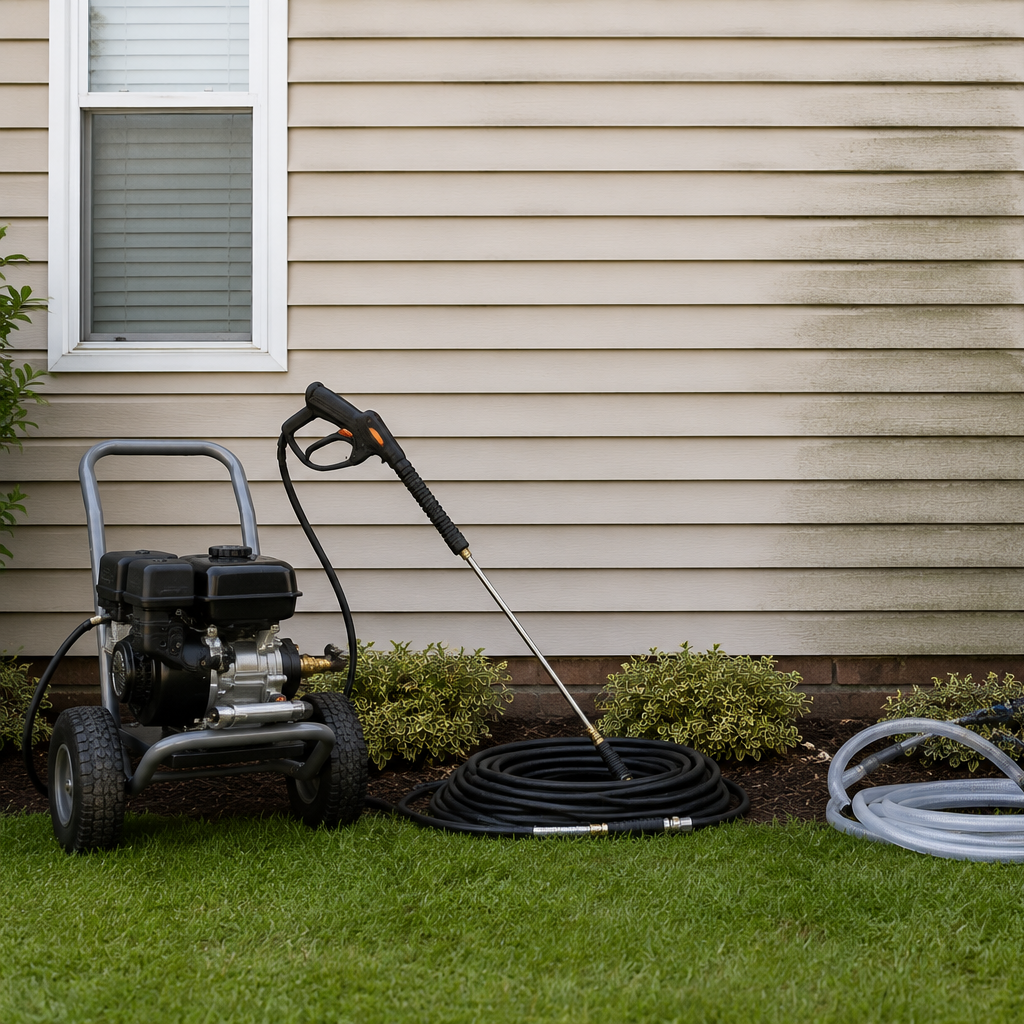
You're standing on the lawn with two estimates in your hand. The first crew showed up with a 4,000-PSI gas-powered washer and a 25-degree tip. The second crew came with a softer wash gun, a 50-gallon tank of mixed solution, and a quieter machine that hisses instead of roaring. Same green algae running down the north wall. Same chalky film on the south wall. Same vinyl siding all the way around the house.
Two completely different jobs. And only one of them is the right call for the wall in front of you.
The short answer: most siding — vinyl, wood, fiber cement, stucco, painted aluminum, painted brick — wants soft washing. Power washing belongs on the surfaces that can take it, which usually means concrete, unpainted brick, masonry, and unsealed pavers. Using a power washer on siding doesn't fail because of operator error. It fails because the tool itself is wrong for the surface, in the same way a chainsaw is wrong for trimming roses.
What each method actually does
The two methods share a hose and a pump and almost nothing else. The work each one performs on the wall is different from the start.
Power washing uses water pressure as the cleaning force. A gas-powered or electric pump pushes water through a narrow tip at somewhere between 2,000 and 4,000 PSI. The high-velocity stream physically blasts dirt, algae, and old coating off the surface. There's no chemistry involved in most setups — just water doing the work through sheer impact. The technique works because almost nothing growing on a wall can hold on against a focused 3,000-PSI stream from three feet away.
Soft washing flips the model. The pump runs at much lower pressure — usually under 500 PSI at the tip, often closer to 150 — but the water carries a cleaning solution that does the actual work. The standard mix is diluted sodium hypochlorite (the active ingredient in pool chlorine and household bleach), water, and a surfactant that helps the solution cling to vertical surfaces long enough to finish its job. The chemistry kills algae, mildew, mold, and bacteria at the root. A rinse a few minutes later carries the dead growth and the loosened film off the wall.
The difference shows up best on algae. Power washing strips the green pigment off the wall — the surface looks clean within seconds. But the algae cells underneath are still alive. They start regrowing as soon as the wall dries. A soft wash takes longer to show results, but the algae is dead by the time the rinse hits it. The wall stays clean for a year or two instead of three months.
What works on which siding
The siding material decides the method more than anything else. The table below sums up the standard practice for the most common siding types.
| Siding type | Recommended method | Why |
|---|---|---|
| Vinyl | Soft wash | Bends and dents at 2,500+ PSI; water forced behind a panel pools against the sheathing |
| Wood (cedar, pine, redwood) | Soft wash | High pressure raises the grain, splinters edges, strips finish |
| Painted wood or painted aluminum | Soft wash | Pressure peels paint film, lifts edges, scars repaintable surfaces |
| Fiber cement (HardiePlank, James Hardie) | Soft wash | High pressure erodes the cement matrix and can void the paint warranty |
| Stucco (traditional cement) | Soft wash | High pressure drives water past hairline cracks into the wall cavity |
| EIFS (synthetic stucco) | Soft wash only | The finish coat is thin acrylic over foam; pressure tears the surface |
| Unpainted brick | Either, depending on age | Newer brick handles light pressure; pre-1950s brick should be soft-washed |
| Painted brick | Soft wash | Pressure peels the paint and forces water into the masonry |
| Concrete, paver patio, asphalt driveway | Power wash | Hard surfaces designed to take impact; soft wash leaves grime in place |
| Sealed deck or fence | Soft wash for cleaning, power wash only to strip before refinish | Pressure damages the seal coat; soft wash preserves it |
The pattern is simple. Anything finished, painted, or made of a material that holds water in its pores wants the gentle method with chemistry doing the work. Anything raw and hard — concrete, masonry, exterior pavers — can take the high-pressure approach.
What soft washing actually does to the green stuff
The black streaks and green patches on a north-facing wall are not just dirt. They are colonies of algae (Gloeocapsa magma for the black streaks, several green species for the patches), with mildew and lichen mixed in depending on how shaded the spot is. Each colony has cells embedded into the surface — into the texture of the vinyl, into the pores of the paint, into the open grain of the wood.
A pressure rinse removes the pigment you can see. The cells stay. Two months of warm humidity later, the colony rebuilds itself and the streak comes back exactly where it was.
Soft washing kills the cells. The sodium hypochlorite in a soft-wash mix oxidizes the cell walls of every microorganism it touches. The surfactant keeps the solution stuck to the wall for the eight to twelve minutes it takes to do the work. By the time the rinse hits the surface, the colony is dead. The pigment lifts off the wall along with the dead cells, and what's left is a clean surface with no living growth to restart from.
This is why a well-run soft wash holds for one to three years on most siding, while a pressure rinse holds for one to four months. Same wall, same weather, three to ten times the durability — because one method addresses the cause and the other addresses the symptom.
The trade-off is timing. A soft wash takes longer to show its full result. The wall may look a shade darker right after the rinse than it will twenty-four hours later, once the dead algae finishes lifting and the surface dries. A pressure wash looks done immediately. Patient customers get the better outcome; impatient ones get a wall that looks great Saturday and needs another wash by August.
When pressure washing earns its place on a wall
A power washer is not banned from siding work. It earns its keep in a few specific scenarios.
Stripping flaking paint before a repaint. When the next step is primer and two new coats of paint, the goal is not to clean the wall — it is to remove every loose flake of failing paint so the new coat bonds to a sound substrate. Higher pressure at the right tip lifts the failing material faster than scraping by hand. The wall ends up rough, and that is the point. Primer and topcoat go on next.
Removing thick, set-in stains on hard surfaces near siding. Oil drips on a concrete walkway against the house, set-in rust at the base of a downspout, asphalt tracked into a porch slab — these jobs need pressure. The soft-wash chemistry that works on living organisms does not do much against engine oil. Power-wash the hard surface, soft-wash the wall above it, and the whole exterior reads clean.
Pre-paint cleaning on rough masonry. Old, unpainted brick before a paint job, or a textured concrete surface that has not been sealed, can absorb a power-wash rinse without damage and benefits from the mechanical scrubbing.
In each case, the power washer is being used on the surface it was designed for. The mistake almost always shows up in the other direction — a crew brings only a power washer to a job that calls for soft washing because soft-wash gear is what they don't own.
What pressure does to the wrong wall
The damage from pressure washing siding is rarely visible the same day. Water gets behind a vinyl panel and sits there for weeks, growing the mold the wash was supposed to stop. A 4,000-PSI tip held too close to wood siding raises the grain and strips the finish in a stripe pattern that mirrors the wand's path. EIFS — the synthetic stucco common on commercial buildings and some newer homes — has a finish coat thin enough to peel off in sheets if a tip touches it at the wrong angle.
The bigger and slower failure is moisture intrusion. A power-washer stream forced past a window seal, behind a piece of siding, or into a stucco crack pushes water into the wall cavity. The water sits between the sheathing and the insulation, finds the framing, and starts to feed wood rot, mold growth, and paint failure from behind the wall outward. The first sign months later is paint bubbling on the inside of the same exterior wall. By then the cavity is wet, the sheathing is soft, and the repair is a wall section, not a respray.
What each method costs
The price ranges below are typical for a single-family home with average dirt and algae load, no extreme access challenges, and standard equipment.
| Method | Typical residential price | What you get |
|---|---|---|
| Soft wash, whole house exterior | $300 – $700 | Algae, mildew, mold killed at the source; one- to three-year clean |
| Power wash, whole house exterior | $200 – $450 | Surface pigment removed; one- to four-month clean before regrowth |
| Soft wash on roof | $400 – $900 | Black streaks killed and lifted without lifting shingles |
| Power wash on driveway, walkway, patio | $150 – $400 | Hard surfaces cleared of oil, dirt, algae, tire marks |
| Pre-paint stripping wash | $300 – $600 | Failing paint removed; surface prepared for primer |
The soft wash costs more per square foot on siding because the chemistry, the slower dwell time, and the careful rinse all take longer than a fast pressure pass. It also lasts five to ten times as long on most walls, which makes the per-month cost lower. A homeowner paying for a power wash every six months pays more across two years than one paying for a soft wash that holds for two.
The hidden cost is the damage scenario above. A $250 power wash that drives water behind a wall and leads to $4,000 of cavity repair is the most expensive cleaning the homeowner will ever buy. The single biggest reason to use the right method on siding is not the immediate cost — it is the cost of the wrong method's worst case.
| Cost driver | Range it adds to the per-sq-ft price | Why |
|---|---|---|
| Wall condition (smooth → heavy patching) | +$0.50 to +$2.50 | Labor for patching, sanding, skim coats, priming over stains |
| Paint grade (contractor → premium) | +$0.30 to +$1.20 | Material cost; sometimes offset by fewer coats |
| Trim and door painting | +$0.75 to +$2.00 | All hand-brushed; often slower than wall painting |
| Ceiling height > 9 ft | +$0.50 to +$1.50 | Ladders, scaffolding, slower production rate |
| Color change (dark over light, or vice versa) | +$0.40 to +$1.00 | Extra primer coat or extra topcoat for full coverage |
| Wallpaper removal | +$1.00 to +$3.00 per sq ft | Steaming, scraping, skim-coating back to smooth |
| Popcorn ceiling repair or removal | +$1.50 to +$3.50 per sq ft (ceiling) | Scraping, skim-coating, dust containment |
FAQs
A homeowner pressure washer puts out 1,800 to 2,500 PSI, which is enough to damage vinyl and wood siding if the tip is held too close or the angle is wrong. It is also enough to drive water behind siding panels. If the goal is to clean a concrete patio or driveway, a homeowner unit is fine. For siding, the risk is real, and the result is short-lived even when nothing breaks. Hiring a soft-wash service for the walls and using the homeowner unit on the hard surfaces is the safer split.
One to three years on most homes, depending on shade, humidity, and how close trees and shrubs sit to the wall. North-facing walls and walls behind dense landscaping get dirty faster because they stay damp longer. South and west-facing walls in dry climates can hold for the full three years. A pressure rinse on the same wall holds one to four months.
The standard mix is diluted enough to be safe with normal precautions: pre-wet landscaping with plain water before the wash, rinse with plain water after, and avoid spraying solution directly onto sensitive plants. Most pro crews wet down beds, hedges, and lawn before they start and rinse again at the end. Concentrated, undiluted bleach burns plants quickly, which is why the dilution rate matters and why this work is not a DIY job with a garden sprayer.
No. Soft washing addresses organic growth — algae, mildew, mold, lichen, bacteria — and the dirt films that come with them. Paint splatter, rust running off a downspout, or oil tracked onto siding need spot treatment with a different chemistry. A good crew will identify those stains before quoting and price them separately rather than promise a full removal as part of the wash.
The equipment is available to a homeowner, but the dilution math, the rinse timing, and the awareness of which plants and surfaces tolerate what concentration take real experience to get right. A first-time soft wash with too strong kills landscaping; too weak leaves algae alive. Most homeowners who try soft washing once hire it out next time. On a two-story house, hiring it from the start is safer.
Picking the right method for the wall in front of you
The decision is made by the siding type, not the dirt. Vinyl, wood, painted surfaces, fiber cement, stucco, and EIFS belong to soft wash. Concrete and unpainted masonry belong to power wash. A crew that brings both setups and knows which to use on each surface is the crew that leaves the exterior right and keeps it that way.