
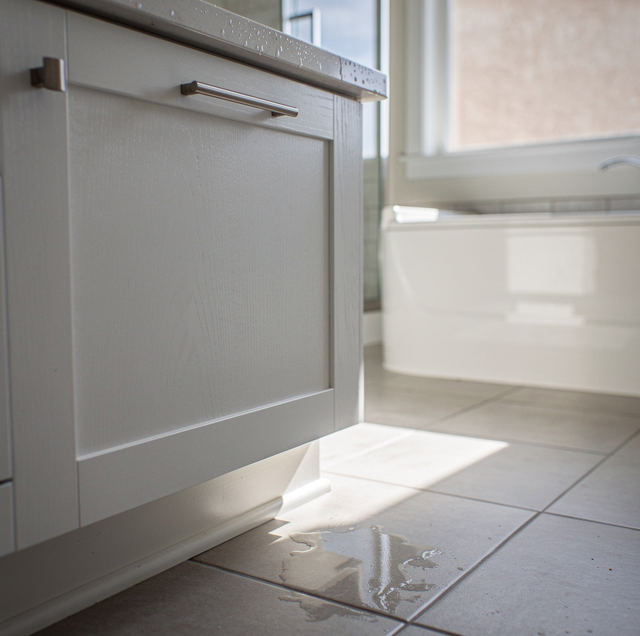
A bathroom vanity sits in a room built around water. Running the faucet splashes the door edges and the top rail; steam from a shower settles on nearby surfaces whether or not the door itself gets touched; and hands reaching for the pulls can carry damp fingers, soap, or lotion residue. A sink base underneath adds one more risk: a supply line or a trap that can drip slowly enough to go unnoticed for a stretch. That exposure decides what has to happen underneath the paint and which finish gets chosen, because a coating picked and applied the way a bedroom door gets painted fails at the edges, rails, and pulls that take that contact.
Each zone on a vanity carries its own exposure and calls for its own piece of the prep and coating work:
| Zone | What It Faces | What the Paint Job Does There |
|---|---|---|
| Door and drawer edges under the sink | Splash from the faucet and drips from hands reaching past the sink | Sealed edges and end grain so water can't wick into the raw substrate |
| Top rail below the counter | Standing steam and condensation running down off the countertop or backsplash | A sealed, wipeable film at the point where moisture collects and sits |
| Toe kick | Floor-level splash, mop water, and cleaning runoff | The same sealed-edge treatment as the door bottoms, since it takes similar contact at floor height |
| Sink-base interior floor | Slow drips from the trap or supply lines | Sealed, or left with a primer-only coat rather than a full topcoat |
| Pulls and the surrounding wood | Constant hand contact carrying soap and lotion residue | A fully cured, wipeable film around the hardware, kept clean of residue |
| Joint where the cabinet meets the counter or backsplash | Direct water contact at the seam, plus movement between two different materials | A flexible caulk seal at the joint |
What the Vanity Is Made Of and Why That Changes the Job
A vanity door might be solid wood, an MDF panel with a thin wood veneer, particleboard with an edge band wrapped around the exposed sides, or a laminate or thermofoil skin heat-formed over a substrate. Solid wood and veneered MDF both take paint over a cleaned, scuffed, and primed surface. A frame-and-panel solid-wood door holds its center panel loose in the frame so the wood can swell and shrink across its grain, and paint that fills the seam where that panel meets the frame can crack in a line as the panel moves. Particleboard is different at its edges, where the exposed core is more absorbent than the faced surfaces and needs its cut ends sealed before anything else touches it, or moisture works its way in from the edge inward long after the face still looks fine. Laminate and thermofoil are different again: a vinyl or resin face with no wood fiber for paint to key into, and a vanity with that kind of door face is worth identifying before any primer is applied rather than after a topcoat has lifted.
Cleaning and Degreasing So Paint Can Bond
Soap scum, hand lotion, and skin oils leave a film on a vanity door. That film sits on top of the existing finish, and paint bonds to whatever is on the surface, not to the wood or laminate underneath it. A degreasing wash lifts it off before any sanding, since sandpaper drags the residue across the surface rather than removing it. Once the surface is clean, a scuff-sand or a liquid deglosser knocks the factory sheen down enough for primer to grip it, since a glossy factory finish stays too slick for paint to hold onto no matter how well it was cleaned first.
Primer and Edges
A bonding primer goes down after the surface is clean and scuffed, and on a vanity it does its key work at the edges. Every cut edge, whether it's the bottom of a door, the side of a drawer front, or the exposed end grain where a panel was trimmed to size, is more porous than the surrounding faced surface and will take on water faster if left raw or under-primed. Working the primer fully into those edges before it ever reaches the flat panel face is what keeps water from creeping in sideways once the vanity is back in daily use. A routed edge on a one-piece MDF door exposes loose fibers that soak up the first coat of primer and can stand up as a fuzzy texture once it dries, so that edge takes a light sanding and a second coat of primer before the topcoat.
Older paint layers on a bathroom cabinet can contain lead. Sanding or scraping that surface sends lead dust through the air of a small room, so the painter tests the coating first and handles any dust-generating step.
Brushing or spraying that primer and topcoat changes the smoothness of the final surface, a separate decision from what gets primed; either way, bonding primers and spray work in a small bathroom call for ventilation and a respirator for whoever applies them.
Choosing a Finish Built for Wet Contact
Sheen does work on a vanity. A semi-gloss or satin finish forms a tighter, less porous film than a flat or matte sheen, so water beads on it and runs off, and a splash of toothpaste or hairspray wipes clean instead of setting into the paint. That tighter film is also what stands up to hands on the pulls throughout the day, which makes the sheen a match between the film and the water, and to the contact each surface takes.
Curing Through the Bathroom's Own Steam
A vanity's top coat needs to finish hardening while the room keeps doing what a bathroom does: fogging with steam and beading condensation on cool surfaces. A film that is dry to the touch has stopped feeling wet, but it hasn't finished the chemical hardening that gives it full resistance to water sitting on the surface, and steam condensing on a top rail or a countertop-adjacent panel during that window can leave moisture against a coat that isn't ready to shed it the way it will once fully hardened. Closing the doors gently, rather than testing how they latch, gives the finish the time it needs to harden before it faces the bathroom's routine at full strength.
Swollen Panels and Leaks Under the Sink
A soft or swollen panel at the sink base signals that water has already gotten in, and paint won't reverse that. Particleboard swells as its compressed wood chips take on water and push apart, loosening the glue between them, and a swollen spot stays thick and weak after it dries out. The water to the sink is shut off at its valves when a leak is suspected; a plumber corrects the leak first; mold that spreads beyond a small patch of the sink-base floor is a remediation job; and any panel that swells out of its flat shape gets replaced rather than repainted.
Dark rings or a musty smell at the back corners of the sink base can indicate a slow drip before any panel swells, and painting should stop at that cabinet until the plumbing has been checked.
Catching that softness before the primer goes down is the difference between a repair and a failed repaint.
Frequently Asked Questions
Yes. The countertop, sink, and faucet stay installed; the counter edge, the backsplash, and the plumbing inside the sink base are masked, the cabinet box is coated where it stands, and the doors and drawer fronts come off to be finished and rehung once the coat has hardened.
The residue is different. A hand reaching for a vanity pull carries soap film or lotion from the sink below, and that residue builds on the paint, dulling the sheen around the hardware. A damp soft cloth lifts it from a cured finish, while an abrasive pad or scouring powder scuffs the film it is meant to clean.
Yes. Everything under the sink and in the drawers comes out, since the interior near the openings gets masked or coated, and cleaning products stored there give off fumes and can spill onto fresh paint; the contents go back once the coat has hardened.
They don't need to come off, but they do need attention where they overlap the cabinet. A wall mirror's clips or a recessed medicine cabinet's frame can overlap the top edge of a vanity's backsplash or side panel, and that overlap gets masked off rather than pulled loose, since the mirror or cabinet has its own separate seal to the wall that a painter doesn't want to disturb while working the vanity's finish.
Yes. With no window, the exhaust fan and the doorway are the only paths for solvent odor and moisture from the next shower, so the bathroom door stays propped open between uses while the coat cures.
It can while the coat is still soft. Two painted surfaces pressed together before they harden can bond at the contact points, a sticking called blocking, so small clear bumpers at the door corners keep the painted faces from resting against each other once the doors are rehung.
Commission bathroom vanity cabinet painting — degreased doors, sealed edges and end grain, and a moisture-tolerant coat at the pulls and top rail. True Coat Painting serves Reno, Sparks, and Spanish Springs. Call (775) 227-0618.