
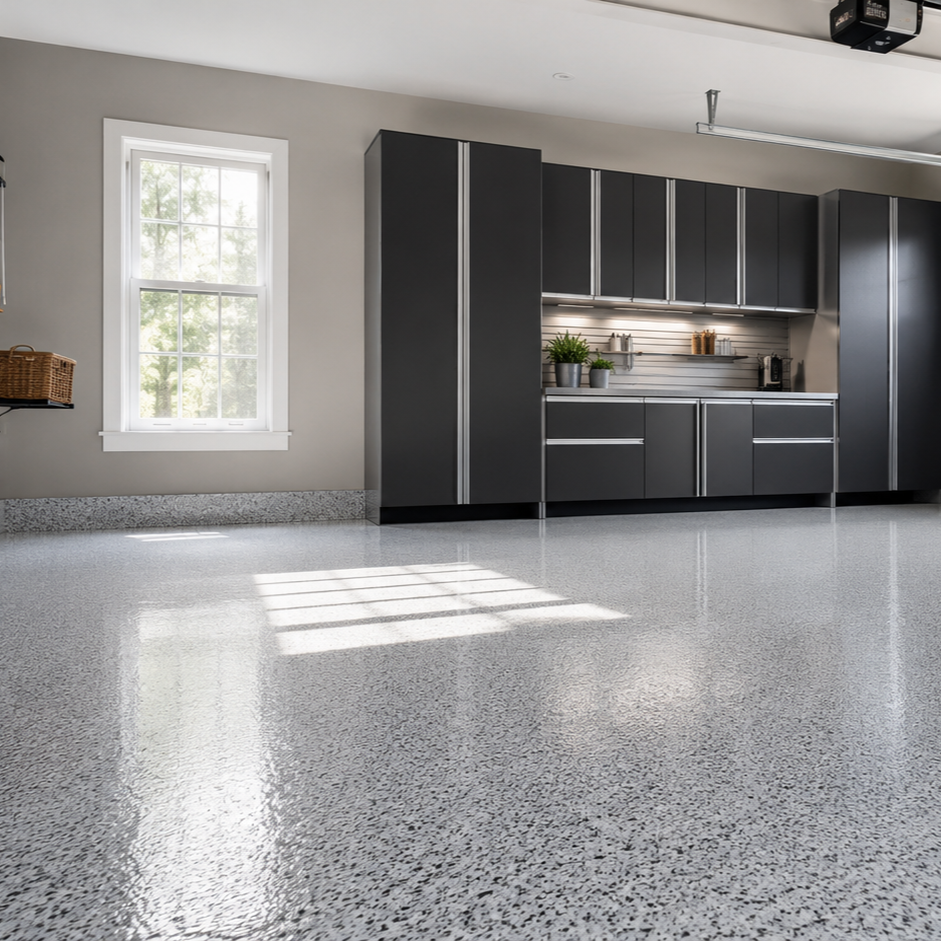
Three quotes for the same two-car garage. One comes in at $1,800. The next at $3,400. The third at $5,200. Same square footage. Same address. Same homeowner standing in the driveway, scratching his head.
When the spread is that wide, the variable isn't epoxy. It's what each contractor planned to do before the coating ever opens — and what they quietly left out. Low quotes get low by trimming scope you can't see in a single line item: prep depth, repairs, moisture testing, topcoat type, cure schedule, warranty terms. Two coatings that look identical on day one can wear like different products by year two.
A good quote tells you exactly what's coming. Here's what should be in writing before you sign.
Concrete prep — the line item that's usually missing
Prep is where most epoxy coatings fail. A poured slab has a thin surface skin of fines and cement laitance on top of the real concrete — on a freshly troweled garage floor it can feel tight and almost glassy. Epoxy poured onto that skin bonds to a paper-thin layer, not the slab. When tires roll over it warm — what installers call hot-tire pickup — the coating lifts in long strips along the tire path.
The quote should name the prep method and describe what it leaves behind.
Diamond grinding uses rotary heads with industrial diamond segments. The heads cut the surface skin off and leave a uniform mechanical profile the coating can grab. For most residential garage work this is the default. The quote should also say whether the grinder runs with a HEPA vacuum attached — grinding concrete without dust containment fills the room with respirable silica.
Shot blasting fires steel shot at the slab and pulls a deeper profile. You see it more often on warehouse, showroom, and commercial slabs, or on residential floors where embedded contamination has to come out.
Acid etching is a chemical wash that loosens the surface skin. It costs less to apply. It also leaves a less uniform profile, can leave residue if the rinse step is rushed, and rarely produces the bond mechanical grinding does. Most professional installers won't warranty a coating laid over acid etch.
The right reference number to ask about is the concrete surface profile, or CSP. Industry guidelines call for CSP-2 to CSP-3 for residential epoxy garage systems. Higher-build systems push toward CSP-4. If the quote doesn't reference a profile target at all, the installer is either skipping the step or hoping you won't ask.
Crack repair and joint treatment scope
Old garage slabs have cracks. Some are cosmetic, some run all the way through, and the quote needs to say what the installer plans to do with each kind.
A "crack repair allowance" by itself isn't enough. The allowance should be tied to a unit — linear feet of crack, number of patches, dollar amount before extras kick in. Without a unit, "allowance" is a number the contractor uses to come in low and then bills against on day two when the floor is exposed.
Control joints and expansion joints get treated differently from random cracks. Control joints are the saw cuts that direct shrinkage — most epoxy systems either fill them with semi-rigid filler and coat over, or honor them by re-cutting the joint after cure. Expansion joints are designed to move, so rigid fillers crack inside a year. The quote should say which approach applies to each joint type, plus what happens at the perimeter where slab meets foundation wall.
Spalling at the garage door threshold is its own line item. So is edge detail along the apron, around drains, and around any embedded posts. A quote that lists "prep included" without mentioning these details will surprise you later.
Moisture testing — and what happens if the result is high
A concrete slab is constantly pushing water vapor up from the ground. How much depends on slab age, soil under the slab, whether a vapor barrier was installed, foundation drainage, and seasonal water table. When vapor transmission runs high, an epoxy coating over it can blister, bubble, or sheet-delaminate within months. The coating is itself a vapor barrier, and water trapped underneath has nowhere to go but sideways — lifting the coating as it collects.
The quote should describe how moisture is tested and what the threshold is for moving forward without mitigation. Two common tests:
The calcium chloride test (ASTM F1869) measures the moisture vapor emission rate in pounds per 1,000 square feet per 24 hours. Most epoxy manufacturers cap their warranties at 3 pounds. Some polyaspartic systems tolerate 5 or higher.
The relative humidity in-slab test (ASTM F2170) drills probes into the slab and reads internal RH directly. Most systems require under 75 to 80 percent.
If the test comes back high, the quote should say what happens next. A moisture-mitigation primer is an epoxy formulated to handle vapor drive — it costs $1.50 to $3 per square foot on top of the base system, but prevents the kind of failure that means tearing the whole floor off and starting over.
The coating system itself — named, not vague
"Epoxy garage floor coating" can mean a dozen different system builds. The quote should name each layer of the system by product, not by category. A complete spec usually reads like this:
A primer or first coat designed for bond to the prepared profile. Sometimes this is the base coat itself, sometimes it's a separate moisture-tolerant primer.
A pigmented base coat at a specified mil thickness, usually 10 to 16 mils for a standard residential system.
Decorative media — color flakes, quartz, or metallic pigment — broadcast into the wet base. The quote should say partial broadcast or full broadcast. Full broadcast uses about 4 to 6 times more flake material and changes both cost and appearance.
A topcoat over the base. This is where systems diverge. A clear epoxy topcoat is cheaper and slower to cure. A polyaspartic or polyurethane topcoat costs more but adds UV stability, abrasion resistance, and chemical resistance. For a garage door that faces afternoon sun, a UV-stable topcoat is the difference between a floor that stays the color you picked and one that yellows in three years.
Mil thickness matters more than coat count. Two coats at 4 mils each is thinner than one coat at 12 mils. Ask for total dry film thickness as a separate line — the answer should land between 18 and 30 mils for a residential build, higher for heavy-use spaces.
Cure schedule and access — when you actually get the garage back
This is the line item homeowners forget to ask about until day three. The quote should give two numbers: hours to foot traffic and hours to vehicle traffic.
A traditional solvent-borne or water-borne epoxy system usually needs 24 to 48 hours for light foot traffic and 5 to 7 days for vehicle traffic. The crew typically comes back on day two or three for the topcoat. You won't park in the garage for almost a week.
A polyaspartic or hybrid epoxy-polyaspartic system can be walkable in 4 to 8 hours and ready for vehicles in 24 to 48 hours. Most polyaspartic installs go down in a single day. The price reflects that — faster chemistry and tighter working windows cost more in product and labor.
If the quote doesn't tell you when you can drive on it, you are going to be moving cars to a neighbor's driveway with no warning. Ask. And read the warranty for early-load language — some products void if a vehicle drives on them before the cure window closes.
Warranty terms and the exclusions that matter
A one-year workmanship warranty on an epoxy floor is short. A five- to ten-year limited warranty is more standard for a system installed with proper prep. The number on the front of the quote matters less than what's actually covered.
Read the exclusions. The common ones to look for:
Moisture-related failure is often excluded if the contractor didn't test, or if testing came back over threshold and the homeowner declined mitigation. That's why the moisture step matters in writing.
Hot-tire pickup is sometimes excluded entirely, sometimes covered for a limited window. If you're parking daily-driven vehicles on it, this is the failure mode that costs you the floor — make sure it's covered or named clearly.
Mechanical damage from dropped tools, jack stands, or chemical spills is almost always excluded.
Color fading at the garage door under direct UV is sometimes excluded on standard epoxy systems and covered on systems with a UV-stable topcoat. If the brochure says "UV-stable" but the warranty excludes UV fading, ask which is right.
Transferability matters if you sell the house in the next few years. Some warranties transfer once to the next owner; some don't transfer at all. A transferable warranty is a small but real selling point.
What a complete quote looks like — side by side
Here's the same job written two ways. The cheap one has every word the homeowner wants to hear and none of the spec.
| Line item | Vague quote | Detailed quote |
|---|---|---|
| Prep | "Surface prep included" | Diamond grinding to CSP-2 profile, HEPA dust containment, edge detail |
| Cracks | "Cracks repaired" | Crack chase and fill up to 20 linear feet; over 20 ft billed at $4/ft |
| Joints | (not listed) | Control joints semi-rigid filler; expansion joints honored, not coated |
| Moisture | (not listed) | Calcium chloride test; mitigation primer at $2/sq ft if over 3 lb threshold |
| Coating system | "100% solids epoxy" | 12-mil pigmented base + full flake broadcast + 8-mil polyaspartic topcoat |
| Total dry film thickness | (not stated) | 20 to 22 mils |
| Cure schedule | "Wait 24 hours" | Foot traffic 8 hrs; vehicle traffic 48 hrs |
| Warranty | "Limited warranty" | 7-year limited; covers hot-tire pickup, excludes mechanical damage and UV on standard system |
| Cleanup | (not listed) | All dust, debris, and packaging removed; site swept and vacuumed |
A homeowner can read the detailed quote out loud and explain what they're getting. The vague quote leaves every decision in the contractor's hands after the deposit clears.
FAQs
For a residential garage with real prep, full system build, and a warranty worth the paper, $2 per square foot doesn't cover materials and labor. Quotes that low usually mean acid etching instead of grinding, one thin coat instead of a primer-base-topcoat build, no moisture testing, no warranty worth filing against, and a finish you'll be recoating in two to three years. The honest range for a quality residential install is $5 to $9 per square foot before add-ons.
Some contractors test every slab. Some test only on slabs with visible moisture history. Some skip testing entirely and warranty around it. The quote that includes testing in the base price is the safer bet — moisture failure is the most expensive way an epoxy floor can fail, and it's the one the contractor will blame on the slab if it happens after install.
100% solids means the coating doesn't contain solvent that evaporates as it cures — the wet mil thickness equals the dry mil thickness. Solvent-borne epoxies lose volume as the solvent flashes off, so a wet 10-mil coat ends up as a dry 5- or 6-mil coat. 100% solids is the standard for serious garage systems because thickness equals durability. Make sure the quote names the product so you can verify the spec sheet.
The quote should reference the chip color, brand, and flake blend by name if you've selected one. Color flake brands sell hundreds of blends, and "earth tones" or "neutral gray" leaves room for substitution. If the contractor brings physical chip samples to the estimate, the chosen chip number should appear on the quote.
Material pricing on resin, hardener, and pigment moves with petrochemical markets, so most epoxy quotes are good for 30 to 60 days. Get multiple bids inside a two-week window so you're comparing apples to apples on material cost.
Sometimes, but the system changes. Exterior concrete faces UV, freeze-thaw, and de-icer chemicals that interior garage floors don't, and most installers won't put a standard interior epoxy outside. A polyaspartic-based system can handle the apron — the quote should list it as a separate line with its own prep, spec, and warranty terms.
Reading the quote out loud
A garage floor coating is a five-figure decision on most homes and something you live with for a decade. The quote should answer four questions plainly: what gets prepped and how, what gets repaired and what extras cost, what coating goes down and how thick, and what happens if something fails. If you can't read those answers off the page, the work behind them probably isn't there.
Take the highest and the lowest quote you've received and line them up against the table above. The gap between them isn't a discount — it's scope. Decide which scope you actually want, then ask the lower bidder to write that same scope into their number. Most of the time, the number changes.