
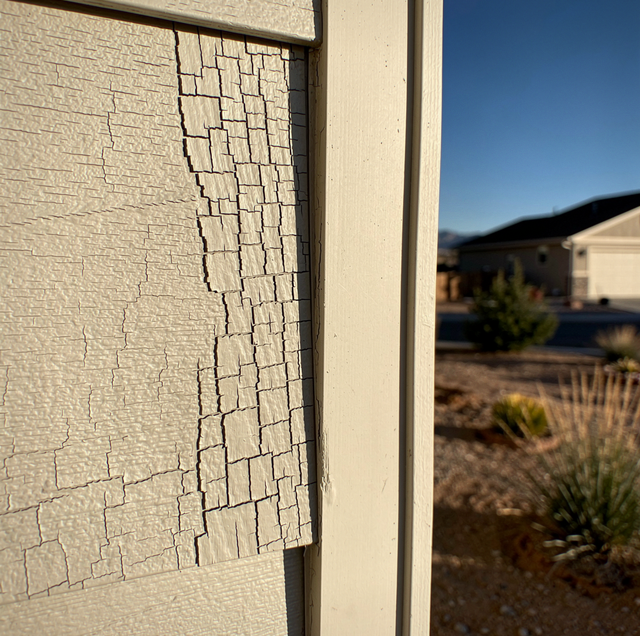
Walk up to a wall where the paint has failed, and the shape of the break says more than the color chart ever will. A coat that has split into a web of fine lines describes a different failure than one lifting away in broad, curling sheets. Cracking is its own defect with its own causes, and a repair aimed at the wrong one usually misses.
Quick Answer: Cracking means the paint film split on its own while still gripping the surface underneath. Age, excess thickness, and a rigid coat over a flexible one are the usual reasons, and alligatoring is the pattern that gives it away.
Read the Break Before You Read the Wall
The shape of the break narrows the cause before a scraper ever touches the surface, faster than the house's age or the brand on the can does.
Two failures get called the same thing outdoors, and they are not the same thing. Peeling is an adhesive failure: the grip between the film and whatever sits beneath it let go, and the coat comes away because nothing is holding it in place. Cracking is a cohesive failure: the film is still stuck down and has split apart within itself. Adhesive versus cohesive is the distinction everything below turns on, and this is about the second one.
So look at what the edge of the damage does. Paint lifting in broad sheets, whether down to bare siding or down to an older layer still stuck tight, has let go of something. Paint breaking into small chips, hairline webs, or a grid of interlocking squares has let go of nothing. It is still attached, gone stiff, and splitting under ordinary movement instead of pulling away.
Run a fingernail across a crack before deciding anything. A crack you can catch a nail in has opened through the full film, while a fine line the nail rides over is surface crazing only in the top coat.
Cracking Is the Film Failing on Its Own
A cured coat is a thin plastic skin that has to stretch and shrink with whatever it covers. Wood swells and dries with the humidity, siding and trim expand and contract every time the sun comes around, and the film has to move with all of it or split.
A dried-out rubber band is the easiest comparison: fresh, it stretches; old, it snaps at the first pull. Paint ages the same way. Ultraviolet light breaks down the binder that gives the film its flex, so the coat gets harder and more brittle every year it faces the sun, and movement it absorbed easily at year two eventually exceeds what it can take at year twelve. Cracking that shows up first on the sunniest walls, and years later or never on the shaded ones, is age doing exactly that.
A coat that is the wrong pairing for what it sits under fails the same way, but much sooner. A hard oil enamel brushed directly over a sound, flexible latex coat has almost nothing in common with it: the two expand and contract at different rates every time the temperature swings, and the stiffer layer on top gives first, splitting along the stress lines where it can no longer stretch with what it is riding on.
Alligatoring Has a Pattern and a Cause of Its Own
Alligatoring is the cohesive failure most people can name on sight without knowing what it means. The film breaks into a field of interlocking squares and rough rectangles separated by wide, rounded cracks, until the surface takes on the look of reptile hide. Those cracks are broad enough to see from the yard, and the segments between them are still firmly attached.
What is actually happening in the film
The pattern arises when one layer moves while another does not. A hard, brittle coat sitting on a softer or still-moving one is the classic setup: an enamel laid over a coat that has not fully cured, or a rigid finish over an old oil layer that still creeps slowly when heated. The top layer cannot follow, so it fractures into cells rather than lines because the stress pulls on it from every direction at once rather than along a single axis.
Excessive film build reaches the same place by a different route: each repaint adds thickness, and a thick film has proportionally less give than a thin one. Incompatible coats do it chemically instead: a solvent-borne finish over a water-borne one, or the reverse without the right primer between them, cures into two layers that never behave as one.
Telling it apart from the alternatives
Scale is the first read. Alligatoring makes large cells, often the size of a coin or bigger, with cracks wide enough to hold dirt. Crazing forms a much finer web confined to the top coat, often not reaching the layer beneath. Crazing points at the last coat and how it was applied; alligatoring points at the whole stack and how thick it has become.
Direction is the second read. Alligator cells run every which way. Cracking that runs in straight parallel lines with the grain of a board is the film following the board, not the film failing: the wood swells and shrinks, and the paint goes along with it. That changes the repair, because the grain-line version keeps returning until the board's exposure to water changes, whereas alligatoring is solved by removing the film and rebuilding it thinner.
Homes painted before 1978 may have lead-based paint under later coats. Sanding or scraping an alligatored surface on those homes releases hazardous dust, so test first and use lead-safe practices or a licensed professional instead of dry sanding.
Film Build Is the Number Behind Most of the Pattern
Film build is how thick the dried coating actually is, measured in mils, and most exterior finishes are formulated to perform somewhere around three to five mils dry across two coats. That range is about flexibility, not coverage: it is the thickness the chemistry was designed around.
Go under it, and the coat is thin, porous, and short-lived. Go well over it, and flexibility falls off, because the film has to bend across its own thickness and a thicker one simply cannot. A board carrying eight or ten repaints is nowhere near the range any of those cans described, which is why railings, window sashes, porch columns, and trim crack long before the flat field of a wall does; those are the parts touched up most often, so they carry the most paint.
This is also why sanding an alligatored surface smooth and recoating it rarely holds. The sanding takes off the peaks and leaves the cracks; the new coat bridges them for a season, and the pattern telegraphs back through as soon as the stack moves again. Getting back inside the range means taking film off, not adding more.
Temperature and Timing Decide Whether the Film Ever Sets Right
Even a sound coat on a well-prepped surface can crack early if it went on outside the conditions it needed to cure. A latex film does not so much dry as coalesce: the water leaves, the resin particles soften, flow together, and fuse into one continuous sheet. That fusing is what gives the film both its strength and its stretch, and it only occurs within a temperature range.
Paint applied in high heat or direct sun skins over on top while the layer underneath is still soft, and the coat cures as two mismatched halves rather than one sheet. Paint applied too cold does the opposite: the resin particles never soften enough to flow together, so the film forms a weak, porous layer of particles that were never really joined. A film that never coalesced properly has less to give when the wall moves, and cracking is how that shows.
Most exterior paints list a minimum and a maximum application temperature on the can for exactly this reason, along with the hours of dry weather the coat needs before rain or dew can touch it. Some products are formulated to coalesce well below the old fifty-degree floor, which is worth reading on the label rather than assuming either way. Painting inside that window lets the film form as a single layer; painting outside it creates a weakness that stays hidden until the wall has seen a full run of hot and cold.
When a Crack Becomes a Peel
Not every crack stays a crack. Once a film has split, those cracks are open channels down to whatever is underneath, and on wood that matters quickly. Rain and dew run into the crack, reach the substrate, and start working the bond loose from behind, so an area that was purely a film problem becomes an adhesion problem on top of it. The order is worth holding onto: the cracking came first and let the water in, so stopping the water without rebuilding the film leaves the same brittle coat to split all over again.
That crossover is where blistering shows up, and a blister is better opened than squeezed. Cut one open and look at what is under the dome. Bare wood, stucco, or siding underneath means water pushed the film off the substrate. Another coat of paint underneath means the lift happened between coats, which points to solvent trapped in the film or to heat applied during the original job. Pressing a blister to feel whether it is wet is the unreliable version of the same test, because a moisture blister that dried out between rain events pops dry and gets read as a heat blister.
Where the damage sits separates the two cases. Trouble confined to one wall, one window, or the siding under one gutter says water is arriving at that spot. Trouble spread evenly across every elevation says the film has run out of flex.
Frequently Asked Questions
It changes how the film ages more than whether it eventually cracks. A flat exterior paint has a high pigment-to-binder ratio, so with less resin holding it together, it tends to lose its surface by chalking rather than splitting. A gloss film is binder-rich, tougher and tighter early on but also harder, so when it reaches the end of its flexibility it cracks instead of powdering. That is part of why gloss trim enamel alligators while the flat siding beside it chalks.
A grid of interlocking cracks points to the paint film itself failing. A straight crack running with the grain of a board, especially one that opens and closes with the seasons, usually means the wood underneath is swelling and shrinking and the paint is following it. That is a substrate problem rather than a coating problem, and repainting alone will not stop it unless the board's exposure to moisture is addressed.
Yes. Caulk shrinks and hardens with age, and once it pulls away from a joint or corner, the paint spanning that gap has nothing solid underneath it at the seam. It cracks along a thin line exactly along the joint, and that crack becomes the entry point for water to get behind the paint at that one spot, even if the rest of the wall is sound.
It can, if the sprayed coat is not worked into the surface afterward. Spraying lays paint down fast, and without back-rolling or back-brushing right behind it, thin spots and dry overspray edges are common on textured stucco or siding. Those thin spots do not carry enough film to stay flexible, so they crack first.
Not for the same reasons, though both can crack. Wood absorbs and releases moisture and moves with it, which drives grain-line cracking no coating can fix. Fiber cement is dimensionally stable by comparison, so cracking on it almost always traces to film build or a coat too rigid for the board. Vinyl is the opposite case: it barely absorbs water but expands and contracts a great deal along its length with temperature, so a hard coating over vinyl cracks from substrate movement with no moisture involved.
Air temperature alone is not the reading that decides it. A wall in full sun runs considerably warmer than the surrounding air, while a shaded wall on the same day can read well below the air temperature and behave like a cold-weather application. Checking the surface itself with an infrared thermometer on the elevation you are about to coat, rather than the sunny side, is the more reliable reading. Surface temperature also has to stay in range while the film cures, not only at the moment the paint goes on.
Have a cracked or alligatored wall looked at before you sand — we'll find whether film build or a coat mismatch split it, so the recoat actually holds. True Coat Painting serves Reno, Sparks, and Spanish Springs. Call (775) 227-0618.