
Airborne Dust on a Fresh Paint Job? The Room Supplies It
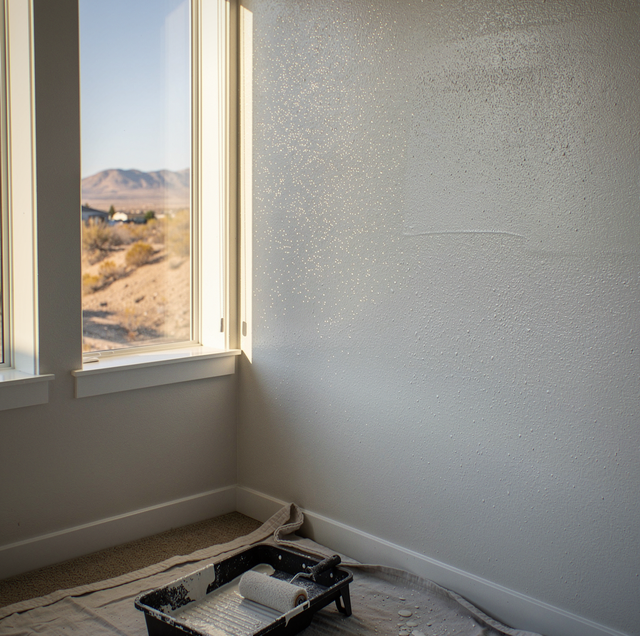
If the air in that room had been still while the film set, the wall would give back one unbroken sheet of light. Light coming in low and off to one side breaks that sheet into points, dozens of them scattered across a surface that reads perfectly smooth from six feet away. Each point is a small solid thing sitting where the film should have closed flat over your wall.
Those points are airborne particulate, and they landed during the window when the coating could still take them. Wind outside a closed window did not put them there. Sanding, sweeping, and people walking past the wall did, and every one of those runs on the crew's schedule rather than on the weather's.
The Window While the Film Is Still Open
Latex paint leaves the can as polymer particles carried in water. Rolled onto your wall, it starts losing that water upward into the room and, on a porous surface, sideways into the substrate. As the water recedes, the polymer particles are drawn closer until they touch, deform against each other, and fuse into a single continuous solid. That fusing turns a wet film into a coating. Until it finishes, your surface stays soft and slightly mobile, and anything that lands on it is held in place.
Under a national standard test method for drying, curing, or film formation of organic coatings, a film is considered dust-free if cotton fibers dropped onto it from a height of 1 inch can be blown off by lightly breathing across the surface. The endpoint is worth thinking about. It measures whether the film still grips what lands on it, and that is a different question from how dry the paint feels to your finger.
The Wetted Particle and the Perched One
What a particle does next depends on when it arrives. Land on a film that is still fully wet and the coating wets the grain on all sides, closes over it, and carries it down as the film shrinks toward its dry thickness. It finishes below the surface with the finish above it continuous. A grain arriving after the surface has skinned gets no such treatment, because the skin is too stiff to flow around it. The particle sits half in and half out, cemented at its base, the rest standing above the plane of your finish.
Fibers behave differently from grains, and the difference reaches past appearance. A lint thread or a stray bristle is long relative to the film's thickness, and a manufacturer's data sheet for an exterior acrylic coating puts the recommended wet film at 4.0 mils and the resulting dry film at 1.4. A fiber several times that length lies across the coat with both ends proud, and as the film shrinks toward 1.4 mils it draws back from the fiber rather than closing over it. What is left is a hair-shaped ridge, your coating thinned along its length.
The Eye Finds It First, the Water Finds It Last
A finish is judged by the distance you actually lean in, with light coming in flat across the wall rather than square onto it. That geometry brings out a particle standing above the film.
Gloss is specular reflection. A smooth film sends light off in one direction, so your eye sees a coherent image of the source; a rough one scatters it, and the image breaks up. A particle standing proud of the surface is a scattering site. That is why sheen affects how much a dusty coat shows: a semi-gloss enamel on a door returns a sharp image, and any interruption in it is visible, while flat paint already scatters light in every direction before a single speck lands.
Your hand picks up what your eye misses. Run your palm across a coat that took fine grit while it was open, and the surface has a faint, even tooth. On a ceiling nobody touches, that goes unnoticed. On a handrail or a door edge, it is the whole complaint, because those are surfaces a household touches several times a day, and the roughness does not wear smooth. It stays exactly as rough as it was on the day the coat set.
The consequence that outlasts both of those has to do with the film's continuity. A coating holds liquid water off wood or stucco by presenting an unbroken layer of fused polymer, and the thinnest point in that layer gives way soonest. A grain sitting half in the film pushes the coating aside as it settles, so the film around its base runs thinner than the film a quarter inch away. A fiber bridging the surface does worse, because the coating pulls back from it along its whole length and leaves a channel instead of a dimple. Neither opens a hole on the day the work finishes. Both give weathering a head start at one specific point, and on an exterior wall that point is the one that lifts first, years ahead of anything else on the coat.
The Dust a Working Room Generates
Sanding puts material into the air and keeps working after the sander stops. The coarse fraction drops out in a minute or two. The fine fraction does not. Under Stokes' law a mineral particle ten micrometers across falls through still air at about eight millimeters a second, clearing an eight-foot ceiling in about five minutes, while a one-micrometer particle falls a hundred times slower and needs around nine hours for the same trip.
Sanding dust comes off the surface and floor on a crew's HEPA vacuum; a broom relaunches the fine fraction, and manufacturer instructions for exterior acrylic coatings call for vacuuming instead.
Everything after that is resuspension. A footfall squeezes air out from under the shoe and carries settled particles up, and dragging a drop cloth across your floor holding sanding residue does the same over a wider area. A room with people working in it never quiets to the level an empty one reaches, so the fine fraction keeps arriving at your wall long after anybody stopped making it.
An exterior coat has its own nearby sources. The ground within a few yards of your wall gets thrown up by a mower or a vehicle on a gravel drive, and the siding sheds material the whole time it is scraped and sanded. Those sit close to the work and run on the crew's schedule, so they can be stopped. The wind is none of those things.
Stopping the Air Before the First Coat
A painter's last job before opening the can is to stop your room's air moving. Someone shuts the system off at the thermostat and tapes plastic over your return grille, and it stays off through the coat and past the point where the film releases what lands on it. The order follows the air: what puts particulate into it comes first and what keeps it out comes last, so the sanding is finished and vacuumed, then the system goes down, then the room is left alone.
A forced-air system does more than stir a room. Its return pulls air through a filter and a duct run that has been collecting material since it was last cleaned, and the supply registers push that air back out at speed, aimed at the walls. Turning your thermostat down does nothing if the fan is set to ON instead of AUTO, which runs the blower between heat calls.
None of this is weather work. A calm day still has a blower cycling and a floor holding what the sander left, and a breezy day with the windows shut and the system off can set a film cleaner than a still one with the furnace running. Site control and sequence determine the outcome, and both sit within a schedule someone writes.
Frequently Asked Questions
Gravity does the sorting. Your walls intercept little of what falls through a room, because the fall is straight down and a wall stands edge-on to it. Lay a door flat across sawhorses, and you have turned its face into a collection surface for everything settling out of the air. That is why your doors and shelves want their own cleared space rather than the room your walls were painted in.
Size. PM10 covers particles roughly 10 micrometers and under, while intact pollen grains range from 10 micrometers up to 100 micrometers. A fifty-micrometer grain falls through still air at around seven centimeters a second and clears a room's height in under a minute, so it lands early and sits proud on the film. The sub-ten-micrometer fraction from sanding stays airborne for hours, and it ends up inside your coat.
Your topcoat follows the contour it is laid over rather than filling it. If your first coat set with a grain standing above the film, your second coat drapes over that grain and reproduces the bump at close to its original height. You will see it in the same raking light that showed it to you before. A particle your first coat had already closed over is the one that stays hidden.
They are different machines. The standard drying test for coatings runs in a well-ventilated room that is free from direct drafts and dust, and that condition is the one you want: exchange without air moving across the wet film. A filter unit running before work starts, drawing from low in the room, takes the fine fraction down before your coat goes on. The same unit discharging at a wet wall drags the film.
It can pick up dust it made. Atomized coating travels as droplets, and those that miss your surface or dry in flight settle as powder wherever the air carries them, including onto the wet film you laid on your wall a minute earlier. A roller atomizes nothing. If your job is sprayed, ask how the overspray is contained, because it is the source your room cleaning will not reach.
It will not. A data sheet's application block lists only what you can put an instrument on: a typical exterior acrylic sheet gives, in the order it prints them, 35 to 110 degrees Fahrenheit for air, surface and paint, a surface temperature at least 5 degrees above the dew point, and a relative humidity ceiling of 85 percent. Dust appears nowhere in it, because it takes a different instrument, which leaves your site and your sequence to settle it.
Settle the sequence and the dust containment before the first coat — if the room still has sanding ahead of it, a finish that cures around the particulate has to come back off and go on again. True Coat Painting serves Reno, Sparks, and Spanish Springs. Call (775) 227-0618.
