
Why Is My Exterior Paint Chalking and Fading So Fast
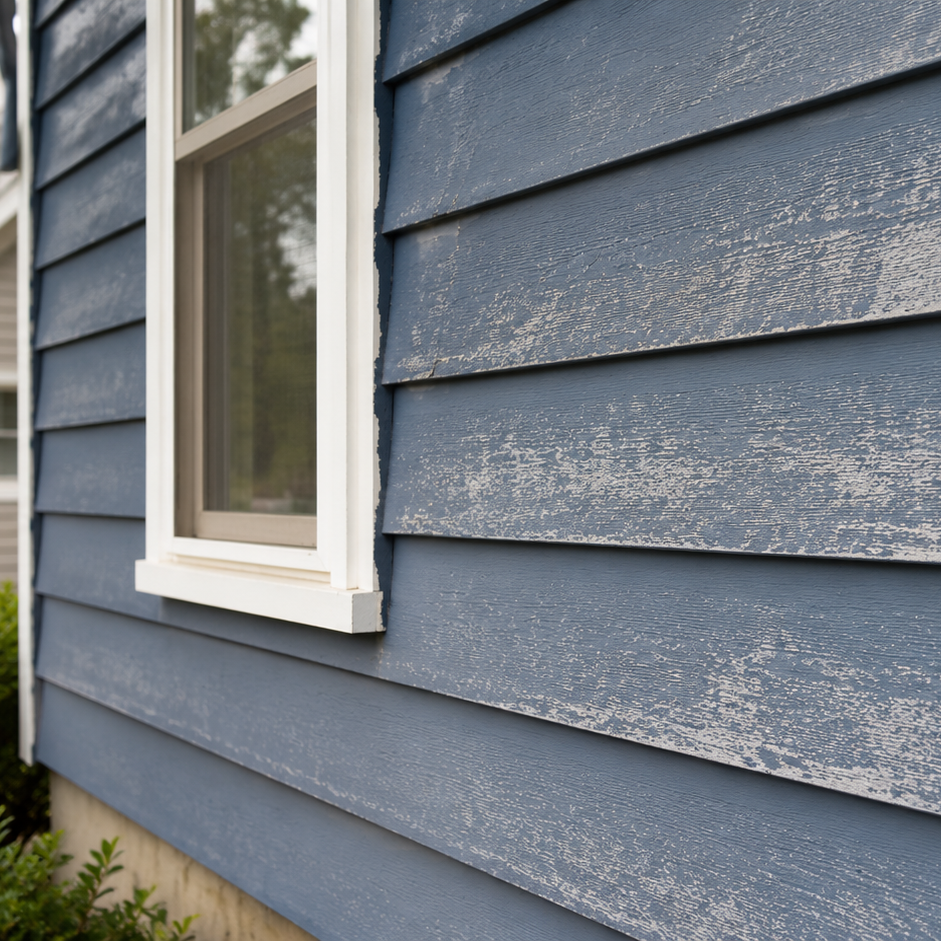
You run a hand down the south wall of the house on a Saturday morning. Your palm comes back coated in a thin layer of pale powder, like dust from a stick of sidewalk chalk. The wall behind your hand looks lighter than the color you remember picking. Maybe even a shade off from the north side, which still looks closer to the original.
That powder is the paint giving up on itself. The color shift is the same problem one step further along. Both are showing you that the binder holding the paint film together has started to break down, and the pigment has nowhere to anchor anymore.
The cause is almost always one of a small handful of things. The fix depends on which one.
What you are actually looking at
Chalking and fading get treated as separate problems. They are not. They are the same chemistry showing up in two different ways.
A coat of paint is pigment particles suspended in a polymer binder. The binder does the work — grips the substrate, holds the pigment in place, and forms the continuous film that keeps weather out. When the binder starts to fail, the pigment loses its grip. The lighter, smaller pigment particles come loose first and end up as the white residue on your hand. The remaining pigment, still partly bonded, looks duller and less saturated than it did when the film was intact. That is the "fade."
So fading is rarely the pigment itself dying. It is the binder failing around it.
| What you see | What it usually means | How fast you should act |
|---|---|---|
| Light powder on a finger swipe, color still close to original | Early surface chalking, normal end-of-life signal | Plan to repaint within 12–24 months |
| Heavy powder, color visibly washed-out on sun-facing walls | Binder breakdown well underway | Repaint this season |
| Powder plus visible bare spots or hairline cracks | Film has lost integrity | Repaint now — substrate is exposed |
| Patchy fading, deeper on some walls than others | Sun exposure or uneven film thickness | Repaint the failed walls; assess the rest |
| White streaks or blotches concentrated on masonry or stucco | Alkali burn — a different mechanism | Wash, neutralize, prime, then repaint |
The table is the quick triage. The rest of this article explains why each pattern shows up.
The mechanism — UV does not wear out paint, it cuts it
The biggest single driver of premature chalking and fading is ultraviolet light. UV is short-wavelength, high-energy radiation, and the polymer chains that make up the paint binder are particularly vulnerable to it. Every time a UV photon strikes the film, it carries enough energy to break a chemical bond inside the polymer. The chain fragments. Then another bond breaks. Across months and years, the long flexible polymer chains the manufacturer formulated get chopped into shorter, brittler pieces.
Once the binder is fragmented, three things happen in sequence. The film loses its flexibility, so daily expansion and contraction starts microcracking the surface. Pigment particles at the surface are no longer fully embedded in binder, so they release with friction — your hand, wind-blown dust, a soft cloth. And UV continues to react with the more sensitive pigment molecules directly, which fades the color even on the bonded surface that remains.
Paint on a south-facing wall ages like a leather jacket left on a dashboard. The leather is still there. The flexibility is gone, and the surface is starting to crumble.
Higher elevation accelerates the process. Every 1,000 feet of altitude raises UV intensity roughly 10 percent because there is less atmosphere to filter it. A house at 4,500 feet takes 40 to 50 percent more UV than the same house at sea level. Light-colored roofs and reflective neighbors send extra UV into the walls. South and west exposures absorb dramatically more than north and east.
Why the bargain paint failed in three years
Two cans of paint that look identical at the store can have wildly different lifespans on a wall. The difference is binder quality.
A high-grade exterior 100% acrylic paint uses a binder formulated to resist UV — usually by including UV-stabilizer molecules that sacrifice themselves to incoming photons before the photons can break the binder itself. A budget exterior paint uses cheaper resin, less stabilizer, lower total binder volume, and more filler. The film looks the same when wet. After eighteen months on a south-facing wall, the difference is obvious. The cheap film is half as thick, the resin chains are shorter to start with, and the UV stabilizers ran out a year ago.
The same pattern shows up on factory-finished siding. Some pre-finished products use a thin baked-on coating that was never built to last more than 7 to 10 years. When it goes, it goes chalky and faded — not peeling.
Why red faded, but the white wall is still fine
Some pigments hold up to UV. Some do not. The chemistry of the pigment molecule decides.
Inorganic pigments — titanium dioxide for white, iron oxide for earth tones — are mineral-based and very UV-stable. A house painted a neutral beige or a soft gray with high-quality acrylic can keep its color for a decade or more.
Organic pigments — the bright colors, especially red, yellow, magenta, and intense blue — are carbon-based molecules. Their chemical structure is exactly the kind of bond UV likes to break. Bright red on a south-facing front door can lose meaningful saturation in two or three years. The same red on a north-facing porch may still look fine because it is getting a tenth of the UV dose.
This is why a homeowner who repaints with the same color sometimes finds the new coat looks shockingly brighter than the rest of the house. The old paint is not faded uniformly — the pigment has changed.
Moisture, alkali, and the masonry exception
UV does most of the chalking damage on wood, vinyl, fiber cement, and other organic substrates. On stucco, brick, and concrete, a different mechanism shows up — alkali burn.
Fresh concrete, mortar, and stucco are highly alkaline. They release lime and free hydroxide ions for years after they cure, especially when moisture is moving through them. Paint applied directly over alkaline masonry without an alkali-resistant primer gets chemically attacked from below. The binder breaks down at the substrate side first. What you see is patchy fading, white blooms, or paint actually lifting away from the wall in small chips that crumble between your fingers.
The fix is different from a UV-driven chalking fix. Power wash, neutralize the substrate with a masonry conditioner, prime with a high-alkali-resistant masonry primer, then apply two topcoats. Skipping the primer and just rolling a fresh coat over an alkali-burned wall gives you a clean look for one summer and a worse failure the next.
Moisture also drives chalking on non-masonry walls. Walls that stay damp from poor flashing, leaking gutters, or sprinkler spray see faster binder breakdown. Water carries oxygen and dissolved compounds into the film, which speeds the chemical reactions that break the polymer. A wall hit by an irrigation head every morning fails roughly twice as fast as a dry wall.
Whether you can just wash and repaint
The first instinct when a chalky wall shows up is to clean it and recoat. That works if the chalking is light and the substrate is sound. It fails badly if it is not.
Loose chalk is a release layer. Anything painted over it bonds to powder, not to the wall behind. The new coat looks great for six to twelve weeks, then starts peeling in sheets because the only thing holding it on is the dust underneath.
The right sequence is washing first — low-pressure water and a stiff brush, until a wet hand no longer comes back chalky. A garden hose with a pump sprayer and a 1-percent TSP-substitute solution does most of the work. A pressure washer above 1,500 PSI on lap siding will drive water behind the boards — useful for cleaning, dangerous if not used carefully. After the wall dries fully, a bonding primer goes down. Then two topcoats of a high-grade 100% acrylic with the right sheen for the wall.
For homes painted in the last three years that are already chalking heavily, the first call is to the original painter or the warranty department of the paint manufacturer. Premature failure that aggressive points to a film-thickness problem or a wrong product, not just UV.
What an honest repaint looks like on a chalky wall
A repaint on a previously chalking exterior is more prep than paint. The work, in order, is something like this.
Walk the house first. Mark every wall that swabs chalky and every soft, punky, or rotted board. Wash the entire exterior with low-pressure water and a chalk-cutting solution, working top down. Let the substrate dry for at least two to three warm dry days — painting over damp siding traps moisture and gives you a brand-new chalking problem in eighteen months.
Spot-prime any bare wood, alkaline masonry, or heavily chalked areas with a bonding or alkali-resistant primer matched to the substrate. Replace any caulk that has hardened, cracked, or pulled away at trim joints. Then apply two full coats of a high-quality 100% acrylic exterior paint, back-rolling where sprayed.
A crew that walks up, pressure washes for 45 minutes, and starts spraying topcoat the same afternoon is not doing the prep this wall actually needs. Ask any painter writing the quote how they confirm the chalk is gone before priming. If the answer is some version of "the primer will bond to it," get a second quote.
FAQs
Take a clean, dark-colored cloth — a navy T-shirt works — and rub a small section of the sun-facing wall. If the cloth comes back with a clear powdery residue that matches the paint color rather than gray atmospheric dust, that is chalking. A light coating that wipes clean with water is regular dust, and the wall just needs a wash, not a recoat.
A small amount of chalking at the end of a paint's useful life is normal — manufacturers actually design some self-cleaning paints to chalk slightly so rain washes the surface clean. Chalking becomes a problem when it shows up early (under five years on a quality paint), when it is heavy enough to coat a hand from a single touch, or when it is paired with visible color loss and bare spots.
South and west walls in the northern hemisphere take three to four times the annual UV dose that north walls do. Combined with longer afternoon sun exposure and higher surface temperatures, those walls age dramatically faster. The south and west exposures often need a repaint a full cycle earlier than the rest of the house.
Darker colors absorb more energy and run hotter on the wall, which speeds binder breakdown. Highly saturated organic colors — bright red, yellow, magenta, and some blues — also fade faster because the pigment molecule itself is UV-sensitive. Whites, beiges, light grays, and earth tones built on iron-oxide pigments hold their color longest.
Painting directly over loose chalk is the single most common cause of a fresh repaint failing within a year. The chalk acts as a release layer, and the new film bonds to powder instead of to the wall. A proper repaint requires washing the chalk off completely and either using a bonding primer or confirming the substrate swabs clean before topcoating.
A two-coat application of a high-grade 100% acrylic exterior paint over a clean, primed substrate lasts 7 to 12 years in most climates, and 5 to 8 years on south and west walls in high-UV regions. Anything failing faster than that points to product, prep, application thickness, or a substrate issue — not normal wear.
The bottom line on a chalky, faded exterior
Chalking and fading are not aesthetic problems. They are the paint film telling you the binder is broken and the wall is losing its weather protection. Light chalking late in a paint's life is a maintenance signal — start budgeting the repaint. Heavy chalking inside the first five years is a product or application problem and worth investigating before throwing fresh paint at it.
The wall in front of you wants three things from its next paint job — a clean substrate with no release layer of dust or alkali, a primer matched to what it sits on, and two full coats of a paint built for the UV dose that wall actually takes. Skip any of the three and the cycle starts over in three years instead of ten.
