
Why Is My Exterior Paint Peeling Off in Sheets
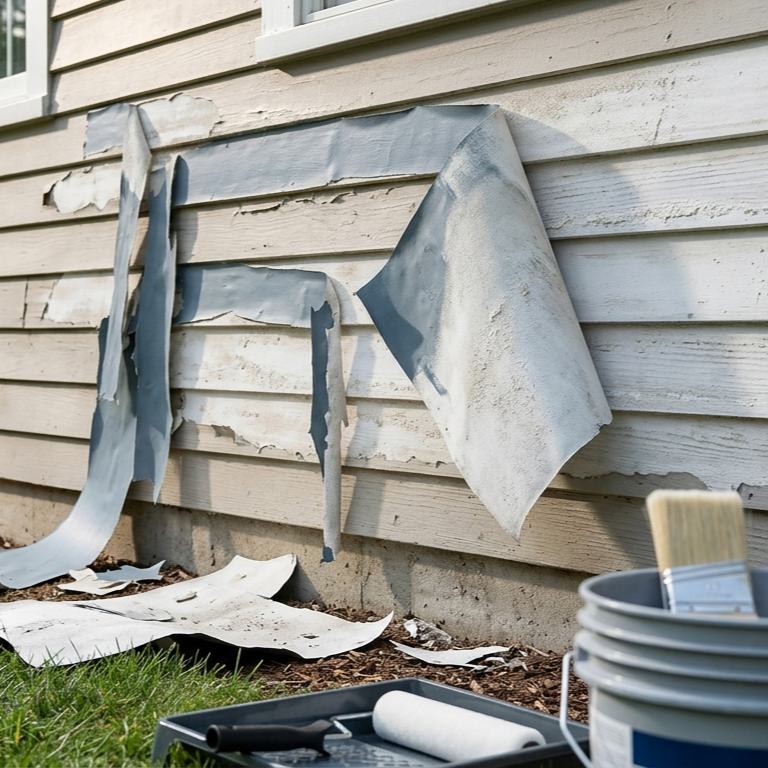
You walk around the south side of the house and notice a curl of paint hanging off a piece of siding. You tug at it, and a strip the size of a dollar bill comes away in your hand. Then a larger one. Ten minutes later, you have a paper bag of paint chips on the lawn and a wall that looks like a topographical map.
That is not normal paint failure. Normal aging shows up as fading, chalking, or hairline cracks. Paint coming off in sheets means the bond underneath the film let go. The paint did its job. Something the paint was stuck to did not.
There are only a handful of reasons this happens, and most are visible if you know what to look for.
Peeling in sheets versus other paint failures
Paint fails in a dozen ways. Cracking and alligatoring show up as a network of fine lines across the surface — usually UV breakdown or paint applied too thick. Blistering shows up as bubbles in the film, from solvent or moisture trapped under fresh paint. Chalking is a powdery residue on a finger swipe, which is the binder breaking down. None of those release the entire film from the substrate in one piece.
Sheet peeling does. The paint is structurally intact when it comes off the wall. You can roll one of the chips between your fingers and feel it as a flexible piece of dried plastic. The failure was not in the film. It was at the bond line — the interface between the new paint and whatever is underneath it.
| What you see | What it usually means | How fast you should act |
|---|---|---|
| Long strips lifting cleanly, chalky residue on the back of the chip | New paint rolled over a chalky old coat | Strip the failed area, wash, prime, repaint |
| Strips lifting with a dark stain or moisture on the substrate | Moisture moving through the wall from inside | Find the moisture source before any repainting |
| Crisp shiny topcoat releasing from a glossy underlayer | Latex applied over a glossy oil or alkyd without a bonding primer | Sand, prime with a bonding primer, recoat |
| Sheets coming off with multiple paint colors layered together | Too many old paint layers, finally too heavy to hold | Full strip to bare substrate on affected walls |
| Peeling concentrated under eaves, behind gutters, or near sprinkler spray | Wet substrate at the time of painting, or chronic water exposure | Fix the water path, dry out the wall, repaint |
The table is the quick triage. The rest of this article explains why each one shows up and what a real fix looks like.
The most common cause — a chalky old coat underneath
Most sheet peeling on an older house traces back to one mistake on the last paint job. The previous painter walked up, pressure washed for forty-five minutes, let the wall dry overnight, and started spraying. The wall looked clean. It was not clean.
Old exterior paint chalks as it ages. UV breaks the binder, pigment loses its grip, and a layer of pale powder builds up on the surface of the film. Run a dark cloth across a five-year-old paint job on a sun-facing wall, and the cloth comes back coated in it. That powder is a release layer. Anything rolled over it bonds to dust, not to the actual wall.
The new film looks beautiful for the first summer. Then a cold winter cycles the wall through expansion and contraction. The chalky dust shifts. Hairline gaps open. Water gets behind the new coat. By the second spring, the homeowner is pulling strips off in sheets and finding the back of every chip dusted in white chalk that matches the original color.
If a fresh peeling chip has powder on the back that matches the old paint color, the bond failure happened at the chalk layer. The new paint is fine. The wall is fine. The release layer between them is the problem.
Moisture moving through the wall from inside
The second common cause is water no one can see. Paint cannot stick to a wet substrate, and walls damp from the inside fail the same way regardless of what coating was used.
Most exterior walls are designed to dry outward. Water vapor inside the house — from showers, cooking, laundry, plants — moves through the wall assembly and escapes through the cladding. When the wall is being asked to dry more vapor than the paint can pass, moisture concentrates just behind the film. Pressure builds. The film lifts.
Bathrooms with bad ventilation are a frequent source on the exterior wall directly behind the shower. Kitchens with no range hood show the same pattern. Laundry rooms vented incorrectly, basements with a high water table, crawl spaces with no vapor barrier — all of them push moisture into the wall cavity that has to escape somewhere. Sprinklers hitting the lower siding are the outdoor version of the same problem. A wall soaked at six in the morning for fifteen minutes a day stays at high moisture content nearly continuously.
The tell is location. Moisture-driven sheet peeling shows up in patches that correlate with a water source — under a bathroom window, on the wall behind the laundry, on the side that takes the morning sprinkler. Cure it by finding the water path and stopping it, not by repainting. A new coat over a wet wall fails on the same schedule as the last one.
Latex applied over glossy oil without a bonding primer
A third pattern shows up on older homes originally painted with oil or alkyd paint and later recoated with latex. The acrylic looks fine for years. Then suddenly, in a hot, dry summer or after a wet winter, large sections release as crisp, shiny sheets that bring the topcoat off the oil underneath.
The mechanism is adhesion chemistry. Oil and alkyd paints cure to a hard, glossy, low-energy surface. Latex relies on the binder being able to physically grip the substrate. A glossy oil surface gives latex nothing to bite into. Without sanding to dull the gloss or a bonding primer to bridge the two chemistries, the latex is essentially stuck to a polished tile.
For a year or two, surface tension and a thin contact layer hold it. As the latex film cycles through temperature and humidity, the contact bond fatigues. When it lets go, it lets go all at once across a large area. The fix is the only one that works — sand the failed section to dull the gloss, prime with a true bonding primer formulated to grip glossy surfaces, then recoat with two topcoats of a quality acrylic.
Too many layers of paint, finally letting go
Some older homes have been repainted every seven to ten years for fifty years. By the time the current owner takes a fresh stab at it, six or seven coats are stacked on the original substrate. Each coat is rigid. Each shrinks as it dries. The cumulative film is thick, brittle, and under constant internal stress.
At some point, the stack gets too heavy for the bond at the bottom to hold. A cold snap, a hot week, or a strong wind event is enough to start it lifting. The peeling sheets come off with three or four distinct paint colors visible on the chip — the painted history of the house in one piece.
The right answer is removing all of it, not just the section that peeled. Stripping the wall to bare substrate, sanding, priming, and repainting is the only durable repair. Spot-stripping leaves the surrounding stack waiting to release on its own schedule, and the same wall is failing again in two or three years.
How to figure out which one is happening on your house
Start with the back of a fresh chip. Powder that wipes off and matches the previous paint color points to a chalky bond layer. Damp wood or visible water staining points to moisture driving the failure. A clean shiny back with a layer of glossy old paint visible underneath points to a chemistry-bond problem between latex and oil. Multiple paint colors stacked on the chip points to layer fatigue.
Then look at where the peeling concentrates. Sun-facing walls with chalk pattern. Walls near a bathroom, laundry, or sprinkler with moisture pattern. Older trim or doors painted decades ago with chemistry-bond pattern. Patches scattered across an old house with no consistent location with layer-fatigue pattern.
Older houses often have multiple problems stacking. A pre-1980 home with sheet peeling under a leaking gutter on a south-facing wall could be chalking, moisture, and layer fatigue at once. Diagnosing the dominant cause is the painter's job. So is being honest about whether one section can be fixed in isolation or the entire wall needs to come down to substrate.
What an honest repaint looks like on a sheet-peeling wall
A repaint on a previously sheet-peeling exterior is far more prep than paint. Walk the entire house first, not just the peeling area. Mark every wall that shows incipient peeling, soft wood, water staining, or chalk on a swabbed swatch. Fix any active moisture source — gutter, downspout, sprinkler head, missing flashing, blocked exterior dryer vent — before any paint goes on. Painting over an active leak is the most expensive mistake on the job.
Remove all loose paint with hand-scraping, carbide scrapers, or feather-edge sanders. Pressure washing alone will not get a sheet-peeling wall to a paintable substrate — the loose paint is loose, but the chalk underneath it is still bonded. Strip back to a stable edge where the remaining paint will not lift when you pull on it. Then wash the entire exterior with a chalk-cutting detergent and low-pressure water, and let the wall dry for at least two to three warm dry days.
Spot-prime any bare wood with a wood primer, any chalked surface with a bonding primer, and any oil-gloss surface with a true adhesion primer. Replace any caulk that has hardened, cracked, or pulled away at trim joints. Then apply two full coats of a quality 100% acrylic exterior paint over the prepped substrate. A crew that arrives, pressure washes for forty-five minutes, and starts spraying topcoat that same afternoon is repeating the mistake that caused the failure in the first place.
FAQs
Pull a fresh chip off the wall and look at the back. If the back is clean and shiny and shows the previous paint color in a single layer, the new paint failed at the surface bond. If the back has powder, dampness, or multiple paint colors stacked together, the failure is somewhere down in the older film, and the new coat was just the last layer to give up.
Painting over an actively peeling wall is the most expensive form of denial in home maintenance. The new coat bonds to whatever was underneath the failure — and that is exactly why the wall is peeling. The fresh paint releases on the same schedule the old paint did, usually within twelve to eighteen months.
Pressure washing makes loose paint look more dramatic, but it does not make the failure worse — it makes it visible. The concern with pressure washing a sheet-peeling wall is driving water behind the siding and into the wall cavity, which adds a moisture problem to whatever caused the original failure. Use lower pressure on lap siding and let the wall dry for several days before priming or painting.
Sheet peeling concentrates where the conditions that caused it concentrate. South and west walls take more UV and run hotter, which accelerates chalking on the old coat. Walls near bathrooms, kitchens, or laundry rooms with poor ventilation get more interior moisture pressure. Walls hit by morning sprinklers stay wet longer. The pattern usually tells you which factor is dominant.
A two-coat application of quality 100% acrylic over a fully prepped substrate — chalk removed, moisture source eliminated, bonding primer where needed, caulk replaced — should run 7 to 12 years on most walls and 5 to 8 years on high-UV south and west exposures. Anything that fails inside three years on a fully prepped wall points to a missed moisture source or a substrate problem the prep did not address.
Not always, but it can be. Persistent sheet peeling tied to chronic moisture is one of the loudest warnings a wall sends before the substrate starts rotting. Soft, punky, or discolored wood under a peeling section means moisture has been there long enough to feed fungal decay. Fix the substrate first, then paint.
The bottom line on sheets of paint coming off the house
Paint peeling in sheets is almost never the new paint's fault. The film that left the wall is structurally fine — it just had nothing solid to grip. Chalk dust between two coats. Moisture pushing from behind. Glossy oil under thin latex. Six layers of history stacked too thick to hold.
The wall in front of you is telling you what went wrong on the last paint job. The next paint job only lasts if it answers what the wall is saying — clean substrate, eliminated moisture source, the right primer for what is actually under the topcoat, and a film built for the sun this wall takes. Skip any one of those, and the sheets come off again in three years instead of ten.
