
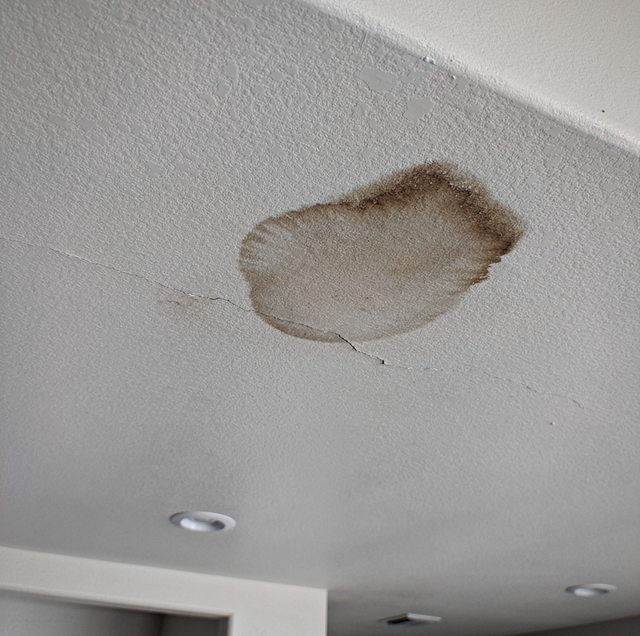
A ceiling that cracks or picks up a stain can be a sign of several problems, and each one leaves its own kind of mark. A hairline crack along a seam points to movement at the taped joint, due to settling, framing shrinkage, or the tape losing its bond. A crack at the corner where the ceiling meets the wall, one that opens wider in one stretch of the year and tightens back up in another, points to the framing above it moving. A brown ring or a yellow haze over a stove points somewhere else again: something soaking into the board or drifting up against it. Reading the mark correctly determines whether the next step is a light patch and a repaint or a call to another trade first. Here are the marks that show up on ceilings, with the likely cause of each and what has to happen before repainting is the right move:
| What You See | Likely Cause | What Happens Next |
|---|---|---|
| Hairline cracks along drywall seams | Joint tape and compound flexing at the seam as the board settles | Painter's fix: sand, re-tape or skim the seam, prime, repaint |
| Corner cracks that open and close with the seasons | The ceiling board pulling slightly at the top wall plate as the framing above it moves | A painter's flexible patch for a small, seasonal gap; a widening or stepped crack needs a framing look first |
| Nail pops, small raised dots or rings in the field of the ceiling | A fastener backing out as the joist dries, or a screw that never fully seated | Painter's fix: reset or add a fastener, patch, prime, repaint |
| Brown water rings | Water reaching the back of the ceiling material and leaving residue as it dries | The leak is fixed first, then a stain-blocking primer goes on before paint |
| Yellowing over a stove or where smoke was | Airborne grease, smoke, or nicotine binding into the paint film | Painter's fix: clean the surface, seal with a stain-blocking primer, repaint |
| Gray shadowing that traces the framing layout | Dust settling unevenly where the ceiling runs cooler over the framing than over the insulated field between joists | Painter's fix: clean, seal with a stain-blocking primer, repaint |
Seam and Tape Cracks
Every seam in a ceiling is a joint, and a joint is where a rigid surface gives first. The field of a drywall sheet is solid board, but the seams between sheets are covered with paper or mesh tape set into joint compound, a thinner, more flexible assembly than the board on either side. As the ceiling settles, or moves a small amount with normal changes in the house, that taped seam is where a hairline crack shows up first, running straight along the joint rather than across open board.
Nail pops belong in the same conversation A nail pop is a small, raised dot, sometimes with a faint ring around it, where a fastener has backed slightly away from the framing behind it, where the joist behind it shrank as it dried, or where a screw never fully seated. The drywall's own weight loosens it over time. It stays a point defect unless several appear in a line along one joist.
Both defects share the same fix, which is cosmetic. A cracked seam gets a light sanding or routing along the line, fresh tape or a skim coat of compound, a sanding pass once that cures, and a spot-prime before repainting. A nail pop gets the fastener reset or a nearby screw added to hold the board flat, a dab of compound over the head, a light sand, and the same spot-prime. Neither calls for anything beyond a painter's patch kit unless the cracking is wider than a seam crack should be or keeps returning in the same spot after a proper repair.
Corner Cracks and Framing Movement
The inside corner where a ceiling meets a wall is two separate surfaces meeting at a joint that was taped the same way a flat seam was. That joint sits directly below the point where the ceiling framing rests on the top wall plate, and the framing lumber changes dimensions slightly as its moisture content shifts throughout the year. A small seasonal swing in that framing is enough to open a hairline gap at the corner in one stretch and let it narrow again in another.
Mark both ends of a corner crack with a light pencil tick and note the date; checking the ticks from the floor across a few months shows whether the crack is growing past them or holding inside them.
A crack that behaves this way, opening and closing rather than only growing, is cosmetic. A painter fills it with a flexible, paintable compound rather than a rigid one, because a stiff patch in a joint that keeps moving will crack again on the same line. What changes the picture is a crack that keeps widening in one direction without closing back, or one that steps down through the drywall rather than running in a straight line. That pattern points to the framing or the foundation beneath it, and it is worth a look by someone who works on the structure before a painter patches it over.
Water Stains
A brown or yellow-brown ring on a ceiling means water reached the back of the ceiling material at some point, spread out as it soaked in, and left behind the dissolved material it carried as it dried. The ring you see is the outer edge of that spread, where the water sat longest before it evaporated. A stain like this is a signal: the water had to come from somewhere, whether a roof, a plumbing line, or condensation building up above the ceiling.
A ceiling that sags or feels soft to a light touch may still be holding water overhead, and the extra weight can cause a sudden collapse. Stay out from underneath it, and have a roofer or plumber find and fix the leak.
Repainting over a water stain without finding the source only hides it for a while; an active leak will bring the same ring back through the fresh paint. The leak gets found and fixed first, full stop. Once the area is dry, ordinary ceiling paint is not the right cover for what is left behind. A plain topcoat lets the residue in the board bleed back up through the new paint as it dries. A stain-blocking primer, applied over the dry, repaired area before any color coat, seals that residue in so it cannot migrate up through the finish.
Smoke, Cooking, and Nicotine Yellowing
Not every ceiling stain comes from water. Grease vapor from cooking, smoke from a fireplace that does not draft cleanly, and nicotine all travel through the air and settle onto whatever surface they meet, and a ceiling above a stove or a fireplace collects it directly. Part of that film bonds to the paint, so a wall cleaner lightens the yellowing without removing it, and what remains can bleed through a new coat.
A related pattern appears without any smoke or cooking at all: faint gray banding that traces the exact layout of the framing above the ceiling. The ceiling surface directly over a joist runs at a slightly different temperature than the insulated field between joists, and airborne household dust settles a little more heavily along that cooler line. Over enough time, it telegraphs the framing pattern right through the paint, even in a room where nothing has ever been burned.
Both problems get the same two-step fix as a water stain, minus the leak search. The surface is cleaned first, since paint will not bond well over a film of grease or soot. A stain-blocking primer goes on next, for the same reason it goes on over a watermark: ordinary paint alone will let the yellowing or gray banding work its way back through a fresh coat.
What Repainting a Ceiling Involves
Once the specific marks are addressed, a ceiling repaint is still its own job. Every crack gets patched, every nail pop gets reset, and every stain gets its stain-blocking primer before any color coat goes on; skipping ahead to paint over unresolved surface problems repaints the same defects back into view.
Flat and matte finishes hide ceiling texture, patch lines, and minor touch-ups better than higher-sheen paints do, which is why a flat finish suits a ceiling even when the walls in the same room get something glossier. A roller with a slightly longer nap handles a textured ceiling better than the short nap used on smooth walls, since it can reach into the texture rather than skating across the high points and leaving the low spots thin.
Order matters too. Patches and primer go down first and get their full cure time, since paint over a primer that is still curing can lift or flash unevenly. The ceiling gets its coats before the walls are cut in along the top edge, so any drips or overlap land on a surface that is getting painted anyway rather than on a finished wall. Working overhead also means more drips find their way back down, so covering the floor and any fixtures below is worth the extra few minutes before the roller comes out.
Frequently Asked Questions
It can come back if the loose tape under it stays in place. A crack filled over with tape that has lost its bond reopens along the same line because nothing beneath the fill is holding. The durable repair cuts out the loose section of tape back to where it is firmly stuck and beds new tape in fresh compound; with mesh tape, a setting-type compound that hardens by chemical reaction is the one that bonds it.
Not from a single pop on its own. One pop is one fastener that lost its hold, and the fix drives a ring-shank nail or a drywall screw just below the surface beside it, where the rings or threads grip the joist that a smooth nail let go of.
Because a stain that looks gone while wet can reappear as the new paint dries. The minerals and tannins stay in the board after the water leaves, and they move into a fresh coat as it dries, so a ring can show through the new paint even over a dry, repaired ceiling. Letting the patched area dry fully and checking it under a raking light will catch any returning ring before the second coat.
Yes. High-heat frying releases grease vapor that settles the same way tobacco smoke does, and a fireplace or wood stove that does not vent cleanly, along with candles burned in one spot, can leave the same yellow-brown film. It shows up wherever the air carrying it drifts before it clears the room, such as above a kitchen doorway.
Yes, if the patch was smoothed flat. A smooth patch on a textured ceiling telegraphs as a flat spot the instant light rakes across it at a low angle, even once it is painted the same color and sheen as the rest of the surface. The texture has to be matched and feathered into the surrounding area before that spot gets primed and painted, not left smooth and coated over.
It depends on the primer type. A shellac-based stain blocker can dry to the touch in under an hour and can be followed by a finish coat the same day. An oil-based stain blocker takes longer, and a water-based one sets its own recoat window on the label; rushing past that window can let the stain bleed through before the primer has sealed it.
Order ceiling crack and stain repair with a full ceiling repaint — seams re-taped, nail pops reset, stains sealed with a stain-blocking primer and the ceiling finished flat. True Coat Painting serves Reno, Sparks, and Spanish Springs. Call (775) 227-0618.