
Do I Need to Prime Before Painting Over Dark Walls
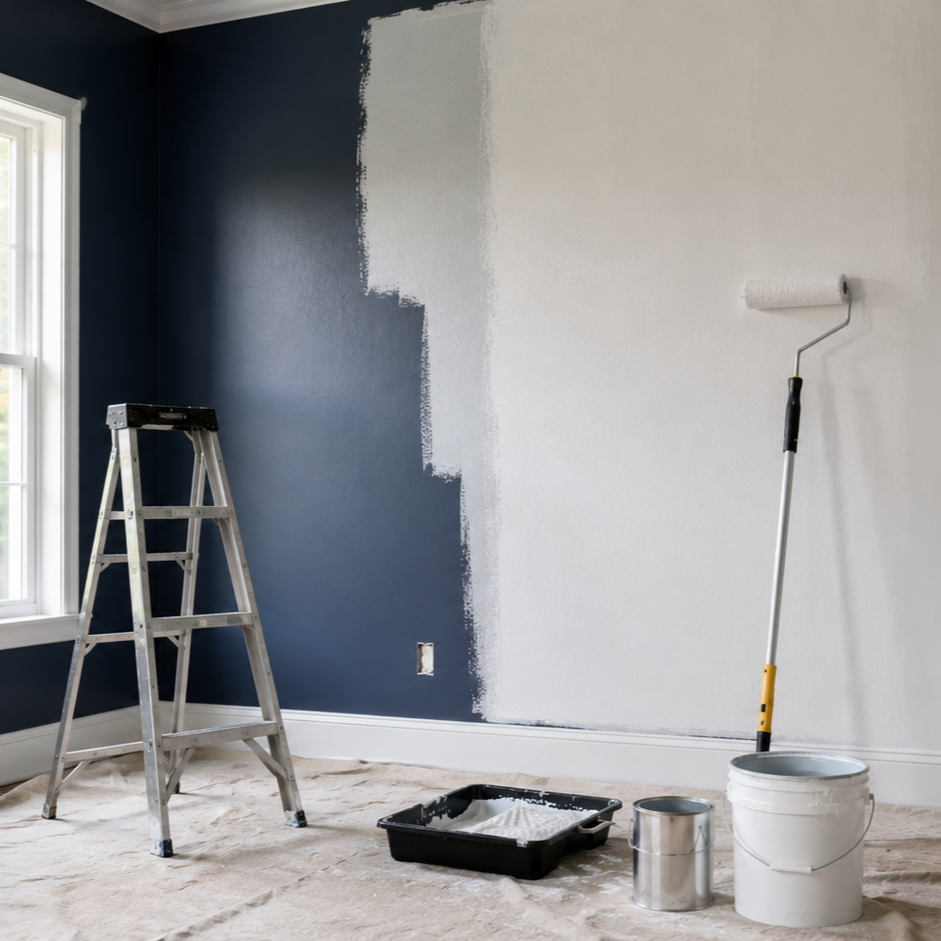
You rolled the first coat of soft white over the navy bedroom wall and it looked fine while it was wet. An hour later, you walked back in with coffee, and the wall looked gray. Not white. Gray, with a darker bruise still showing through wherever the roller hit a corner. You went back at it with a second coat, and the gray got a little lighter. Not white yet. The paint can said "one-coat coverage" right on the front.
The can isn't lying. It just isn't talking about your wall.
The honest answer to whether you need primer over a dark wall is almost always yes, but not for the reason most people think. The real question isn't whether to prime. It's what kind of primer, and whether one coat of primer plus two coats of color will get you done faster and cheaper than four coats of color paint trying to do both jobs at once.
What primer actually does on a dark wall
Wall paint and primer are different products. Paint is built to look good, lay down a uniform color and sheen, and stand up to scrubbing and sunlight. Primer is built to bond to what's underneath, even out porosity, and block what's behind it from coming through.
On a dark wall, the part of the primer that matters most is hide — covering the color underneath in a single coat so the topcoats don't have to fight it. White and off-white wall paints carry pigments designed to look clean and bright, not opaque over deep saturated colors. Some of those bright whites are actually slightly translucent. Roll them over navy, charcoal, or burgundy and the color underneath reads through every coat until enough film builds up to bury it.
A primer coat solves that in one step. Primer is loaded with high-hiding pigments and a binder built to grip what's behind it. One coat takes the wall most of the way to the new color before the finish coats go on. The two topcoats then have a much easier job — bring the color and sheen to spec, not bury a dark base.
Skip the primer and the topcoats do both jobs at once. They do it badly, in three or four coats instead of two.
When you can actually skip primer over a dark wall
Situations where primer is optional are narrower than most homeowners want them to be.
Same color, same finish, sound surface. If the wall is staying navy and you're just refreshing the existing color with the same paint, primer is unnecessary. Two finish coats over a cleaned wall look fresh without anything underneath.
Going slightly darker, not lighter. Going from a medium-dark color to a similar or slightly darker color in the same family — dark gray over medium gray, deeper navy over lighter navy — usually finishes in two coats. The new color has to be at least as saturated as the old one. Going laterally between two saturated colors of different hues is a different problem.
Premium one-coat paint in a low-light room. A premium-tier one-coat paint can sometimes deliver acceptable hide in two finish coats over dark, but only in the same color family and only where the light doesn't rake across the wall. A closet, a laundry room, a back hallway. In a sunny living room, even premium paint usually loses this bet.
That's the list. Everything else, prime first.
When you absolutely cannot skip primer
A few situations turn primer from optional to mandatory.
Dark wall to a light or white color. White, off-white, beige, soft gray, or any other light color over navy, charcoal, forest green, deep red, burgundy, or black needs primer underneath. Without it, you're looking at three to five coats of finish paint and probably still seeing shadow at the corners.
Glossy or semi-gloss old surface. If the dark wall is semi-gloss or high-gloss, the new paint won't grip the slick surface. A bonding primer is mandatory after a light sand. Skip it and the new paint peels off in sheets the first time someone wipes the wall.
Old oil-based paint underneath. Older homes and especially older trim often have oil paint. Latex over oil without a bonding primer is a peel waiting to happen.
Stained walls. Water stains from an old roof leak, smoke staining, marker, crayon, nicotine, and grease all bleed through latex topcoats. A stain-blocking primer — oil-based or shellac — is the only thing that buries those for good.
Patched or skim-coated areas. Joint compound dries porous. Paint sinks into it at a different rate than the surrounding wall, which shows as a dull spot called flashing. A primer coat over patches evens the porosity so the finish coat reads uniform.
| Situation on the dark wall | Primer recommendation | Why |
|---|---|---|
| Same dark color refresh, sound finish | Skip primer | Topcoats only need to refresh, not hide |
| Going slightly darker in same family | Skip primer | New color easily covers old |
| Dark → light or white | Stain-blocking or tinted white primer | Light pigments are translucent over dark |
| Dark → bright saturated color (red, navy) | Gray-tinted primer | Cuts saturated topcoats from 4 to 2 coats |
| Semi-gloss or high-gloss old finish | Bonding primer after light sand | New paint won't grip a slick surface |
| Old oil-based paint underneath | Bonding or shellac primer | Latex won't bond to oil without it |
| Visible stains (water, smoke, marker, grease) | Oil-based or shellac stain-blocker | Latex primer won't block bleed-through |
| Heavy patching or skim coat | PVA or all-purpose primer | Evens porosity, prevents flashing |
| Wallpaper paste residue | Oil-based primer | Locks paste, so latex doesn't reactivate it |
Tinted primer — the trick most homeowners skip
Tinted primer is the difference between a job that takes a weekend and a job that takes two. Most paint stores will tint a gallon of primer for free or a couple of dollars.
For a light finish color over dark, ask for white primer tinted slightly toward your topcoat — a touch of beige if the topcoat is beige, a touch of gray if the topcoat is light gray. The primer stays light enough to bury the dark, and the tint nudges the wall toward the finish so the topcoats have less work to do.
For a saturated finish color over any wall — bright red, deep navy, forest green, mustard — ask for gray-tinted primer. Most paint manufacturers publish a recommended primer gray for each saturated topcoat: a warm gray under red, a cool gray under blue, a darker gray under deep colors. The gray cuts the old color while giving the saturated topcoat a neutral base that won't fight its pigment. A wall that would otherwise need three or four coats of navy finishes in two over the right gray.
For dark over dark in a different hue — burgundy to forest green — gray primer is safer than white. White primer underneath a dark color forces the topcoat to bury the white, too, which sometimes adds a coat.
What primer to grab for which job
The primer aisle has at least six different products. Most homeowners pick the cheapest gallon and end up with the wrong one. Here's what each is for.
| Primer type | Best for | Notes |
|---|---|---|
| Latex all-purpose primer | New drywall, light wall colors, minor patches | Cheapest; weak on stains and oil |
| PVA drywall primer | Raw drywall, skim-coated areas | Formulated for porous drywall |
| Stain-blocking latex primer | Light water stains, mild smoke, color shift | Water cleanup; not strong enough for heavy stains |
| Oil-based stain-blocking primer | Heavy stains, smoke, grease, nicotine, wood knots | Stronger blocker; mineral spirits cleanup; slow dry |
| Shellac-based primer | Severe stains, smoke odor, pet odor, knot bleed | Strongest blocker; alcohol cleanup; very fast dry |
| Bonding primer | Glossy surfaces, oil-painted trim, tile, laminate | Designed to grip slick surfaces |
| Tinted primer (any base above) | Color changes, dark to light, dark to saturated | Free or low-cost tinting at most paint stores |
For most dark-to-lighter color jobs in a normal home, a quality stain-blocking latex primer tinted toward the topcoat is the right grab. Stained walls, smoke damage, or old oil paint underneath calls for oil-based or shellac. Glossy old finish, bonding primer is non-negotiable.
The math: one primer coat saves two topcoats
Homeowners skip primer to save a step. The math usually goes the wrong way.
A gallon of mid-grade interior latex runs $40 to $55. A gallon of primer runs $25 to $40, a few dollars more for shellac or bonding. A medium bedroom takes about one gallon of primer plus two gallons of topcoat for a primed dark-to-light repaint — roughly $130 to $180 in paint.
Skip the primer and the same wall typically needs four coats of finish paint to bury the dark. Four gallons. Roughly $160 to $220. Same bedroom, more paint, two extra hours of rolling and drying, and a worse-looking finish because translucent pigments are doing a job they weren't designed for.
| Approach | Coats | Paint cost | Time on the wall |
|---|---|---|---|
| Skip primer, fight with topcoats | 3 to 5 finish coats | $160 to $275 | 1.5 to 2 days |
| One primer + two topcoats | 1 primer + 2 topcoats | $130 to $180 | 1 day |
| Tinted primer + two saturated topcoats | 1 primer + 2 topcoats | $135 to $190 | 1 day |
The saved coat isn't theoretical. It shows up on the gallon count at the register.
What pros do that DIY usually skips
A few habits separate a primed wall that finishes in two coats from a primed wall that still needs a third.
Spot prime, then full prime. On a wall with patched holes or a few stains, a careful painter spot-primes the patches and stains first, lets them dry, then rolls the whole wall with primer. The spot prime keeps stains and patches from telegraphing through.
Sand glossy surfaces before priming. Bonding primer needs a key — a slight scuff — to grip a glossy old surface. A 220-grit sanding screen over the wall before priming doubles the bond and prevents the peel that shows up months later.
Tint to the topcoat, not to white. White primer under a deep color forces an extra topcoat in many cases. A primer tinted toward the topcoat, or to a recommended gray under a saturated color, is what makes a two-finish-coat job actually finish in two coats.
Cut in with primer, too. Primer cut-ins at the corners and trim line matter as much as the rolled wall. Skipping the cut-in leaves a thin strip of unprimed dark wall along every edge, and that strip shows through the topcoats no matter how careful the finish cut-in is.
FAQs
Usually not, despite the marketing. Paint-and-primer-in-one is a higher-solids, higher-pigment finish paint. It hides better than standard paint and sometimes works for a same-color refresh or a small color shift. Over a true dark wall going to a light color, it still typically needs three coats and the finish often looks slightly less uniform than primer-plus-two-topcoats. For a saturated topcoat over dark, dedicated primer is almost always cheaper and faster.
Yes. For a light or off-white topcoat, a white or slightly tinted white primer is right. For a saturated color, a gray-tinted primer recommended by the paint manufacturer cuts the old color and gives the saturated topcoat a neutral base. For a dark color over dark, medium gray is usually safer than white. The paint store can tint at the counter in a few minutes.
For latex primer at normal room temperature and humidity, two to four hours recoat. For oil-based primer, six to eight hours, sometimes overnight. For shellac, often as little as 45 minutes. Always check the can. Recoating before the primer fully dries traps moisture and causes the topcoat to lift days or weeks later.
For a flat or eggshell dark wall in sound condition, no — a wipe with a damp cloth to remove dust is enough. For semi-gloss or high-gloss, yes — a quick scuff with 220-grit sanding screen breaks the surface so the bonding primer can grip. For walls with peeling paint, scrape and sand the loose edges flush, then spot-prime the bare areas before full priming.
If the new dark color is in the same family or slightly darker, yes. Two finish coats usually cover. If you're going laterally between two saturated colors of different hues, or the old wall has stains, glossy paint, or oil underneath, primer is still the right call.
A primer coat on a medium-sized bedroom adds about two to three hours total — an hour to roll and cut in, then dry time. That's almost always less than the extra finish coats you'd need without primer. On a whole-house repaint, priming the dark walls usually adds a half-day and saves a full day of fighting hide problems with finish paint.
The short version
Primer over a dark wall isn't a tax. It's a shortcut. One coat of the right primer turns a four-coat job into a three-coat job, costs less in paint, and ends with a finish that reads uniform under every light. Skip it only when the wall is staying the same dark color, or going slightly darker in the same family. Every other dark-wall repaint earns its primer coat.
