
How Much Does It Cost to Paint a Whole House Interior
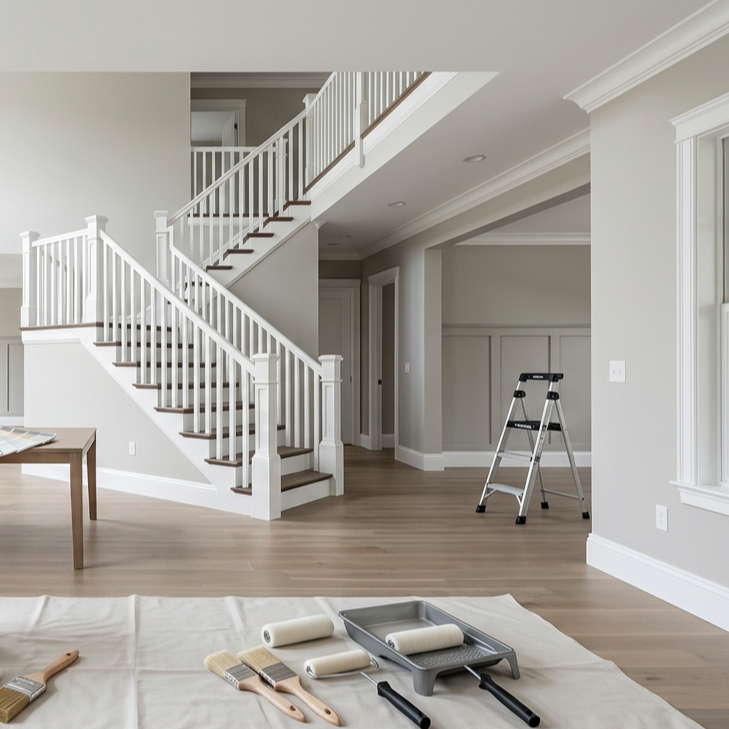
The boxes are still in the garage. You closed on the house three weeks ago, and the furniture truck shows up next Saturday. Every room is empty — beige walls, dust on the baseboards, three sample chips taped above the master bedroom outlet. You've been walking through with a tape measure and a calculator, and the question that won't go away is the one that matters most: how much should the whole interior cost.
Two bids on the counter range from $3,800 to $11,200 for the same house.
Both can be right. The difference isn't markup — it's scope. "Whole-house repaint" can mean five different things depending on which painter is bidding it.
What a whole-house interior repaint usually costs in 2026
For most homes in the U.S. in 2026, a whole-house interior repaint with walls, ceilings, and trim included lands in a predictable band by home size. Use the floor area on your tax record as the rough yardstick. The numbers below assume one-color repainting of walls (two coats), light patching, mid-grade paint, normal door and window count, and a crew-spray-and-roll approach.
| Home size (floor area) | 2026 whole-house repaint cost | Rough crew time |
|---|---|---|
| 1,000 sq ft (small bungalow, condo) | $2,500 – $5,500 | 2–4 days |
| 1,500 sq ft (small ranch, townhome) | $3,500 – $7,500 | 3–5 days |
| 2,000 sq ft (typical 3-bed home) | $4,500 – $10,000 | 4–7 days |
| 2,500 sq ft (mid-size family home) | $5,500 – $12,000 | 5–8 days |
| 3,000 sq ft (larger family home) | $7,000 – $15,000 | 6–10 days |
| 4,000 sq ft (large home, two-story) | $9,000 – $20,000 | 8–14 days |
The low end of each range is a fast same-color refresh on a house in good shape. The high end is the version where the walls need patching, the trim hasn't been painted since the house was built, the ceilings get done too, and the homeowner picked four different colors. Most well-maintained homes between 1,500 and 2,500 square feet land in the $5,000 to $9,000 zone for the version that includes everything. Quotes below that band are usually missing something. Quotes above usually include cabinets, popcorn removal, or a custom feature wall.
Why a whole house costs less per square foot than one room
Bring a painter in to do a single bedroom, and you'll pay $400 to $700 for a 12-by-14 room — roughly $3 to $5 per square foot of floor area. Bring the same painter in for the entire 2,000-square-foot house, and the per-square-foot number drops to $2.25 to $5, sometimes less.
The drop is real. It's also math, not generosity.
A one-room job is like booking a moving truck for a single dresser. The truck still shows up. The driver still loads it, drives it, and unloads it. The cost per item ends up brutal because the overhead is the same as for an apartment full of stuff. Painting works the same way. Driving out, walking the rooms, masking, taping, setting up tarps, opening cans, cleaning brushes at the end — that's three or four hours of fixed overhead on a job with two hours of actual painting in it. Spread across one room, that overhead eats half the bill.
Spread the same setup across twelve rooms, and the overhead shrinks to a small fraction of the total. Most of the time on a whole-house job is rolling, brushing, and cutting in — not setup. The crew moves through the rooms in sequence, drying time in one room becomes painting time in the next, and a skilled team can finish three bedrooms in a day once prep is done. Materials follow the same logic. Paint bought by the five-gallon bucket is cheaper per gallon than paint bought by the can, and a whole-house job uses enough to take advantage of that pricing.
If you are planning to repaint three or more rooms in the next twelve months, it's almost always cheaper to do them all at once. Splitting it into three trips next spring, summer, and fall is the most expensive way to repaint a house.
What "whole house interior" actually includes
This is where bids diverge wildly. "Whole house interior" is a phrase the homeowner uses to mean "all of it." For the painter, it means whatever ended up in the line items.
| Scope item | What it covers | Typical share of total |
|---|---|---|
| Walls | Bedrooms, living spaces, hallways, stairwell walls | 50–60% |
| Ceilings | All ceilings or just specific rooms; popcorn ceilings add labor | 10–15% |
| Trim, baseboards, doors | Casings, baseboards, door slabs, both sides, closet doors | 20–30% |
| Closet interiors | Walls and trim inside closets — often skipped on cheap bids | 3–5% |
| Patching beyond pinholes | Skim-coating, larger drywall repair, water stains, popcorn repair | 5–15% |
A walls-only bid runs 50 to 60 percent of a full-scope bid. That's the gap that makes one painter look like a bargain, and another look expensive when they're really quoting different projects.
Read a bid by line item, not by the bottom-line total. A painter who broke out walls, ceilings, trim, and doors lets you decide which pieces to include. A painter who threw out one number for "whole house interior" without breaking it down has either decided what's in for you or is hoping you don't notice what's not.
Four decisions that move the total
A 2,000-square-foot house can come in at $4,500 or $9,000, depending on the choices the homeowner makes before the first brush gets opened. Four of those choices move the price more than anything else.
Color count is the first. Painting every room the same off-white is the cheapest path. The crew loads one bucket, one color, one cut-in line, and rolls through the house. Painting four different colors across the rooms means four bucket changes, four cut-in passes, and four cleanups. Each color change adds 10 to 15 percent in labor over a same-color job. Add a deep accent wall — navy, charcoal, forest green — and that wall might need a tinted primer plus two topcoats to cover, which is another half-day per accent.
Ceiling work is the second. A flat 8-foot ceiling rolls fast and gets included on most whole-house bids without much fuss. A vaulted ceiling, a tray ceiling, or a 14-foot great-room ceiling needs scaffolding or longer ladders, and the production rate drops by half. Popcorn ceilings move the math further: scraping the texture, skim-coating the drywall smooth, and then painting it can add $2 to $4 per square foot to that ceiling alone. A homeowner who wants the popcorn gone is signing up for something closer to a small drywall job than a paint job.
Trim and doors are the third. Trim painting is slower than wall painting by a factor of two or three. Every linear foot of baseboard, casing, crown molding, and door is cut by hand with a brush. Doors come off the hinges, get sanded, get two coats both sides, and go back on. Painting all the trim and doors adds $1,500 to $4,000, depending on how much trim there is and whether the existing finish is oil-based (slower) or latex (faster). Skip trim, and you save real money. The house just looks half-finished — fresh walls with grime-edged trim is a worse outcome than tired walls and clean trim.
Wall condition is the fourth, and it's the variable a homeowner can't always see in advance. Smooth walls just need a refresh and paint up quickly. Walls with crayon marks, nail holes from a previous tenant, water stains, peeling paint, or wallpaper that needs to come off can double or triple the prep time. A bid that came in cheap on a house with rough walls is a bid that assumed the walls were ready, and "the walls were worse than we thought" is the most common change order in painting.
Cheap bids tend to be cheap because they assumed the walls were ready for paint. The expensive bids are usually the painters who walked the house, opened a closet door, looked at the hallway trim, and added line items for what they saw.
Living in the house during the repaint
Schedule matters as much as price on a whole-house job. A 2,000-square-foot interior takes a competent crew four to seven working days. That's a week the family is sharing the house with painters, paint cans, drop cloths, fan smells, and rooms that can't be slept in or cooked in until they're dry.
Two ways to handle it.
The first is staged. The crew paints one section at a time. Bedrooms first while the kitchen and living areas stay usable. Then living areas while the family sleeps in finished bedrooms. The kitchen gets done over a weekend when meals can happen out of the house or in the dining room. This stretches the project by a day or two but lets the family stay put.
The second is empty-house. The family moves out for the week, the crew runs the whole house at once with no staging, and the job finishes faster. Common during a move-in, between tenants in a rental, or for homeowners who'd rather rent an Airbnb for five nights than live through paint smell. Empty-house jobs finish 20 to 30 percent faster because the crew doesn't have to mask, unmask, and re-mask different sections each day. The bid usually comes in a little lower for the same reason.
A few small things speed both versions. Furniture clustered in the center of each room and draped before the crew arrives. Picture frames, switch plates, curtain rods, and wall art down before day one. Closet contents bagged or moved into one closet that gets painted last. And color decisions made before the crew shows up — every "let me think about it" delay holds up a room.
Paint smell on a modern interior job is mostly about chemistry. Low-VOC and zero-VOC paints air out in hours instead of days, which is why most crews use them by default. Older oil-based trim paint takes longer to off-gas — one reason most painters now use waterborne alkyd trim, which behaves like oil for hardness and dries like latex for smell.
FAQs
Most painters supply the paint, and the math usually favors letting them. Painters buy at contractor pricing — sometimes 30 to 40 percent below retail — and pass some of that through in the bid. They also know how much paint the job needs and how much primer to keep on the truck for surprises. Homeowners who supply their own paint usually overbuy and end up with five gallons of leftover wall paint in the basement for ten years. Exception: if you want a specific premium brand the painter doesn't normally stock, supplying it yourself can make sense.
This varies more than it should. Most quotes include moving small furniture to the center of each room, draping floors with drop cloths, and masking trim. Large furniture — pianos, heavy armoires, big sectionals — is often the homeowner's responsibility, or it carries a separate line item. Floor protection beyond a basic drop cloth (rosin paper on hardwoods, plastic film over carpet) is sometimes extra. Ask before signing. The bid that didn't mention furniture probably didn't budget for moving it.
A 1,500 to 2,500-square-foot home with a crew of two or three painters takes four to seven working days. Larger homes or homes with heavy patching, popcorn ceiling work, or wallpaper removal can stretch to two weeks. A single painter working alone takes longer — sometimes twice as long. If a bid quotes the same timeline as a crew bid but only one painter is showing up, something doesn't add up.
Sometimes, but less than people expect. The crew is already in the house. Skipping two bedrooms saves maybe 15 percent of the bid, not 25 percent, because most of the setup, cleanup, and material costs are fixed. The DIY rooms also tend to look noticeably different from the pro rooms — different brush technique, different roller marks, sometimes a different sheen. If the goal is a uniform whole-house look, paying the crew for everything is usually worth the money. If the goal is just to refresh a couple of bedrooms before a kid moves back in, DIY makes sense and the crew handles the rest.
Faster than most renovations. Interior paint is one of the few home-improvement items that returns close to its cost — sometimes more — when a house is being prepared for sale. Realtors routinely suggest a whole-house repaint in neutral colors before listing because fresh paint signals a well-maintained home and makes every other feature look better in photos. A $6,000 repaint often shows up as $10,000 to $15,000 extra on the closing price for a typical home.
The math worth checking before you sign anything
In 2026, a whole-house interior breaks into three tiers across most of the U.S. — $3,000 to $5,500 for a small home, $5,000 to $10,000 for a typical home, $9,000 to $20,000 for a large home. Inside each tier, the bid lands toward the high end when scope includes ceilings, trim, doors, and closets, and toward the low end when it's walls-only on a house in good shape.
Three things are worth checking on any whole-house bid: what's included by surface, what the timeline looks like in working days, and what happens if the crew finds something they didn't expect once the furniture is moved. A bid that's clear on all three is one you can compare to anything else.
The painter who deserves the job is the one who treated the walk-through as the actual job — opening closet doors, peering at trim corners, asking which ceilings have popcorn texture. That painter shows up on day one with a number that fits the house. The painter who quoted from the entry shows up on day one with surprises.
