
Epoxy vs Polyaspartic Garage Floor Coatings: Which Is Better
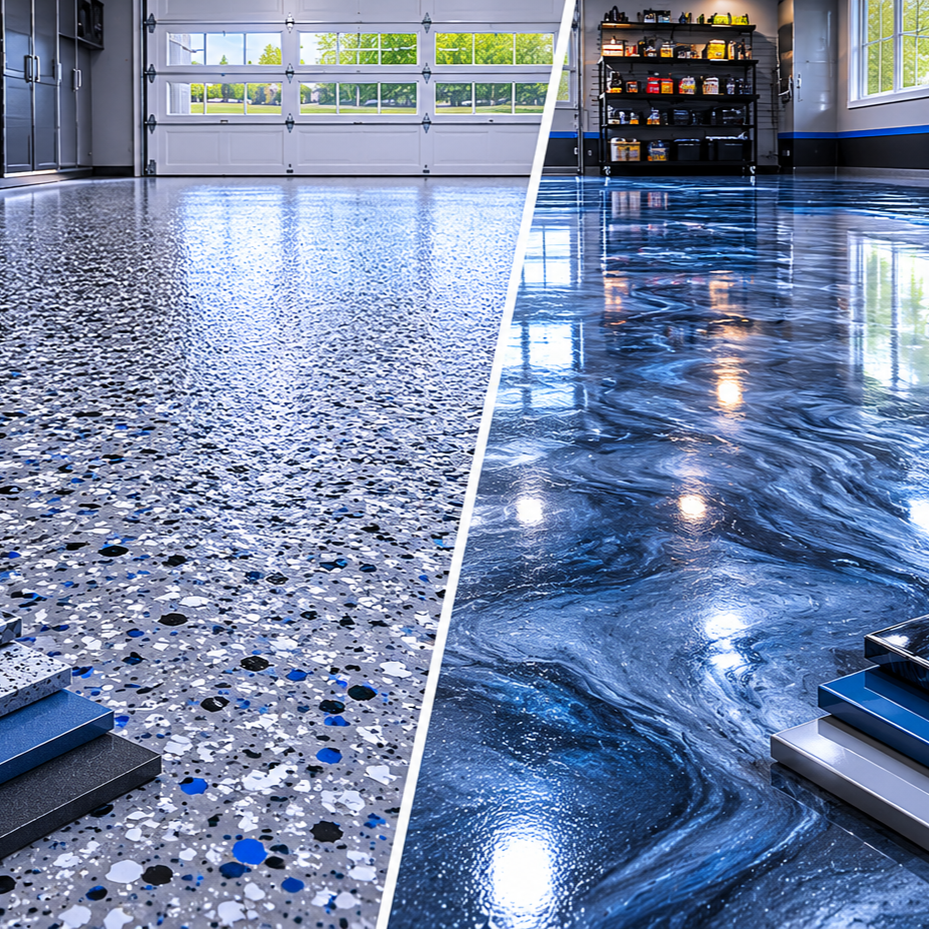
Two installers walked the same garage on the same afternoon. One quoted a three-day epoxy floor with flake. The other quoted a one-day polyaspartic system. Both pulled up product brochures on their phones. Both said their chemistry was the right answer. Both said the other system would fail inside five years.
They were each partially right. They were also each partially wrong.
Epoxy and polyaspartic aren't interchangeable, and they aren't really direct competitors. They're two different chemistries with different strengths. Once you see what each one is actually doing, the choice stops sounding like Coke versus Pepsi and starts looking like picking the right tool for the slab.
What epoxy actually is
Epoxy is a two-part thermoset resin. Part A is the resin, Part B is the hardener. Mix them and a chemical reaction starts — slow, exothermic, and irreversible. Over hours, the mix gets thicker. Over days, it cross-links into a hard plastic film bonded to the surface it was poured onto.
That slow cure is both the gift and the curse of epoxy. Slow cure means the chemistry has time to wet out the concrete — to flow into the pores, displace air, and grip the substrate mechanically. That's why a 100%-solids epoxy on a freshly ground slab is one of the most reliably bonded coatings in the trade. It's also why a full epoxy floor takes five to seven days from start to drive-on, and why temperature matters: most epoxies want the slab between 60 and 85 degrees during cure or the chemistry stalls.
Pro-grade epoxy — the kind a contractor applies, not a thinned-down DIY kit — builds film thickness in a single coat. Fifteen to twenty mils of dry film from one pour is normal. That thickness is what protects the slab from impact and abrasion for years.
The weakness of epoxy is sunlight. Standard epoxies are aromatic — meaning the molecule includes ring structures that absorb UV. The UV breaks those rings, the polymer chains fragment, and the surface yellows, then chalks. Inside a closed garage that almost never matters. Near a window, a translucent garage door, or any door left open during the day, it matters within a year or two.
What polyaspartic actually is
Polyaspartic is an aliphatic polyurea — a faster, more flexible cousin in the polyurethane family. The cure mechanism is different from epoxy. Instead of two chemicals reacting with each other over hours, polyaspartic cross-links rapidly in the presence of trace moisture and reaches a hard film in 30 to 90 minutes.
The word "aliphatic" matters because the molecule doesn't include the UV-absorbing rings that make epoxy yellow. Polyaspartic on a south-facing concrete driveway looks the same in year five as it did the day it went down. The film is also harder, more flexible, and more chemical-resistant than epoxy. A polyaspartic at full cure measures around 85 Shore D — ten points harder than a typical epoxy.
Here's the counterintuitive part. The harder epoxy actually scratches more easily than the slightly softer polyaspartic. Epoxy is rigid. When a steel jack stand drags across it, the rigid film fractures along the scratch line. Polyaspartic has just enough flexibility to absorb that energy instead of breaking — the surface dimples and recovers where epoxy chips and stays chipped.
What polyaspartic gives up is workability. Pot life from mix to gel runs 20 to 45 minutes, sometimes less in warm or humid conditions. The applicator has minutes — not hours — to spread, broadcast flake, and back-roll before the material flashes. On a 500-square-foot garage that means a crew of two working fast. On a 2,000-square-foot shop it means five people and military timing.
The other catch is cost. Raw materials for a polyaspartic-only system run roughly double what comparable epoxy materials cost in the same bucket size. The premium reflects the chemistry itself, not contractor markup.
Head-to-head — where each one wins
The marketing on both sides oversimplifies. A fair comparison lines them up by what they actually do in the field.
| Performance category | 100%-solids epoxy | Polyaspartic |
|---|---|---|
| Walk-on time | 12 – 24 hours | 1 – 2 hours |
| Drive-on time | 5 – 7 days | 24 hours |
| UV stability | Yellows; chalks in 1 – 3 years of sun | No yellowing for 10+ years |
| Hardness (Shore D) | 75 – 80 | 80 – 85 |
| Scratch resistance | Lower (rigid, fractures) | Higher (slightly flexible) |
| Abrasion resistance | Good | Excellent (2 – 3× epoxy) |
| Chemical resistance | Good for most automotive fluids | Better against acids and solvents |
| Application temperature | 60 – 85°F | 0 – 100°F on most products |
| Behavior on minor slab flex | Telegraphs cracks | Absorbs small movement |
| Pot life from mix | 30 – 60 minutes | 20 – 45 minutes |
| Material cost per sq ft | $1.50 – $3 | $3 – $5 |
| Field lifespan in a garage | 5 – 10 years | 10 – 20+ years |
The table doesn't pick a winner. It tells you who's stronger where. Epoxy wins on price, bond reliability, and forgiveness of imperfect application. Polyaspartic wins on speed, UV stability, scratch and abrasion resistance, and field lifespan — at a cost premium.
The two aren't interchangeable. And that's why most serious commercial and high-end residential installs don't use either chemistry alone.
The hybrid system most pros recommend
The standard premium garage floor in 2026 isn't pure epoxy or pure polyaspartic. It's a hybrid stack designed to use each chemistry where it's strongest.
The bottom layer is usually a moisture-tolerant epoxy primer. Epoxy's strength is bonding to concrete, especially slabs that aren't perfectly dry. The slow cure lets the resin soak into the open pores and lock itself to the substrate. This layer is the foundation everything else sits on.
The middle layer is a colored basecoat with broadcast flake. The basecoat can be another epoxy or a pigmented polyaspartic, depending on the system. While it's still tacky, the installer broadcasts vinyl color chips — sometimes called flakes — until the surface refuses to take any more. The flake adds texture, slip resistance, depth, and helps mask future scratches.
The top layer is a clear polyaspartic. This is the layer that takes the abuse — tire heat, dropped tools, road salt, sunlight from an open door. Polyaspartic's UV stability, hardness, and flexibility protect the cheaper, more deeply bonded epoxy underneath. The combined system runs 15 to 25 years in residential garages without needing a recoat.
A hybrid system costs more — typically $6 to $12 per square foot installed. The math still works out better than redoing a cheaper floor every five or six years. A $4,500 hybrid floor on a two-car garage lasting 18 years runs about $250 a year. A $2,200 single-coat epoxy stripped and recoated every six years runs closer to $370 a year over the same span.
When pure epoxy is still the right answer
Hybrid doesn't always make sense. Pure epoxy still earns its keep in three situations.
A garage with no direct sunlight — no windows, no translucent door, no door left open during the workday — never sees the UV that breaks down epoxy. Yellowing isn't a problem if the only light hitting the floor is a ceiling bulb.
A budget-driven residential install where the homeowner needs the floor to look good and hold up for five to seven years, not twenty. A 100%-solids epoxy with a colored topcoat fits that bill at half the cost of a hybrid. Some homeowners would rather coat the floor twice in two decades than pay double up front.
A basement or workshop slab with known moisture issues. Moisture-tolerant epoxies bond better to damp concrete than polyaspartic does. If a calcium chloride moisture test reads above about 4 pounds per 1,000 square feet per 24 hours, the epoxy primer is doing real work that polyaspartic alone can't match.
When pure polyaspartic is the right answer
Polyaspartic-alone makes sense in a smaller set of cases — usually where speed or weather forces the decision.
A working garage that can't be out of service for a week. A polyaspartic floor goes from bare concrete to drivable inside 24 hours. For a body shop, a fleet garage, or a one-car household, that turnaround is worth the premium.
Cold-weather installs. Most epoxies stop curing below 50°F. Polyaspartics keep curing well into the 30s and 40s, and some product lines work near zero. For a garage that has to be coated in late fall or early spring, polyaspartic is sometimes the only chemistry that physically cures.
Driveways and exterior concrete that see direct sun. A pure polyaspartic — sometimes with a quartz broadcast instead of flake — handles full UV and abrasion better than epoxy, and the cost premium pays back because redoing exterior concrete is expensive.
How to read a quote that mentions both
Some installers will quote "epoxy" but actually mean a hybrid system with a polyaspartic topcoat. Some will quote "polyaspartic" but mean a single-coat application without an epoxy primer underneath. The label on the bid is not a reliable description of what's actually going down.
A quote worth comparing names each layer separately — primer, basecoat, flake or no flake, topcoat — and identifies the chemistry of each. It also names a manufacturer and product line for at least the topcoat. A bid that just says "two-coat epoxy system, color of your choice" is a placeholder for whatever happens to be in the truck.
There's one more tell. One-day installs that pack grind, basecoat, flake, and polyaspartic topcoat into a single eight-hour push sound great in a sales pitch. The catch is that the topcoat goes down late in the day with tired installers on a basecoat that may not be tacky in the right way. A two-day install — grind and basecoat on day one, flake set and topcoat on day two — gives every layer time to do its job.
FAQs
For most residential garages, yes — but usually as a topcoat in a hybrid system, not on its own. The polyaspartic layer is what gives you UV stability, scratch resistance, and a 15-to-20-year service life. Used by itself without an epoxy primer underneath, it still works on a clean, freshly ground slab, but you lose the deep bond into concrete that the epoxy provides. A hybrid stack gets you both at a smaller premium than going pure polyaspartic.
Sometimes, with conditions. The existing epoxy has to be clean, dry, and well-bonded — no peeling, no loose flake, no hot-tire pickup. The surface needs to be screen-sanded and solvent-wiped first to give the polyaspartic something to mechanically and chemically grip. Most contractors will only do this on coatings less than five years old that are still in solid shape. Old, weathered epoxy gets ground off and started over.
Walk-on in one to two hours, light traffic in eight to twelve hours, full vehicle return in 24 hours. Compare that to epoxy's 12 to 24 hours to walk on, 48 hours to light traffic, and five to seven days for vehicles. The cure-time gap is roughly five-fold. In a residential garage that means a Friday install can be a Saturday-drivable floor — versus a Monday install with the car parked outside until the following weekend.
Less often than epoxy does. Polyaspartic stays slightly flexible at full cure — somewhere between a hard plastic and a tough rubber — so small slab movement gets absorbed instead of telegraphing through the coating. That doesn't make it crack-proof. Active structural cracks still need to be chased out and filled with a flexible crack filler before any coating goes down. Working slab joints have to be honored in the finished floor, not coated over flush.
On day one, mostly yes. Both can be tinted to the same color, both can hold the same flake broadcast, and both finish to a similar gloss. The visible difference shows up over time. An epoxy floor in a garage with any direct sun yellows by year two and chalks by year four. A polyaspartic topcoat in the same garage looks essentially unchanged at year seven. In a fully enclosed basement or interior space with no sunlight, the two finishes look nearly identical for years.
Yes — both, when applied as a real system with proper prep. Hot-tire pickup happens when the tire's plasticizers migrate into a coating that's still too soft, and the tire physically lifts a piece of finish off when it cools. The fix isn't choosing one chemistry over the other; it's making sure the system has cured fully before driving on it, and that the slab was clean enough during install to give the coating a real bond. DIY kits with thin film build and poor prep are where most hot-tire failures live. Real systems — epoxy or polyaspartic — survive summer driving without issue.
Picking the system that fits the slab
The honest answer to "epoxy or polyaspartic" almost always starts with another question: what does this slab need, and how long do you want the floor to last.
A clean, dry, sun-protected garage where the owner plans six to eight more years in the house does beautifully with a 100%-solids epoxy at half the cost of a hybrid. A high-traffic working garage in direct light, a driveway, or a forever home with a 20-year plan deserves the hybrid stack. A garage that needs to be back in service tomorrow is the polyaspartic-only case.
