
Flake vs. Metallic Epoxy Floors: What Actually Sets Them Apart
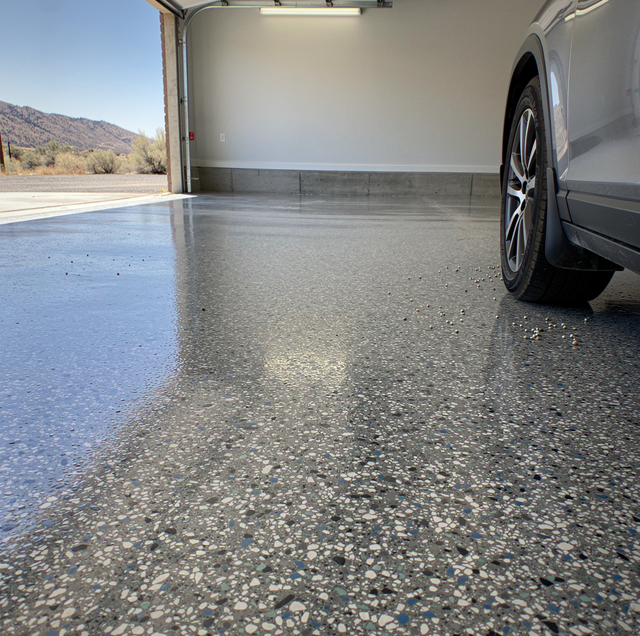
A flake floor is scattered with small flecks of color under a hard, glass-clear finish. A metallic floor seems to shift and ripple as you cross it, catching the light differently with every step. The look is what gets compared first. The real difference sits underneath: a flake floor and a metallic floor aren't two colors of the same coating; they're built in a different order, and that order is what decides how each one wears, hides dirt, and takes a repair.
Both start as an epoxy or polyaspartic system applied over prepared concrete, and both end up as a hard, sealed floor a homeowner can park a car on or push a shop stool across. What happens in between, the sequence of coats and how each one gets its texture, is the actual decision buyers are making when they pick between the two, whether or not the person selling it frames it that way.
How a Flake Floor Is Built
A flake floor starts with a pigmented base coat rolled onto the prepared slab, the same first step used on almost any coated concrete floor. While that base coat is still wet and tacky, an installer broadcasts vinyl color chips across it, either by hand from a bucket or with a hopper gun in larger rooms, at a coverage rate that ranges from a light scatter that leaves base coat visible to a full broadcast where chips cover the surface edge to edge. Once the base cures, the loose chips that never bonded are swept and vacuumed off, leaving only those embedded in the coat. A clear topcoat, epoxy, or polyaspartic then gets rolled over the whole floor, filling in around every chip and burying the broadcast layer under a hard, level, protective film.
That sequence is why a flake floor's texture and thickness trace back to the chips themselves. The topcoat follows the contour of what's underneath, preserving that shape as it seals it, so the finished surface reads as slightly textured even though it's sealed under a continuous clear film. A full broadcast floor is also measurably thicker than a bare two-coat paint job, because the chip layer adds real material between the base and the topcoat.
How a Metallic Floor Is Built
A metallic floor also starts with a pigmented base coat, usually a mid to dark solid color that sets the field the metallic effect will float over. From there, the two systems diverge. Nothing gets broadcast onto that base. The metallic pigment, typically a mica-based reflective powder, gets mixed directly into the topcoat before it goes down. While that pigmented topcoat is still wet, the installer works it across the floor with a trowel, a squeegee, or, in some methods, a burst of compressed air, physically moving the material to develop swirls, cells, and lacing before it begins to set. Once the pigmented topcoat cures, a clear finish coat is applied over the whole floor, sealing the pattern beneath a hard, glossy film.
Because that pattern stems from how the wet material was moved during a specific pour on a specific day, a second application can't reproduce it. Two metallic floors poured from the same pigment blend, by the same installer, in the same week, still come out with different patterns, since the movement that creates the effect occurs in real time and only once.
| Flake Floor | Metallic Floor | |
|---|---|---|
| Where the texture comes from | Broadcast chips embedded under the topcoat | Movement worked into the wet topcoat itself |
| When the look is set | After the chips are broadcast and swept | During the pour, before the topcoat sets |
| Can the exact look be repeated | Yes, the chip blend is a manufactured product | Every pour develops its own pattern |
Which Surface Gives Better Footing
Slip resistance comes down to how much texture each system has to start with. A flake floor's texture comes from construction: the topcoat sits over an uneven, chip-studded surface, and that unevenness carries through even though the film covering it is smooth and continuous. That gives a flake floor more texture to start from than a metallic floor does, though a thick, glass-clear topcoat over broadcast chips can still make it slick once it's wet.
Neither system is safe to leave bare wherever water tracks in. A metallic floor's self-leveling topcoat cures glass-smooth with no texture at all, and a flake floor's topcoat can still go slick wet at a garage entry or basement stairwell landing.
A metallic floor starts with less texture than that, since the whole point of the technique is a smooth, glass-like plane for the pattern to read clearly through. Wherever water gets tracked in from outside, both systems end up leaning on the same fix: an anti-slip additive broadcast into the final coat before it cures.
Installers broadcast a fine aluminum oxide additive into the final coat to add grip. It's a standard add-on for any coated floor, flake or metallic, that sees water tracked in from outside.
Which One Hides Wear, Dirt, and Daily Use
A busy, multi-color flake pattern breaks up the surface visually, so tire marks, dust, hairline scratches, and small stains blend into all that scattered color and lose their outline against the pattern. A dark, glossy metallic floor works the opposite way. Because the surface reads as one continuous field of color and light, anything that interrupts it- a footprint, a thin scratch, a ring of dried water- stands out clearly against that continuous field.
That difference tracks with what actually lands on the floor day-to-day. A working garage generates grit, oil film, and tire dust on a near-daily basis, the exact kind of mess a flake pattern is built to visually absorb. A showroom, a finished basement, or a retail floor usually sees foot traffic and an occasional spill, well short of the grease and grit a working garage takes on daily, so the visibility a metallic floor trades away in a garage matters less in a space that stays cleaner to begin with.
What Happens When One Gets Damaged
Repairability is where the two systems pull apart the most. A flake floor is built from hundreds of small, randomly scattered chips under a clear film, so a repair can grind out the damaged spot down to bare concrete, lay in a fresh base coat, broadcast a reasonably matched blend of chips into that patch, and roll a new top coat over it. Because the original surface was already random, a well-matched patch settles into that randomness and reads as part of the floor.
A metallic floor doesn't have that forgiveness. The pattern across the whole floor came from one continuous, wet pour applied by hand in a single day, and a repair is a second pour, made under different conditions, using a different set of hand movements. Grinding out a section and repouring metallic into it creates a new, self-contained pattern that can echo the color palette of the original but can't match its specific swirls and cells. A metallic repair reads as a repair; there's no equivalent to loose flake chips that simply get swept back into place.
The Slab Problem Neither System Can Fix
Both systems bond to the same underlying layer: cured, mechanically profiled concrete. Moisture moving up through a slab from below attacks the bond between the coating and the concrete itself, a mechanism that has nothing to do with whether the film on top carries embedded chips or suspended metallic pigment. A coating that seals a slab still pushing vapor upward traps that moisture against the concrete, and the pressure that builds underneath eventually works the film loose from the bottom up, no matter which of the two systems is on top.
That's why the substrate question comes before the pattern question. A slab that hasn't been tested and prepared for moisture will eventually push either coating loose on a similar timeline, for the same underlying reason, no matter which one was chosen for the look. The same holds for day-to-day wear under tires and chemical spills: installation quality and system grade decide how long a floor holds up more than which of these two builds a buyer picks.
Frequently Asked Questions
Some installers run a metallic field in the main area with a flake border or accent strip along walls and edges, since both techniques share the same pigmented base-coat step before the methods diverge into two separate zones handled with two separate application steps.
The reflective pigment used in most metallic systems is mica-based, and as the wet topcoat gets worked with a trowel, tiny variations in coating thickness and small air pockets form beneath the surface. Light bounces off the suspended particles differently at those different depths, and that variation is what reads as movement or dimension in a surface that's actually flat to the touch.
It runs the other way. Flake color chips get sold as standard multi-color blends, but an installer can hand-blend individual chip colors from separate bins to hit a specific custom look. Metallic pigment is typically sold as a fixed set of premixed powder colors meant to be used as-is, so the color flexibility on a metallic job comes from choosing among those set colors, since blending powders on-site isn't standard practice.
It can. Warmer material and a warmer slab shorten the working time before the topcoat begins to set, reducing the time an installer has to develop swirls and cells before the pattern locks in. A cooler pour extends the working window, giving more time for movement in the pattern before it firms up.
Not exactly. A sample board or photos of a past job by the same installer show the general character of a color combination, how bold the contrast is, and whether it leans warm or cool. The actual swirls and cells on the finished floor still come from that specific day's pour, so what a sample board previews is the color palette; the finished pattern only exists once the floor is poured.
It can be, and the reason has nothing to do with which system goes down. A basement slab typically sits closer to groundwater than a garage slab, which increases the likelihood of moisture rising through the concrete from below. That's the same mechanism that pushes either coating loose from underneath over time, so vapor testing before the floor goes in carries more weight in a basement than it does in a typical garage.
Get a free flake or metallic floor estimate — we will walk the slab with you and match the system to how the room actually gets used. True Coat Painting serves Reno, Sparks, and Spanish Springs. Call (775) 227-0618.
