
Why Is My Deck Stain Peeling After Only One Year
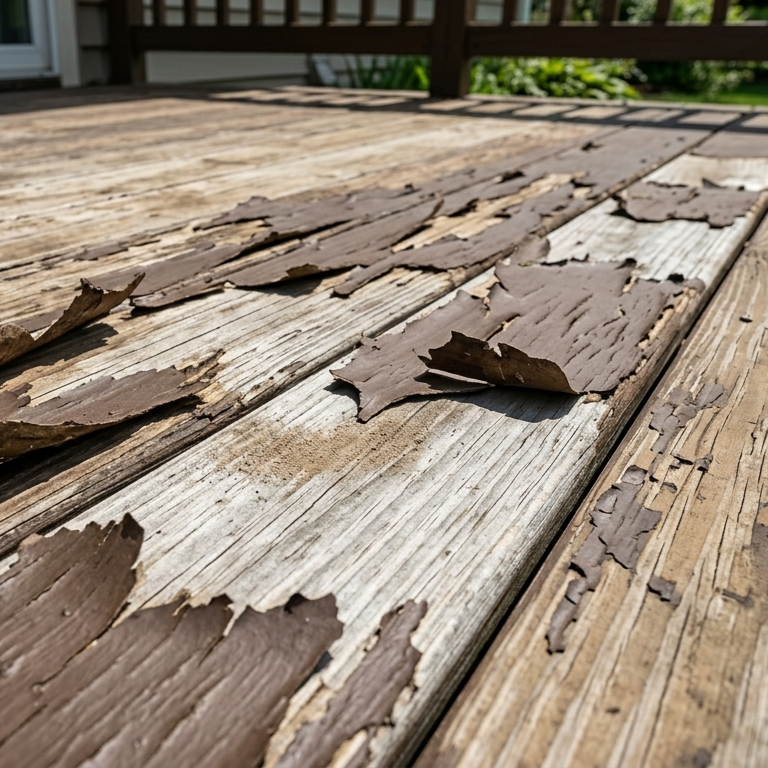
You walk out on the deck for the first warm Saturday in May. The boards looked perfect last spring when the painter wrapped up. Now there are dollar-sized flakes lifting off the rails, the stair treads have gone gray and patchy, and a chunk near the door peels off when you scuff it with your shoe.
That timeline is a problem. A stain that releases inside a single season did not fail from weathering — it failed from one of three things the last job got wrong. The wood, the prep, or the product.
Penetrating deck stains are supposed to soak into the wood fibers and weather away over three to five years. Film-forming finishes sit on top and last longer in theory, but only when no moisture is trapped underneath and the surface gives them something to bond to. When a deck stain peels off in twelve months, the problem is almost always upstream of the stain.
What twelve-month peeling actually tells you
Stain that has weathered down naturally looks faded, slightly chalky, and uniform. The color is duller but the wood still has pigment in the grain. Pour water on it and it darkens without beading.
Peeling stain is different. The finish lifts away in flakes or sheets and leaves bare wood underneath, often with a sharp line between the failed area and the still-bonded section. Pull a flake off. A thin chip of plastic means a film-former that never bonded. A fine dusty sheet of pigment points to a penetrating stain over a sealed surface. Either way, the bond let go.
| What you see on the deck | What it usually means | What needs to happen |
|---|---|---|
| Flaking film with a clean shiny back, peeling worst on flat boards | Solid or semi-solid stain applied over horizontal deck surfaces | Strip the film, switch to a penetrating stain on the deck floor |
| Peeling concentrated under furniture, planters, or the grill mat | Moisture trapped under coverings degraded the bond | Pull all coverings, dry the deck out fully, restain |
| Patchy peeling on the side hit by morning sprinklers | Wood was wet at the time of application or stayed wet underneath | Adjust sprinklers, check moisture content before any restain |
| Peeling everywhere with a glossy, almost waxy back to each flake | New stain rolled over an old finish or factory mill glaze | Sand the entire deck to bare, clean wood |
| Stain faded at the railings and balusters first | Vertical surfaces dried too fast, applied in direct sun | Restain in shade or early morning, two thin coats not one heavy one |
The table is the quick triage. The rest of the article walks through what each row actually means and how to fix it without repeating the same mistake.
A film-forming product on a deck floor
This is the most common cause of one-year peeling, by a wide margin. The previous painter used a solid or semi-solid stain — which behaves more like thinned paint than like a true penetrating stain — on the horizontal walking surface of the deck.
Solid stain forms a continuous film on top of the wood. That film looks great on vertical siding, fences, and the underside of overhangs, where it lasts seven to ten years. On a deck floor it has nothing going for it. The boards expand and contract daily as they take sun, rain, and foot traffic. The film is rigid. The wood underneath is not. Within a year the film cracks at the joints between boards, water gets underneath, and the film starts releasing in chips.
Penetrating stains — transparent or semi-transparent — work the other way. They soak pigment into the top layer of wood fiber and leave no film on the surface. There is nothing to peel because there is no film. They weather down by losing pigment over a few years rather than lifting off in chunks.
If the flakes look like thin shavings of dried plastic and the back of each is smooth and shiny, the product was a film-former on a surface that needed a penetrating one. Strip the deck back to bare wood and switch products.
Stain rolled over wet wood
The second pattern is invisible at the time of application and unforgiving twelve months later. The crew pressure washed the deck on Monday, the wood looked dry by Wednesday afternoon, and they stained on Thursday. The surface was dry. The wood underneath was not.
Pressure washing drives water into the top quarter inch of the boards. Cedar and redwood hold it. Pressure-treated pine holds it longer. The surface flashes off in a day, but interior moisture can sit at 18 to 25 percent for four to seven days depending on temperature, humidity, and how much shade the deck takes. A stain applied on top traps that moisture between the finish and the substrate. By the next spring, trapped water has cycled through enough freeze-thaw to push the stain right off.
The same thing happens on a deck that catches a morning sprinkler hit every day. The boards never fully dry. Penetrating stains rely on dry wood to draw the pigment into the grain — if the fibers are already saturated, the stain sits on top instead of soaking in, and the surface peels within a year.
Bad prep — old finish or mill glaze still on the wood
The third pattern shows up when the previous painter skipped the harder half of the job. Either an old finish was never fully removed before the new coat went on, or the deck was brand new and still had factory mill glaze on the surface from the planer at the lumber yard.
Old finish acts as a release layer. The new stain bonds to the old film instead of the wood itself, and when the old film flakes off the new one comes with it. Some semi-transparent stains advertise "no stripping required," but that only works when the prior coat is the same product, applied recently, and not failing anywhere. Most one-year peeling on previously-stained decks traces back to skipping the stripping step.
Mill glaze is the surprise on new construction decks. When boards run through the planer at the mill, the cutter heads compress the surface fibers and burnish them into a slick, almost waxy layer. That layer repels stain. The deck looks perfect after the first coat — color even, wood bright — but the stain is sitting on top of the glazed fibers, not in them. By the next summer the whole finish is lifting in fine sheets.
The fix in both cases is the same. Sand the entire deck with a 60- to 80-grit pad on a random-orbital or pole sander until the surface is bare, slightly fuzzy wood with no shiny patches. Hand-sand treads, railings, and balusters with the same grit. Vacuum, wipe down with a tack rag, and let the wood dry to under 15 percent moisture before any pigment touches it.
Moisture from underneath — no airflow under the deck
The fourth cause is the one homeowners almost never check. The deck looks fine from above. The peeling is real but inconsistent — worst in the middle, fine at the edges, sometimes following a strange diagonal line. The cause is moisture moving up through the boards from below.
Decks built close to grade with no air gap underneath behave like the lid on a slow cooker. Soil moisture wicks up into the underside of the boards. There is no airflow to carry it away. The wood is being asked to release water through the top surface — straight through the stain — every time the sun warms the boards.
The same pattern shows up on decks built over an unsealed slab, decks with low-slung skirting that traps humidity, and decks where the joists are tight against the boards with no ventilation gaps. Even a careful application of a penetrating stain on dry wood will peel within a year if the boards are venting moisture upward through the finish every afternoon.
The fix is structural, not chemical. Cut larger vent openings in any skirting. Trim back vegetation and grade soil so it slopes away from the deck. If the deck sits on a slab, an applied vapor retarder on the slab can help. Then strip and restain. Without addressing the moisture path, no product holds for more than a season.
How to figure out which cause is yours
Start with the flake. A glossy, shiny back means film-former or a sealed substrate. A powdery back with pigment dust suggests a penetrating stain over a chalked surface. Wet or dark wood underneath the flake points to moisture at the time of application. A smooth, waxy back with no pigment carrying through points to mill glaze on new lumber.
Then look at the pattern. Worst on flat boards but fine on railings means product mismatch. Concentrated under planters or doormats means trapped moisture. Patchy near a sprinkler means wet wood. Peeling everywhere — including balusters — points to bad prep. Worst in the middle with edges holding fine means moisture from below.
Older decks often have more than one cause working at once. A six-year-old cedar deck restained twice by different crews can peel from product mismatch and bad prep at the same time. Honest diagnosis is the first part of an honest restain quote.
What a real restain on a peeling deck looks like
A restain on a deck that peeled inside a year is mostly prep, not staining. Walk the entire surface first — flat boards, treads, railings, balusters, fascia. Anywhere the finish is lifting gets stripped back to bare wood. Anywhere it is still bonded gets sanded enough to feather the edge so the final color is even.
Stripping is the right call when more than thirty percent of the deck is peeling or when the previous coat is a film-forming product. Use a sodium percarbonate or sodium hydroxide stripper applied wet, allowed to dwell per the label, and rinsed at low pressure. Follow with a brightener — usually oxalic acid-based — to neutralize the stripper and restore the natural color. Let the deck dry fully for two to four warm days.
Sand treads, railings, and vertical surfaces by hand with 80-grit, then vacuum. Test the moisture with a meter before any pigment goes on. Apply the stain in two thin coats, brushed or pad-applied so the pigment actually penetrates rather than puddling, working out of direct sun. Coverage of 200 to 300 square feet per gallon means the wood is taking the product. Significantly higher coverage means it is not absorbing — stop and find out why.
A two-coat application of a quality penetrating stain on well-prepped wood should hold three to five years on shaded boards, two to three in full sun, and two to four on heavily walked treads. Vertical surfaces run five to seven.
FAQs
Restaining over actively peeling sections is the deck version of painting over a leak. The new stain bonds to whatever the original stain was stuck to — which is exactly what failed in the first place. Inside a year, the new layer will peel on the same schedule the old one did. Strip back to bare wood in any area showing active failure before applying any new stain.
A penetrating semi-transparent stain on a well-prepped horizontal deck floor holds two to four years in full sun and three to five years in shade. Vertical surfaces last five to seven years on the same product. Solid stains on vertical surfaces can run seven to ten years. Treads and high-traffic walking lanes always fail first regardless of product. If any of those numbers are coming up short by half, the prep or the product was wrong — not the stain itself.
Aggressive pressure washing can absolutely cause peeling on the next coat. Pressure above 1,500 PSI on softwood boards fuzzes the fibers, drives water deep into the wood, and tears out enough surface material to interfere with stain adhesion. Use 500 to 1,200 PSI with a 25- or 40-degree fan tip held about a foot from the surface, then let the deck dry for four to seven warm days before any stain goes on.
Yes. Treads see the most foot traffic per square foot of any surface on the deck, and that wear is concentrated in the path most people walk. Tread finishes typically wear two to three times faster than the surrounding boards. Plan to spot-restain treads every one to two years even when the rest of the deck is holding fine, and use a penetrating stain so the wear pattern stays even.
Most penetrating stains include the repellent in one pass — adding a sealer on top creates a film that peels. No topcoat over a stain-and-sealer combo. A separate clear repellent is fine over a true colorant, but must match brand and chemistry.
What the deck is telling you
A stain that peels off in one year is not a bad product. It's a deck written by the last crew — film-former on a floor, wet wood stained before it dried, old finish never stripped, mill glaze still on new boards, or moisture pushing up from below.
The fix is the prep step the last job skipped — usually a strip, sometimes a moisture meter, sometimes a product change. Stain only lasts on dry, clean, unsealed wood — skip any one and it's flakes by next summer.
