
Painting a Garage Door, Front Door, and Shutters vs. Replacing
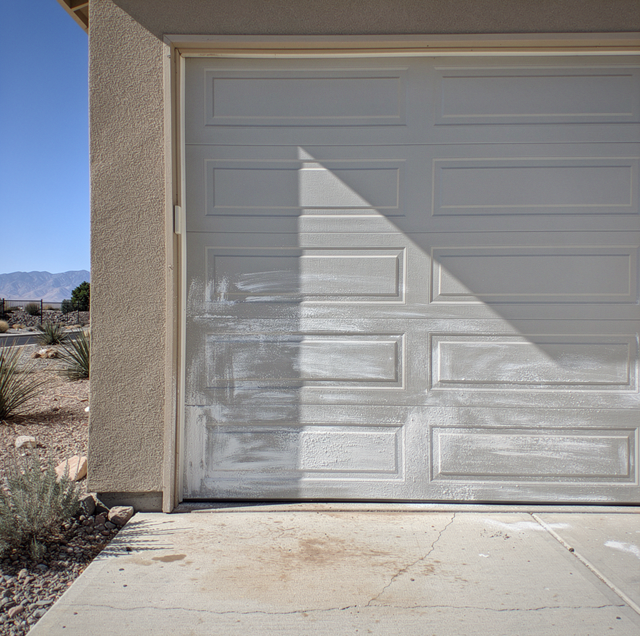
You back out of your driveway, turn to check the street, and end up facing the front of your own house. The siding still looks fine. The garage door does not. It has gone flat and chalky across the lower panels, the front door carries a hard sun line where the storm door ends, and the shutters have faded past matching anything.
A view like that sends plenty of homeowners straight to replacement quotes. Before you call for one, it helps to know what the coating is doing on each surface, because your garage door, your front door, and your shutters give out in three different ways. Some of those ways tell you the material is finished. Most tell you the paint quit first.
Three Surfaces That Fail Three Different Ways
A garage door is the largest painted panel on most houses and the least sheltered. It is steel over a foam core, and it left the factory with a baked-on finish no brush ever touched. That finish is thin, hard, and very good until the binder holding its pigment breaks down over years of sun exposure. Then the color does not peel. It powders.
A front door lives a different life. It might be wood, fiberglass with a molded grain skin, or insulated steel, and each holds a coating differently. Its worst enemy is rarely rain. It is trapped heat, the kind that builds between a dark slab and a storm door on a bright afternoon, softening the film until it lets go.
Shutters change the problem again. Most are vinyl, which arrives with no paint on it, because the color lives in the material. Sunlight oxidizes the outer skin over years, and that oxidized layer is what you see when a shutter looks faded from the curb. Wood shutters carry a coating, and they flake at the louver ends first.
What Flakes First on a Door, a Shutter, or a Garage Panel?
Failures recur on these three surfaces, and once you can name the pattern in front of you, the question of repainting gets much simpler.
| Surface | What you see | What it usually means | Repaint or replace |
|---|---|---|---|
| Steel garage door | Flat color leaving chalky powder on a dark rag | The factory binder has broken down; the steel is sound | Repaint after a wash and a degloss |
| Steel garage door | Blistering along the bottom rail and panel seams | Moisture wicking into the seam and corroding from behind | Repaint if the metal is solid, replace the section if perforated |
| Front door | Coating lifting in sheets on the outward face only | Heat behind a storm door cooked the film loose | Repaint after full removal and a bonding primer |
| Wood front door | A dark, spongy bottom rail that gives under a thumbnail | Water at the sill has started rot in the end grain | Carpentry first, because paint does not bridge rot |
| Vinyl shutter | Chalky, uneven fade, brighter where a downspout shaded it | Oxidation of the vinyl surface, nothing structural | Repaint in a color rated for vinyl |
| Vinyl shutter | Cupping, brittleness, a crack that runs when a corner flexes | Plasticizer has migrated out and taken the flexibility with it | Replace |
| Wood shutter | Flaking at the louver ends while the joints stay tight | Ordinary coating failure at end grain | Repaint after scraping and priming those ends |
Read down that last column and the split shows up on its own. Nearly everything marked repaint is a coating problem, nearly everything marked replace is a material problem, and those two sit nowhere near each other in cost or disruption. A coating problem lives inside a film a few thousandths of an inch thick that was always going to give out first; the steel, the fiberglass skin, the wood stile, and the vinyl body underneath were built to outlast several coats of it. A material problem means the part itself has changed: metal thinned from the back side, end grain gone soft, plasticizer gone from the vinyl for good. Replacement quotes get signed so often on doors and shutters that never needed replacing because a badly failed coating looks exactly like failed material from the curb, and almost nobody walks up and checks it from three feet away.
Telling a Coating Problem From a Material Problem
The checks that separate the two take minutes. Wipe a dark rag across a garage panel and see whether pigment comes off. Press a thumbnail into the bottom rail of a wood door where it meets the sill and feel for give. Flex a shutter corner you can reach and watch whether it returns or crazes. Then open and close the front door and notice whether it still latches without a shoulder.
The inspection stops at an older house. Paint made before 1978 can contain lead, and scraping or sanding it releases dust that settles in the entry and the soil where children play. Renovation that disturbs paint in housing from that period requires certification. For a house that old, any testing and disturbance of the old coating must be done by a certified lead-safe renovation contractor, so bring one in before a scraper touches anything.
The Prep That Makes a Repaint Hold
Exterior prep runs in a set order: power washing to remove dirt and debris, scraping loose paint, sanding rough areas, and priming exposed surfaces. Here, the washing carries more weight than it looks, because chalk is a bond breaker. A coating rolled over a chalked garage door bonds to loose pigment dust, not the panel, and lets go in sheets within a couple of seasons.
After the wash, each surface asks for something different. A factory finish on steel is slick and needs a scuff or a liquid deglosser so the new coat has a tooth. A fiberglass skin usually wants a bonding primer, since its molded surface sheds everything. The lock area and kick zone of a front door collect hand oils that repel paint, so those spots get degreased separately.
Vinyl shutters get washed, dried, and nothing else. All of it happens with the garage door closed and hanging on its hardware, a boundary worth naming before anyone reaches for a wrench.
Never release the opener, unbolt a panel, or take a garage door off its track to paint it flat, because the counterbalance spring and cables store energy; a garage door technician handles the hardware, and painting happens in place, closed.
Color, Sheen, and the Vinyl Shutter Question
Vinyl imposes the tightest limits on color for a simple reason: darker colors absorb more heat, and the vinyl warps, buckles, and distorts. A shutter repainted deep charcoal can bow off its fasteners in one hot stretch, and that traces to a color choice.
Vinyl-safe color lines address that, but the limit still applies: the range resists warping or buckling only when applied to sound, stable vinyl. A cupping shutter sits outside it.
Steel has a dark-color limit too. A garage door painted a dark color can bow from heat, a flex driven by the temperature gap between the two skins of an insulated panel. Sheen carries its own rules. Doors take satin or semi-gloss, which clean up after hands and weather, while a garage door often looks better a step lower, since high sheen across flat steel telegraphs ripples.
Matching the Method to the Surface
Application methods suit each surface, so coverage stays even and edges stay clean across doors, trim, and details. A garage door gets painted closed, and in place, panel by panel, with the stiles cut in by brush and the flats rolled or sprayed. Surface temperature drives the timing, so the work follows the shade around the house.
A front door gives up its hardware first. Hinges, lockset, knocker, and kick plate come off and get bagged, because cutting around them leaves a line. The face gets coated in a set order on a panel door: recessed panels, then muntins, then rails, then stiles, so every wet edge meets another wet edge at a natural break. The top edge gets coated too.
Shutters come down when their fasteners allow it and lie flat on horses, where both faces and the undersides of the louvers can be reached. Upper-story work belongs to a crew on properly footed ladders. Fasteners are replaced since the old ones come out chewed and will not draw tight.
When Paint Stops Being the Answer
There are honest limits, and they show up in a few places. Steel perforated at a bottom rail cannot be primed back into a panel. A fiberglass skin delaminated from its frame keeps moving. A wood stile with soft rot needs wood, not filler.
Operation is its own category, and homeowners fold it into an appearance complaint. A garage door that binds, drops quickly, or has a bent section has a mechanical fault that a garage door technician can diagnose. A front door that no longer seals has a fit problem living in the frame, the hinges, or the threshold instead of the finish. Paint restores color depth and contrast and protects what sits under it, but cannot correct geometry.
Frequently Asked Questions
Dry to the touch and ready to shut are not the same thing. Most exterior coatings want several hours before your door can press against its weatherstripping. If you have to close it overnight, a dusting of talc on the stop face keeps a soft film from bonding to the gasket and tearing when you open your door.
They rarely are. A common approach ties your front door and shutters together as the accent pair, then lets the garage door recede by matching it to the body or the trim. That keeps the largest panel from dominating the elevation while your entry works as the focus. If your front door is your only accent, shutters in the trim color keep things balanced.
Satin and semi-gloss both work, and your choice usually turns on how much you care about flaws showing on your entry. Semi-gloss cleans up most easily and defines panel edges, but it also highlights every dent, patch, and raised grain on the slab. Satin hides more of that and wipes clean. Flat finishes hold dirt and resist washing, so keep them off a door your family touches daily.
Usually not, and adding one can backfire. Coatings rated for vinyl bond to a clean, dull, oxidized surface, and a primer between the two adds a layer that can fail on its own. What your job does need is a clean substrate: chalk washed off, mildew killed, and every shutter dry before you apply anything. Skipping that drying step costs you more than skipping primer would.
Read the product label, then read your surface, because the two rarely agree on a sunny day. Most exterior coatings require a substrate temperature between roughly 50 and 90 degrees, and dark steel in direct sun sits above the ambient air. Paint hitting a hot panel flashes off before it levels, leaving you ropey brush marks and weak adhesion. Late in the day you face the opposite risk, since a surface cooling toward the dew point collects moisture that your film traps.
Anything removable comes off. Hinge pins, locksets, handles, kick plates, and shutter fasteners get bagged and labeled so they return to their openings. Weatherstripping and the rubber bottom seal on a garage door get masked, since pulling them ruins them. Glass inserts are masked to the glazing bead so the coating seals without hazing your pane.
Once someone walks all three surfaces with you, the split gets clear. The finish belongs to the painter: chalk, adhesion, sheen, and how color holds in sun. The material belongs to you: a rotted rail, a perforated panel, a cracking shutter. A crew that tells you which of your surfaces sits on which side has done the part you needed.
Book a free estimate for your front door, shutters, and garage door — we will walk all three surfaces with you, tell you which ones a fresh coat will actually hold on, and name any of them that have moved past paint. True Coat Painting serves Reno, Sparks, and Spanish Springs. Call (775) 227-0618.
