
How Much Does It Cost to Stain a Wood Deck
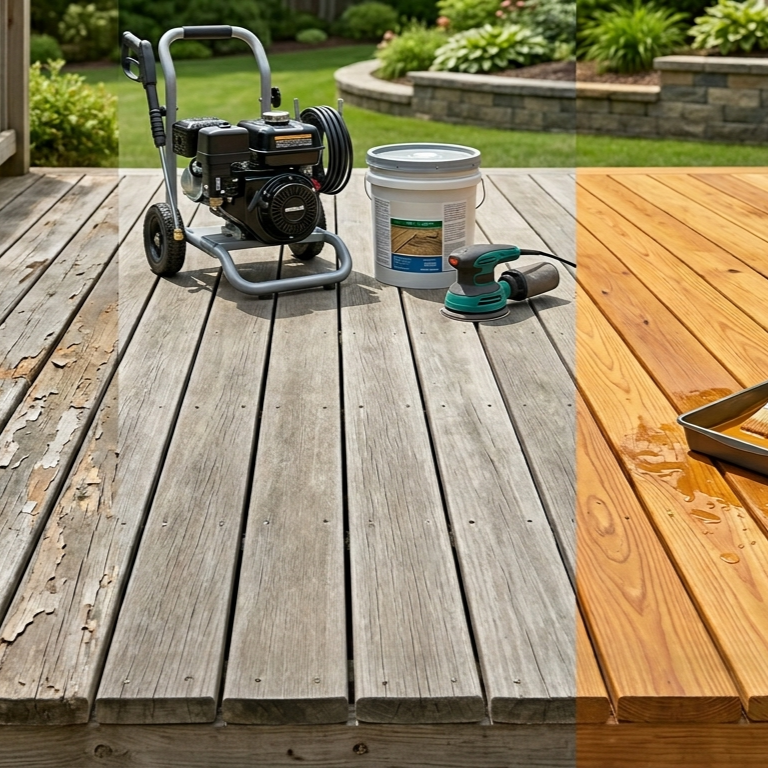
You walk out onto the deck in May, barefoot, expecting that familiar warm-wood feel. Instead, the boards are fuzzy. Dry. A little splintery near the railing. The color that used to be honey or cedar is now a flat, washed-out gray, like driftwood somebody hauled up the back stairs.
The deck still works. The boards are solid. But every spring it's looked a little worse, and this is the year you're finally going to deal with it.
Then you start calling around for quotes, and the numbers don't make sense. One painter says $450. Another says $1,400 for the same deck. A third quotes $4.50 per square foot for "the full restoration." Same wood. Same square footage. Wildly different prices. Why?
Why one deck draws three different prices
The reason quotes vary so much isn't markup. It's that "staining a deck" can mean three completely different jobs depending on how bad the wood looks when the painter shows up.
A deck that's been kept up — restained every two or three years, swept, kept clear of leaves and standing water — is essentially a clean-and-recoat job. Power wash, let it dry, apply two coats, done. That deck lands at the bottom of the range.
A deck that's gone five or six years without attention has weathered wood with old stain hanging on in patches, mildew in the shaded corners, and lifted top fibers — that fuzzy gray surface. You can't put fresh stain on top of that. The old finish has to come off, the wood needs sanding past the damaged grain, the mildew has to be killed. That's a totally different job. Three to four times the labor.
A deck that's failed completely — solid stain peeling in sheets, soft spots near the posts, hairline cracks in the boards — needs full stripping with chemical strippers, a deep brightening wash, sometimes board replacement before staining can even start. That's the high end.
So the question is never just "what does it cost to stain a deck." It's "what does it cost to do this deck, in this condition, today." Once you sort that out, the per-square-foot math gets a lot cleaner.
The real per-square-foot ranges
Across most of the country in 2026, professional deck staining lands in a fairly tight band when you compare the same job. Materials make up about a quarter of the bill. Labor — prep, sanding, washing, brushing, rolling — is the other three-quarters. Here's what each level of work runs.
| Scope of work | Cost per sq ft | What it covers |
|---|---|---|
| Stain and seal only | $0.50 – $1.50 | Light cleaning, one or two coats of stain on planks in good condition |
| Power wash, stain, and seal | $1.00 – $2.50 | Pressure wash to remove dirt and loose stain, then stain and seal |
| Power sand, stain, and seal | $2.00 – $4.00 | Sanding to bare wood on the planks, then stain and seal |
| Strip, stain, and seal | $2.50 – $5.50 | Chemical stripping of old finish, brightener wash, sand, stain, seal |
| Painting (solid stain or deck paint) | $2.00 – $5.00 | Solid stain or paint, fully opaque finish on heavily weathered wood |
| Railings and spindles | $4 – $12 per linear ft | Hand-brushed separately; usually a line item of its own |
For a typical 200- to 400-square-foot deck, that translates to roughly $300 to $2,300 all-in. The national average sits around $730 for a standard restain. Decks that need full stripping and have a lot of railing can easily run $1,500 to $2,500.
The cleanest bids itemize this. They tell you which scope they're quoting (clean-and-recoat, sand-and-recoat, or strip-and-recoat), they break out the railing footage as its own line, and they name the stain product and color. A bid that just says "$3.00/sq ft" without telling you what scope is included is a bid you can't compare to anything else.
What's actually moving the number on your quote
Two decks with identical square footage can land at opposite ends of that range. The variables aren't mysterious. They're just things the painter sees on the walk-through that the homeowner doesn't always notice.
Wood condition is the biggest driver by a wide margin. Smooth, lightly weathered planks that just need cleaning sit at the low end. Heavily weathered, sun-bleached, mildewed, or splintering wood needs prep the smooth deck doesn't, and prep is labor.
Old finish type matters almost as much. A transparent stain that's mostly worn away washes off with a power wash and a brightener. A solid stain or paint that's peeling has to be stripped or sanded to bare wood before any new finish will grip. That step is what turns a $600 job into a $2,000 job.
Square footage and shape move the number in two ways. More area means more time. Shape drives it less obviously — a simple rectangular 300-square-foot deck stains faster than a 300-square-foot deck with three angles, a hot tub cutout, and a pergola overhead, because every angle is more hand-cutting.
Railings, balusters, and stairs carry separate pricing because they're hand-brushed rather than rolled. The flats go fast with a roller or stain pad. Railings can take as long as the planks for a fraction of the surface area. On a deck with long rails, that rail labor often matches the floor labor.
Two coats versus one affects the price by roughly 40 to 60 percent on the stain step. Most semi-transparent and solid stains need two coats to deliver their rated color and lifespan. A bid quoting one coat is cheaper than a bid quoting two — worth knowing before you compare.
| Cost driver | What it adds to the bid | Why |
|---|---|---|
| Heavy weathering (gray, fuzzy, splintered) | +$1.00 – $2.50 per sq ft | Sanding or stripping before stain can grip |
| Solid stain or paint that's peeling | +$1.50 – $3.00 per sq ft | Chemical strip plus brightener plus sand |
| Tall or long railing systems | +$4 – $12 per linear ft | Hand-brushed, every baluster cut by hand |
| Stairs and landings | +$8 – $20 per stair | Each tread brushed top and front |
| Mildew or algae remediation | +$0.25 – $0.75 per sq ft | Bleach or oxygen-based wash before stain |
| Board replacement (per board) | $15 – $40 per board installed | Often discovered mid-prep; usually a change order |
| Two coats versus one | +30% – 50% on the stain step | More material, more time |
The thing to ask any bidder is what scope they assumed. A painter who walked the deck for ten minutes, opened the gate to look at the back side, and pulled up a board near the post to check for rot has a real number for you. A painter who emailed a per-square-foot quote from the truck guessed.
What deck stain itself costs
A gallon of deck stain runs $20 to $90, depending on the type, with most quality products landing between $35 and $60. One gallon covers 200 to 300 square feet of plank, depending on how thirsty the wood is and how heavy the application gets. A 12-by-16 deck with railings usually takes two to three gallons.
The type of stain you pick drives both the look and how often you'll be back out there doing it again.
| Stain type | Look | Cost per gallon | Restain interval |
|---|---|---|---|
| Clear sealer | Natural wood, almost no color | $20 – $60 | Every 1 – 2 years |
| Transparent stain | Light tint, full grain visible | $20 – $60 | Every 2 – 3 years |
| Semi-transparent stain | More color, grain still shows | $20 – $50 | Every 3 – 4 years |
| Semi-solid stain | Heavy color, grain barely visible | $45 – $80 | Every 4 – 6 years |
| Solid stain | Opaque, looks like paint | $10 – $60 | Every 5 – 7 years |
The trade-off is simple in real-world terms: the more pigment a stain has, the longer it lasts (the pigment is what blocks UV), but the less you see of the wood underneath. Clear and transparent stains are best for new or near-new wood you want to show off. Solid stains are best for older wood you'd rather cover up.
Oil-based stains penetrate deeper into the wood and tend to last a year or two longer than water-based stains of the same pigment level. Water-based stains dry faster, clean up with water, smell less, and resist mildew better. Most quality manufacturers now make excellent water-based options that perform as well as the oil-based stains they replaced.
DIY versus hiring a pro
DIY deck staining runs $0.50 to $1.00 per square foot in materials, plus pressure washer rental ($35 to $50 per day) and brushes, rollers, and tape. For a 250-square-foot deck that's roughly $200 to $300 out of pocket.
The hidden cost is time. Staining a deck the right way takes about 4 hours per 100 square feet, spread across two days, because you can't apply stain to wet wood or in direct hot sun. A 300-square-foot deck is a full weekend of work, sometimes two if the weather turns between coats.
DIY makes the most sense when the deck is in good shape and just needs a clean-and-recoat, you already own a sander and pressure washer, and you've got a stretch of dry weather between 50 and 90 degrees. Hiring out makes more sense when the deck needs stripping or heavy sanding, has tall railings or stairs that would take days to hand-brush, or is large enough that a single weekend won't cover it.
The break-even is usually around 250 square feet. Below that, a careful DIY with rented gear comes out fine. Above that, the time and equipment rental start to eat the savings, and the quality gap between a homeowner with a roller and a crew with sprayer-and-back-brush starts to show.
What gets left out of a cheap bid
A low bid isn't always a problem. Sometimes a painter has the route, the schedule, and the volume to do a clean restain at a good price. But three things commonly disappear from a too-cheap bid: one coat instead of two (cuts the lifespan by a year or more), railings quoted as "extra" rather than included, and an assumption that the wood is in better shape than it actually is. Any one of those turns into a change order on day two when the homeowner has no negotiating room. Ask all three before signing.
FAQs
It depends on the stain type and the exposure. Transparent stains usually need recoating every two to three years. Semi-transparent runs three to four. Semi-solid and solid stains can last five to seven years if applied correctly and not under heavy foot traffic. South-facing decks and decks under no overhead cover fade faster than north-facing or shaded decks. The clearest signal that it's time is water no longer beading on the surface — that means the sealer has worn through.
Sometimes. If the old stain is the same type (oil over oil, water over water) and the old finish is mostly worn away rather than peeling, you can clean the deck, let it dry, and apply a fresh coat directly on top. If the old stain is peeling, flaking, or a different type than what you want to put down, it has to come off first. Putting new stain over peeling old stain is the single most common reason a DIY job fails inside a year.
Most 200- to 400-square-foot decks take two days of crew time. Day one is moving furniture, power washing, sanding any rough spots, and letting the wood dry. Day two is applying stain and sealer. If the deck needs stripping, add a third day. If the weather turns wet between days, the job stretches across a week because the wood has to fully dry before stain can be applied.
Between 50 and 90 degrees Fahrenheit for the entire day, ideally with two or three dry days on either side. Stain applied in direct hot sun above 90 degrees dries on the surface before it can soak into the wood — the result is a sticky, uneven coat that lifts later. Stain applied below 50 degrees doesn't fully cure and stays tacky. The sweet spot most painters look for is morning application on a 60- to 80-degree day with no rain in the forecast for 24 to 48 hours.
No. New pressure-treated lumber holds factory moisture that blocks stain absorption. Wait three to twelve months depending on wood and climate — until water poured on the deck soaks in within a few seconds instead of beading. New cedar and mahogany can be sealed within a few weeks, but full pigmented staining benefits from a month or two of weathering first. Staining too early is the second-most-common reason DIY stain jobs fail.
Sealing protects from water and mildew. Staining protects from UV and adds color. Waterproofing is the strongest version of sealing. Most modern stain-and-sealer combos handle UV and water in one application. Standalone sealers preserve the natural wood color. Standalone stains without a sealant additive should be followed by a clear sealer on top.
What a fair deck staining quote looks like
A good deck staining bid breaks the job into the parts that actually drive the price: which scope of work is being done, how many coats, what product, what's included on the railings and stairs, and what happens if soft boards or hidden rot show up once the prep starts. The painter worth hiring walks the deck, pushes on the boards near the posts, and gives you a number that reflects what they saw. The painter to skip asks for square footage from the driveway and emails a quote that afternoon — that's a number, not a job.
