
Transparent vs Semi-Transparent vs Solid Deck Stain: Which Should You Choose
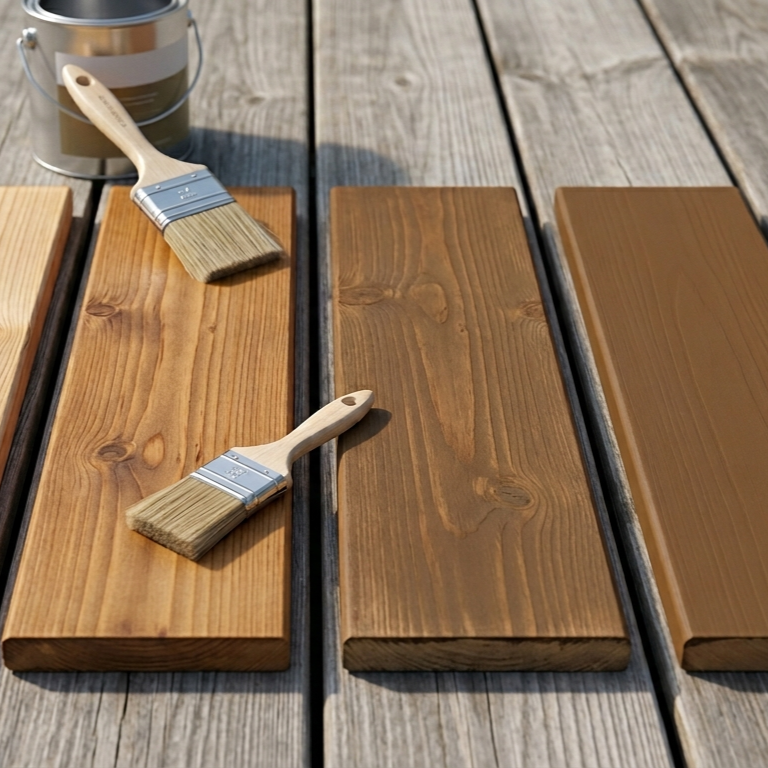
You are standing in the stain aisle holding two cans. One shows a cedar deck where the grain glows through like honey. The other shows a deep redwood, opaque, almost like paint. Both say "deck stain." Both promise UV protection and water resistance. The prices are within five dollars of each other. The only word that's different is "transparent" or "solid."
Which one your deck wants isn't a style question. It's a wood-condition question with a style consequence. Pick the wrong opacity and the stain looks fine for six months, then fails in a way the right opacity wouldn't have.
Here's how the choice works.
The four opacity levels, plain English
Deck stains come in a spectrum, not just two extremes. The marketing names vary a little by brand, but the physics underneath is the same. More pigment in the stain means less of the wood you can see, and more UV protection the stain itself provides.
| Opacity | What you see | Pigment level | Best for |
|---|---|---|---|
| Transparent / clear | Full grain, natural wood color | Almost none | New or nearly new wood you want to show |
| Semi-transparent | Grain visible with a tint | Light | Lightly weathered wood, modest color shift |
| Semi-solid | Color dominant, grain barely visible | Heavy | Older wood with uneven coloring |
| Solid | Opaque color, no grain visible | Very heavy | Heavily weathered or previously painted wood |
A clear or transparent stain is essentially a sealer with a whisper of color. It soaks into the wood. You can still see the knots, the grain pattern, the natural color shifts between boards. The trade-off is that with almost no pigment in the film, the wood itself takes the UV hit, and the finish wears off quickly.
Semi-transparent is the most popular choice on residential decks. Enough pigment to give the wood a uniform tone, not enough to hide what it is. Think of the difference between a tinted moisturizer and full coverage foundation. You see the wood, just dressed up a little.
Semi-solid sits in a category most homeowners don't know exists. It's heavier than semi-transparent — the grain pattern still shows through as texture, but the natural color of the wood is mostly covered. Useful when boards have aged unevenly and you want them to match without going fully opaque.
Solid stain is the opposite end. It's not quite paint, but close. It forms a film on top of the wood rather than soaking in, blocks UV almost completely, and covers any color or staining underneath. The grain pattern disappears entirely.
Wood condition is what should pick the opacity
The first question to ask isn't what color you want. It's what your wood looks like right now.
New wood, fewer than two years old, with clean color and tight grain — that wood was bought to be seen. A transparent or semi-transparent stain lets the buyer's choice show. Putting solid stain over fresh cedar is like buying a leather couch and then covering it with a sheet. The whole point of the material is its grain.
Wood that's a few years old, mostly intact, with some color fading but still sound grain showing — this is semi-transparent territory. The light pigment evens out the sun-bleached patches without covering what you bought. Most decks five to ten years out from new sit here.
Wood that's gone gray, has patches where the original color is gone entirely, has scattered black mildew stains that didn't fully clean out — this wants semi-solid or solid. Semi-transparent on weathered wood just shows you all the damage in better lighting. The pigment isn't heavy enough to even it out. You end up with a deck that looks freshly stained but still looks tired.
Wood that's previously been painted, or had solid stain applied at any point — this is solid stain only. Once a film-forming finish has been on the boards, the wood pores are sealed by the residual film. Semi-transparent and even semi-solid stains can't penetrate where they need to. They sit on top, fail to grip, and peel inside a season.
This is why a painter walking the deck before quoting matters. From the driveway, all decks look about the same. Up close, on hands and knees, the right opacity becomes obvious.
The pigment and lifespan trade-off
There's a clean inverse relationship between how much wood you see and how long the finish lasts. The reason is physics, not product quality.
Ultraviolet light is what destroys wood and finishes alike. Pigment particles are what block UV — the more pigment in the finish, the more of the sun's energy gets absorbed by the pigment and not by the wood underneath. A clear sealer with no pigment blocks no UV. The wood ages straight through it. A solid stain is essentially a thick blanket of pigment that the sun has to chew through before it touches anything.
| Stain type | Lifespan (full-sun deck) | Lifespan (shaded deck) | Recoat trigger |
|---|---|---|---|
| Clear sealer | 1 – 2 years | 2 – 3 years | Water no longer beads |
| Transparent | 1 – 2 years | 2 – 3 years | Color faded, water no longer beads |
| Semi-transparent | 2 – 3 years | 3 – 4 years | Color worn thin in foot-traffic areas |
| Semi-solid | 4 – 5 years | 5 – 7 years | Color uneven, traffic paths worn |
| Solid stain | 5 – 7 years | 7 – 10 years | Peeling or flaking starts |
A south-facing deck with no overhead cover lives at the bottom of those ranges. A north-facing deck under a covered porch can hit the top. Decks under deciduous trees fall somewhere in the middle and also catch tannin staining from the leaves.
The math for a homeowner is simple. A transparent finish looks best for the first year and most worn by year three. A solid stain looks the same on year one as it does on year five. If you enjoy refinishing your deck on a regular schedule, transparent fits. If you'd rather not think about your deck for half a decade, solid was built for that.
Foot traffic changes the calculation
Lifespan numbers above assume normal residential use. A deck that hosts a grill, a dining table, and weekly entertaining gets more wear in the high-traffic lanes than the rated lifespan suggests. A deck that holds a couple of chairs and sees occasional use gets less.
A clear sealer on a busy deck looks worn in the walking paths inside a year, even though the unwalked corners still look fresh. The fix isn't more clear sealer — it's a step up in opacity, because pigment is what's getting abraded off by foot traffic, and there isn't enough of it in a clear finish to wear evenly.
On the flip side, a solid stain on a low-traffic deck can look identical at year six to year one — the pigment film is barely being abraded, and the only enemy is UV, which solid stains are built to fight.
Converting from one opacity to another
The rule is one-directional. You can almost always go more opaque without stripping the old finish. You can rarely go less opaque without taking the deck back to bare wood.
A deck currently wearing transparent stain can be recoated with semi-transparent, semi-solid, or solid without removing what's there. Clean, dry, recoat — the new finish has wood pores to anchor into, either through the worn-thin clear layer or directly where the clear has weathered off.
A deck currently wearing semi-transparent can be recoated with semi-solid or solid the same way. The new pigment layer covers the old without compatibility issues, assuming both products are oil-based or both are water-based.
A deck currently wearing solid stain that you want to take back to semi-transparent or transparent — that's the hard one. The film of solid stain has to come off completely. Chemical strippers, sometimes a full sand to bare wood, then a brightener wash to even out the wood color before the new lighter stain goes on. This is the most common reason a deck refinishing job gets quoted at $3,000 instead of $800: someone wants to "lighten things up" on a deck that's been solid-stained for ten years.
The same applies between paint and any stain. Paint comes off first.
A decision table for picking the right opacity
| If your deck is... | Pick this opacity | Why |
|---|---|---|
| New wood, under 2 years, clean grain | Transparent or semi-transparent | Show the wood, accept shorter recoat cycle |
| 3–8 years old, even color, sound boards | Semi-transparent | Light pigment evens minor fading, grain still shows |
| Old, gray, uneven color, peeling | Semi-solid or solid | Pigment covers age damage |
| Previously solid-stained or painted | Solid | Compatibility with existing film |
| Heavy foot traffic, entertaining deck | One step more opaque than you'd otherwise pick | Pigment wears better than clear coats do |
| Shaded, low traffic, owner loves the wood | Transparent | Maximum grain visibility, shaded life is reasonable |
| Owner doesn't want to refinish for years | Solid | Best UV blocking and longest cycle |
The wrong opacity isn't a visible mistake on day one. It shows up in year two when the finish wears unevenly, and by year three when stripping becomes the only path forward.
Oil-based versus water-based, at every opacity level
Both oil-based and water-based formulas exist at every opacity. The chemistry difference matters less than it used to — modern water-based stains perform within a year of oil-based at the same pigment level — but a few things still hold up.
Oil-based stains penetrate deeper into the wood, so they tend to last a year longer in the lower opacity categories where penetration matters most. They smell stronger during application, take longer to dry, and clean up with solvent. They've been disappearing from retail shelves in some states because of air-quality rules.
Water-based stains dry faster (often recoatable in two to four hours instead of overnight), clean up with water, smell less, and resist mildew growth better. They've gotten significantly better in the last decade. Most quality manufacturers now make water-based products in every opacity that perform on par with their oil counterparts.
For a homeowner choosing today, opacity matters more than the binder. Pick the opacity that fits the wood and the use case, then pick whichever oil-or-water version is available locally in a color you like.
FAQs
Barely. In the can, they look like roughly the same brown or gray liquid. The difference shows up when the stain goes on the wood. Semi-transparent dries leaving grain pattern and natural color shifts visible. Semi-solid covers most of the color but leaves the grain as a texture under the pigment. The fastest way to compare is to brush a sample swatch on the actual wood.
You'll see every flaw the wood already has, just with a clear coat on it. The gray sun-bleached patches stay gray. The mildew stains stay visible. The uneven color between boards stays uneven. The finish itself will still protect against water for a year or two, but visually the deck looks like a deck that needs work, not a deck that just got refinished.
Color matters for aesthetics. Opacity matters for performance. A deep brown semi-transparent stain and a light cedar semi-transparent stain will last about the same length of time on the same deck — the pigment load is similar. Going from semi-transparent to solid in the same color, however, can double the lifespan. Pick opacity first, color second.
The two reliable signs are water no longer beading on the surface (means the sealer or finish has worn through) and color thinning in foot-traffic paths. For transparent and semi-transparent stains, this usually shows up at year two to three. For semi-solid and solid stains, it's year four or later, often appearing as small patches of color loss or, with solid stains, a few areas starting to peel.
You can, though it usually looks worse than picking one. A common case is a solid stain on the floor and railing tops where wear and weathering are worst, and a semi-transparent on the spindles and skirting, where they aren't. This delivers a longer recoat cycle on the high-wear surfaces without giving up grain visibility on the low-wear surfaces. It's a real strategy, but it takes a painter willing to mask carefully and a homeowner who wants the result enough to accept the line where the two finishes meet.
Solid stain has a wider market — it covers paint-grade fences, siding, and decks. Transparent stains are a smaller market and tend to come from higher-end product lines. The price difference reflects manufacturing volume more than performance. The performance difference (in either direction) shows up on the deck, not on the price tag.
Picking what fits your deck, not the catalog photo
The temptation in the stain aisle is to pick the can with the prettiest photo. That photo is almost always shot on a brand-new sample board under controlled lighting. Your deck is not that board.
Look at your wood first. If it's young and healthy, you can afford to go light and accept the trade-off of recoating every few years. If it's older and gray, going heavier delivers a better-looking deck and a longer cycle between refinishes. If a previous owner already committed you to solid stain, the choice was made for you — stay solid until you're ready to fund a full strip.
The good painter walks the deck, asks how often you want to refinish it, looks at how the boards have weathered, and tells you which opacity fits both questions. The answer for a young couple who likes weekend projects on a new cedar deck is rarely the answer for a retired homeowner on a twenty-year-old pressure-treated deck. Same product line. Different opacity. Different result.
