
How Often Should Commercial Storefronts Be Power Washed
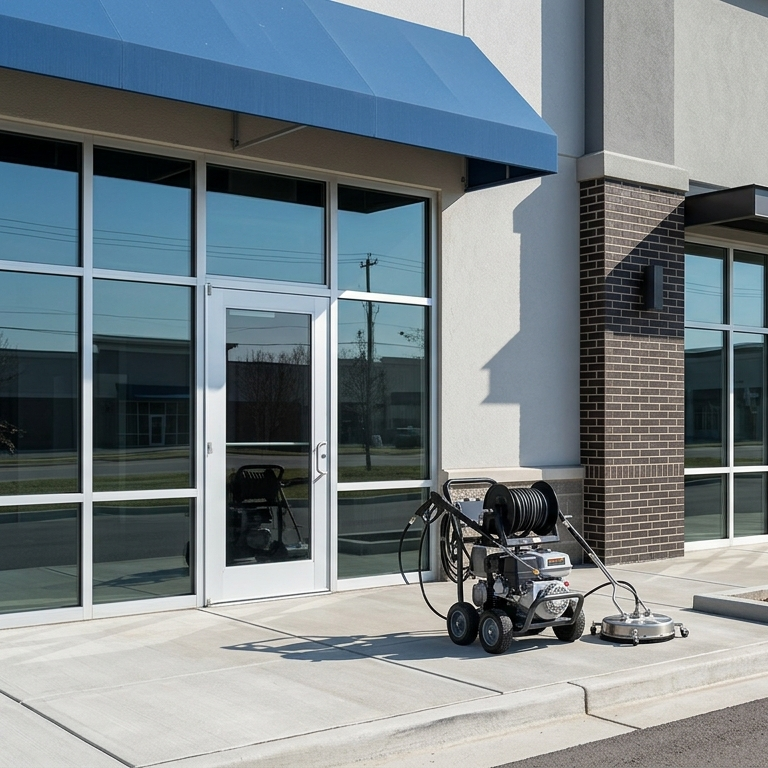
You open the front door at 6:42 a.m. and look at the sidewalk before the first customer pulls in. There's the coffee ring from yesterday, a dark grease spot near the corner where someone tossed a paper bag, two black streaks running off the awning down the column, and the gum from three weeks ago. The glass looks fine from the inside. Standing on the sidewalk and looking back in, the place reads like it hasn't been touched in a month.
That gap — between how the storefront looks from the customer's side and how it looks from yours — is the real reason commercial power washing runs on a cadence. The dirt builds up faster than anyone expects, and most owners only notice once they're parked across the street looking at their own building.
The short answer: restaurants and food-service storefronts need a wash every two to four weeks. Retail and high-traffic storefronts need one every six to twelve weeks. Lower-traffic offices and professional buildings can run a quarterly or twice-yearly schedule. Every storefront, regardless of category, benefits from a heavier annual rinse that hits the walls, soffits, and signage above the door, not just the sidewalk.
The frequency by business type
A storefront's wash schedule tracks two things: what gets dropped on the ground in front of the door, and how many people walk past per day. The table below sets a baseline. A property in a desert climate with summer dust storms or a winter freeze-thaw cycle runs on the heavier end of each range. A shaded urban block with year-round foot traffic and food spills runs faster than the table suggests.
| Business type | Sidewalk and entry | Full storefront wash | What drives the cadence |
|---|---|---|---|
| Restaurant or coffee shop | Every 2 – 4 weeks | Every 2 – 3 months | Grease, spilled drinks, cigarette ash, food packaging |
| Bar or nightclub | Every 1 – 2 weeks | Every 2 – 3 months | Vomit, beverage spills, gum, smoking debris |
| Quick-service retail or convenience | Every 4 – 6 weeks | Every 3 – 4 months | Foot traffic, soda spills, packaging |
| Specialty retail | Every 6 – 12 weeks | Every 4 – 6 months | Dust, sidewalk gum, awning grime |
| Salon or service retail | Every 8 – 12 weeks | Every 6 months | Hair-color stains at the door, hand-sanitizer drips |
| Medical or professional office | Every 8 – 12 weeks | Every 6 – 12 months | Light foot traffic, mineral spotting from sprinklers |
| Strip-mall common areas | Every 4 – 6 weeks | Every 6 – 12 months | Mixed traffic, parking-lot oil tracked onto sidewalk |
| Standalone office building | Every 12 weeks | Every 12 months | Window film, sprinkler residue, bird droppings |
Two short rules adjust the schedule. Cut the interval in half if the storefront sits downwind of a fast-food vent or a parking lot with frequent oil drips. Add fifty percent if the building sits under a covered walkway that blocks both rain and direct sun.
What actually piles up on a storefront
Most owners think of storefront dirt as a single category. It isn't. Five soil types build up in five different ways, and they need different cleaning approaches. Knowing what's on the sidewalk and the wall turns the wash schedule into a tool instead of a guess.
Foot-traffic film. Every shoe that crosses the threshold drops a small amount of road dirt, asphalt residue, salt, and tracked-in oil. On a busy restaurant sidewalk this becomes a measurable layer in three weeks. It doesn't look dirty the way grease does — it just makes the concrete read darker than the same slab one storefront over.
Food and beverage residue. Spilled coffee, soda, beer, sticky ice cream, the occasional half-eaten taco. These dry into the concrete or onto the storefront tile within an hour. Once cured, they need hot water or a degreaser to come up — a cold-water rinse pushes the stain deeper into the pores instead of lifting it.
Grease and smoke film. Anything within fifty feet downwind of a kitchen exhaust collects a fine, sticky film on the upper walls, awning fabric, and the underside of any soffit. The film grabs every dust particle that lands on it and turns black within months. This is the layer most owners miss because they look at the sidewalk, not the soffit.
Biological growth. Mildew in the corner where rain pools, algae on the north side of a column that never sees sun, bird droppings under an overhang. Each one etches the surface it sits on. Leave bird droppings on stone or stucco for three months and the acidity bleaches the surface even after the dropping is gone.
Mineral and dust film. Window film from sprinkler overspray, alkaline streaks where roof runoff dribbled down the wall, and a yearly coating of pollen and dust driven into the surface by every passing car. This is what makes a building read as old even when nothing is structurally wrong.
The storefront isn't one surface
each with a different cadence and a different pressure setting.
The ground zone — sidewalk, entry mat area, curb, planter box bases — runs on the tightest A storefront wash that only hits the sidewalk and the door area misses two-thirds of the building. The mistake is treating the storefront as a single surface when it's really four zones, cycle. This is where shoe traffic, food drops, and gum live. Most cleaners run this zone at high pressure with a surface cleaner attachment that gives an even, streak-free finish. Hot water makes a big difference here; cold water against dried soda or coffee just pushes it around.
The lower wall zone — the bottom four feet of the facade, base of columns, the underside of windows, the door frame, and the kick panels. This zone collects splash from sidewalk cleaning, sprinkler overspray, and a constant brush from passing carts and strollers. Lower pressure than the sidewalk. Soft-wash chemistry, where the surface is painted or finished.
The window and signage zone — glass, vinyl lettering, awnings, signs, light fixtures. This zone almost always wants a soft wash. High pressure lifts the edges on vinyl signage, stretches and tears awning fabric, and forces water past window glazing and into the storefront.
The upper wall and roofline zone — anything above the door, soffits, fascia, the underside of any overhanging element. This zone usually only sees a wash once or twice a year. It collects grease film, bird activity, and the slow drift of street and exhaust dust. It's also where damage hides the longest, because nobody walks up there to look.
Seasonal triggers that pull the cadence forward
A storefront on a clean schedule still hits two or three points in the year where the next wash needs to come earlier than the calendar says. Watching for these triggers keeps the sidewalk from being embarrassing for a full month before the regular visit.
After a dust storm. Wind events in dry climates leave a fine grit on every west-facing surface. A storefront that was clean last Friday can look six weeks dirty by Monday morning. Move the next wash forward to the first dry day after the storm.
After the first hard rain of the season. The summer's worth of film on the upper walls rinses down in streaks during the first heavy rain, leaving vertical stains all the way down to the sidewalk. Schedule the next wash within a week.
After a holiday weekend. Foot traffic, food trucks, parking-lot vendors, and outdoor gatherings deposit two months of normal soil into a single weekend. Add a sidewalk wash the Tuesday after.
After signage, paintwork, or a tenant changeover. Construction debris, masking residue, and the adhesive from temporary or move-in signs all leave marks that get harder to remove the longer they sit. A light wash within a week of any contractor leaving the site, or before a new tenant takes possession, keeps the residue from setting and sets the standard for what comes next.
Signs you are behind schedule
Three indicators tell you the current cadence is too loose, regardless of what the calendar says.
The sidewalk reads two shades darker than the parking lot it borders. This is the foot-traffic film building up. It doesn't show up as a stain — it shows up as a comparison. Stand at the curb and look at the line where the concrete changes. If that line is sharp, the sidewalk is overdue.
Black streaks appear on any vertical surface below an overhang. The grease and smoke film on the soffit has saturated and is now running down the wall during humid mornings. The streaks come back faster than a touch-up wash will remove them; the soffit needs a full wash, too.
A customer mentions it. By the time a customer says something out loud — "the sidewalk's a little rough out there" — the building has been past schedule for at least a month. And by that point, the cleanup takes a heavier visit than routine maintenance would have. The schedule should run far enough ahead that customers never notice the building, only the products inside it.
| Cost driver | Range it adds to the per-sq-ft price | Why |
|---|---|---|
| Wall condition (smooth → heavy patching) | +$0.50 to +$2.50 | Labor for patching, sanding, skim coats, priming over stains |
| Paint grade (contractor → premium) | +$0.30 to +$1.20 | Material cost; sometimes offset by fewer coats |
| Trim and door painting | +$0.75 to +$2.00 | All hand-brushed; often slower than wall painting |
| Ceiling height > 9 ft | +$0.50 to +$1.50 | Ladders, scaffolding, slower production rate |
| Color change (dark over light, or vice versa) | +$0.40 to +$1.00 | Extra primer coat or extra topcoat for full coverage |
| Wallpaper removal | +$1.00 to +$3.00 per sq ft | Steaming, scraping, skim-coating back to smooth |
| Popcorn ceiling repair or removal | +$1.50 to +$3.50 per sq ft (ceiling) | Scraping, skim-coating, dust containment |
FAQs
For most foot-traffic businesses, no. Annual washing is the right cadence for the upper walls and roofline of a low-traffic professional office. The sidewalk, entry, and lower facade of any storefront with regular foot traffic need washing at least quarterly, and most restaurant and retail spaces benefit from monthly or six-week intervals. The mistake is treating "the building" as a single washable surface; it's actually four zones on four different schedules.
A monthly sidewalk-only wash plus an annual full-building wash. The sidewalk-only visit takes a fraction of the time and credit of a full wash and addresses ninety percent of the dirt that customers actually see. The annual wash hits the soffits, upper walls, awnings, and signage that build up over months and need the heavier visit to clear. Many commercial accounts run this rhythm and come out ahead of properties paying for full washes every visit.
It can, if the wrong setting is used on the wrong surface. Direct high-pressure spray inside three feet on storefront glazing pushes water past the seals and into the framing. Direct spray on vinyl lettering peels the edges. Most signage and window work is done with soft-wash chemistry at low pressure — a different service from the sidewalk power wash, run with a different tip and a different solution. A wash contractor who uses one setting for the whole building is the wrong contractor.
Most commercial work happens before opening or after closing, both to avoid customer disruption and because the surfaces dry within a usable window. Early morning before 6 a.m. is common for retail; late evening after closing works for restaurants. By season, the heaviest washes usually run in late spring and late fall — the spring wash removes a winter of grit and salt, the fall wash strips a summer of grease and dust before the wet months arrive.
It depends on the lease. Triple-net leases generally put exterior cleaning on the tenant, full-service leases generally put it on the landlord, and gross leases split it case-by-case. The cleaner pattern is for the landlord to schedule a property-wide wash on a fixed cadence and bill it back through CAM charges, with the tenant paying for any extra cleaning their use requires — restaurants paying for the additional grease-related visits, for example.
Pressure washing uses high water pressure — 2,000 to 4,000 PSI — to physically blast dirt off hard, durable surfaces like concrete, brick, and unpainted stone. Soft washing uses much lower pressure, often under 500 PSI, combined with chemistry that does the cleaning work. The two methods exist for different surfaces, not as alternatives to each other. The sidewalk gets pressure washed; the windows, awnings, and vinyl signs get soft washed. A storefront wash done well uses both.
The cadence that holds up
A storefront on the right cadence is one customers stop noticing — the building reads clean every time they walk past, and they spend their attention on the products inside instead of the gum on the sidewalk. The cadence that gets there isn't fancy. Pick a schedule that matches the business type from the table above, tighten it by two weeks if a spill or a customer comment shows up, loosen it by two weeks if the sidewalk reads clean at the end of every cycle. Add the annual upper-wall and signage wash so the parts nobody walks past stay current too.
The storefronts that look ten years younger than their neighbors aren't running expensive product. They're running a steady cadence and addressing trigger events as they come. Every other detail is downstream of that.
