
Getting a Factory-Smooth Finish on Painted Cabinets
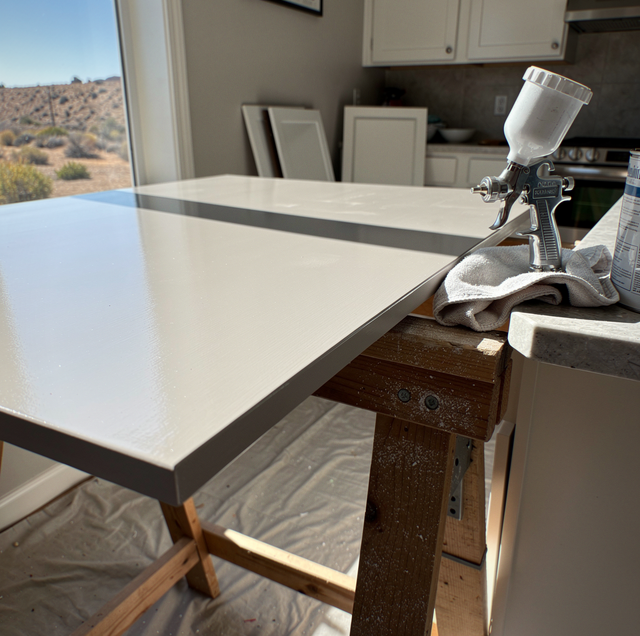
Run your fingers across a cabinet door a week after painting, and you can usually tell right away whether it was sprayed or brushed by feel alone: either it's glass-smooth, or it has a faint texture like the peel of an orange, or worse, a raised line where a brush stroke dried before it could level out. What separates a factory-smooth cabinet door from one with visible brush marks comes down to application method, not the product on the label.
Why Cabinets Show Every Flaw That Walls Forgive
A wall gets viewed from three feet away under ambient light, at an angle that hides small texture. A cabinet door gets viewed from six inches away, often under direct kitchen lighting that rakes across the surface and throws even the faintest ridge into shadow. That's why the same brush technique that looks fine on a wall reads as amateur on a cabinet door.
The Four Defects and What Actually Causes Them
Brush marks and lap lines: These are ridges left where the brush deposits paint unevenly and the film starts to set before it can level flat. Fast-drying paints and painting in a warm room both shorten the window the paint has to self-level before it skins over.
Orange peel texture: This dimpled texture results from spraying rather than brushing, and it occurs when atomized paint droplets don't have enough time or fluidity to merge into a flat film before they begin to dry. Spraying too far from the surface, using too little material per pass, or spraying in a room that's too dry all speed up that premature drying.
Dust nibs: Small hard specks trapped in the dried film almost always come from airborne dust settling on wet paint, which is why cabinet spraying is done in a space that's been cleared and, ideally, has some way to control airflow rather than a garage with the door open to outside dust.
Tackiness that never fully hardens: A film that stays soft or slightly sticky for weeks usually means it was recoated before the previous layer had time to flash off (the point at which solvents have evaporated enough for the surface to accept another coat), trapping solvent beneath a skin that looks dry on top.
Why Spraying Levels Out Where Brushing Doesn't
A brush deposits paint in a directional stroke, and the bristle marks are physically raised ridges in the wet film. An HVLP sprayer (high volume, low pressure) breaks the paint into a fine mist of droplets that land on the surface and merge together as a flat sheet, with no directional stroke pattern to level out in the first place. That's the mechanical reason spraying gets closer to a factory look: it isn't a better paint, it's a different way of putting the same paint on the surface.
What Happens Before the Sprayer Ever Comes Out
The finish only holds up as well as what's underneath it, and cabinet prep looks different from wall prep.
Doors and drawers come off: Hardware gets removed and labeled, and doors are painted flat, laid out or hung on a rack, so gravity isn't pulling the wet film sideways the way it would on a vertical, hung door.
A deglosser or scuff-sand comes first: Factory cabinet finishes are often a hard lacquer or conversion varnish that new paint won't grip without some mechanical or chemical roughing up, typically a liquid deglosser wipe or a pass with fine-grit sandpaper.
A bonding primer goes down first: A shellac-based or dedicated bonding primer seals in existing stains, blocks tannin bleed from wood like oak or cherry, and gives the topcoat something to actually hold onto over a slick factory surface.
Sanding happens between every coat: A light pass with a fine grit, usually in the 220 to 320 range, followed by a wipe with a tack cloth to lift the resulting dust, keeps each layer bonding to the one below it rather than sitting loose on top.
The Paint Itself Matters Too
Not every interior paint is built to level the way cabinets need. Waterborne cabinet-grade enamels are formulated with more flow and leveling agents than standard wall paint, giving the wet film more time to settle flat before it sets. A flow additive can be mixed in to extend that open time further in a dry room where paint would otherwise skin over too fast. Sheen matters too: a satin or semi-gloss shows off a smooth surface, while the same texture in flat paint is far more forgiving, which is part of why flat paint hides more prep shortcuts.
Quick Reference: Matching the Flaw to the Fix
| What you see | Most likely cause | What actually fixes it |
|---|---|---|
| Raised ridge lines in the paint | Brush strokes drying before they level | Switch to spraying, or use a slower-drying enamel with more open time |
| Dimpled, orange-peel texture | Paint atomizing but not merging before it sets | Adjust spray distance and fan pattern, or thin the material slightly per the label |
| Small hard specks in the dried film | Airborne dust settling on wet paint | Spray in a cleared, controlled space rather than an open garage |
| Finish stays soft or tacky for weeks | Recoating before the prior layer flashed off | Extend dry time between coats, especially in cold or humid rooms |
| Yellow blotches showing through white paint | Wood tannins bleeding through a water-based coat | Seal with a shellac-based stain-blocking primer before the topcoat |
Spray equipment settings matter more than most owners expect. A fine-finish tip, often with a smaller orifice size than the one used for walls, paired with the correct fan-pattern width for a cabinet door's size, keeps the mist even rather than leaving a heavier band down the center of each pass. Painters typically overlap each spray pass by about half its width, so the film builds evenly rather than showing lighter and darker stripes once it dries.
Dry to the Touch Isn't the Same as Cured
A painted cabinet door can feel dry within a few hours and still not be at its final hardness. Full cure, meaning the film has reached the hardness it will hold long-term, often takes two to three weeks depending on the product and the room's humidity. Rehanging doors and slamming them shut, or stacking heavy items in a drawer, during that cure window is one of the most common ways a brand-new cabinet finish gets its first dent or stuck-together mark.
Frequently Asked Questions
A skilled brush-and-roll technique using a foam roller for the base coat followed by careful brush tip-off can get close, especially with a slow-drying enamel, but it will still show faint texture under raking light that spraying avoids entirely. Most painters reserve pure brushwork for cabinets that can't be removed, such as an island attached to plumbing.
Most cabinet enamels need roughly 2 to 4 hours of dry time before a light sand and recoat, but that window stretches significantly in a cold or humid room since solvent evaporation slows down. Recoating too early traps solvent beneath the new layer and later shows up as a soft, dentable finish.
Oak has an open, porous grain that telegraphs through paint unless it's first filled with a grain filler or sanded down to several extra coats of primer. Skipping that step is why some painted oak cabinets keep a faint wood-grain texture even under a glossy topcoat.
Removing doors lets them be painted flat on a rack or table, which prevents wet paint from sagging or pooling along a vertical edge the way gravity pulls it on a hinged door. It also gives full access to the edges, which get missed constantly when doors are painted while still hanging.
It depends on both the wood and the source of the discoloration. Oak, cherry, and knotty pine bleed water-soluble tannins that a shellac-based primer blocks in a single coat. Mahogany and redwood share a similar tannin problem but may require a second coat of blocker on heavily figured grain. Knots are a different issue entirely: they ooze sap and resin rather than tannin, and that resin can keep bleeding for months, especially on a cabinet near a heat source like an oven or a sun-facing window, which is why painters sometimes give knots their own dedicated shellac seal on top of the regular primer before the topcoat ever goes on.
Full hardness typically takes two to three weeks, and a simple test is to press a fingernail lightly into an inconspicuous edge; if it leaves a mark, the film hasn't fully cured yet. Painters usually recommend propping doors open rather than latching them shut during that window so surfaces don't bond together.
None of the prep work behind a smooth cabinet finish shows up in the paint color itself: a degreased and primed door looks identical to one rushed straight over old lacquer, right up until the first six months of daily use start telling the difference. Properly prepped doors close smoothly and maintain their sheen at the handle and edge; the ones that skipped a step start showing wear exactly where a hand touches them every day.
Get a free cabinet refinishing estimate — we'll spray a finish that withstands daily use without brush marks. True Coat Painting serves Reno, Sparks, and Spanish Springs. Call (775) 227-0618.
