
Stucco vs Siding vs Wood: Which Exterior Surface Costs Most to Paint
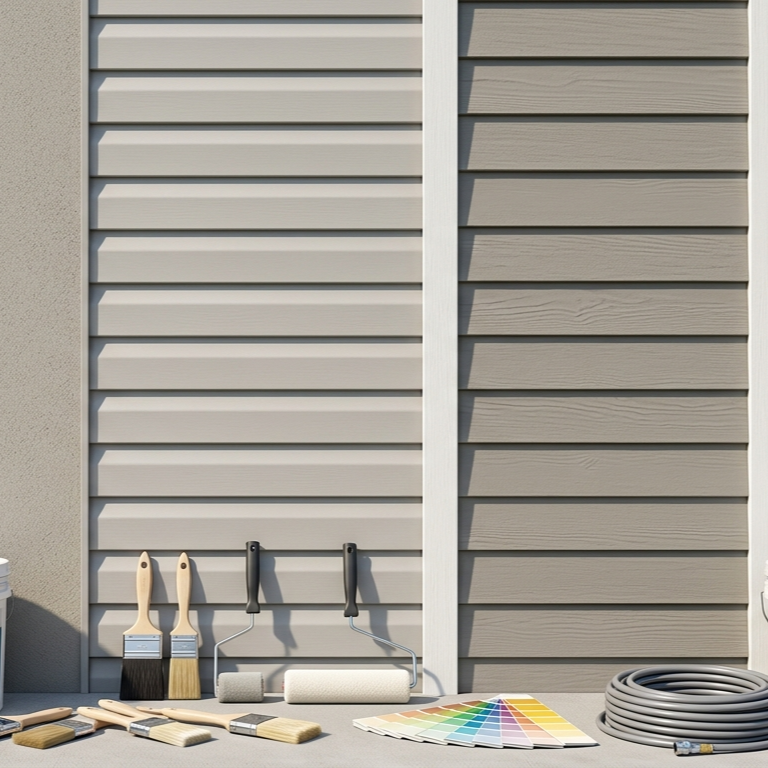
Three houses sit on the same block. Same floor plan, same square footage, built the same year. One is stucco. One is vinyl siding. One is cedar lap with painted wood trim. The same painter walked all three properties last Tuesday morning. The bids came back at $4,800, $6,400, and $9,200.
Same neighborhood. Same crew. Same paint line. Three numbers that aren't close.
The walls themselves did most of the work to make those numbers different. Texture, porosity, prep needs, and crew speed across the surface all show up in the bid before anything else does. The order most owners expect — vinyl cheapest, wood most expensive — is mostly right. The spread is bigger than people guess.
What each surface actually costs to repaint
Painting cost on an exterior repaint is usually quoted by the total job, but the cleanest way to compare across siding types is per square foot of wall surface. The numbers below assume a mid-grade exterior paint, two topcoats on body, normal prep, and a single-color repaint. No body color change, no major carpentry, no lead containment.
| Surface type | Cost per sq ft of wall | Typical 2,000 sq ft home | Where the cost goes |
|---|---|---|---|
| Vinyl siding | $1.50 – $2.50 | $3,000 – $6,500 | Wash, light scuff, vinyl-safe paint |
| Fiber cement (Hardie) | $1.75 – $3.00 | $4,000 – $8,000 | Caulking joints, premium paint |
| Wood lap siding | $2.25 – $4.00 | $5,500 – $10,000 | Sand, prime bare wood, caulk gaps |
| T1-11 plywood | $2.50 – $4.25 | $6,000 – $10,500 | Slow brush passes in vertical grooves |
| Stucco | $2.75 – $4.50 | $7,000 – $11,500 | Crack patching, breathable topcoat |
| Cedar shake | $4.00 – $7.00 | $9,000 – $16,000 | Every shingle hand-brushed |
On a typical 2,000-square-foot single-story, vinyl runs $4,500 to $6,500. Wood lap with normal weathering lands at $6,000 to $10,000. Stucco — with crack patching and an elastomeric topcoat — usually comes in $7,500 to $11,500. Cedar shake on the same footprint can climb past $14,000.
The biggest cost driver isn't the paint itself. Mid-grade exterior latex runs $40 to $60 per gallon; a premium elastomeric runs $60 to $90. Across a whole house, that's a few hundred dollars of difference in material. The rest of the spread is labor — how fast a crew can move, how much surface there really is per square foot of wall, and how much prep happens before the first coat goes on.
Why stucco eats more paint than people expect
Stucco looks like a flat surface from the curb. Up close, it's a field of micro-craters. The acrylic sand-finish texture that's standard on most modern stucco has thousands of tiny peaks and valleys per square foot, and paint has to coat every one of them. A gallon of exterior latex that covers 350 to 400 square feet on smooth vinyl barely covers 200 to 250 on stucco.
That changes two numbers on the bid. Material goes up — roughly 50 to 75 percent more paint for the same wall area. Labor goes up too, because the roller has to work harder and the painter has to make slower passes to push product into the texture. A two-person crew that finishes 2,500 square feet of vinyl body in a day might finish 1,500 to 1,800 of stucco in the same window.
Stucco also needs a different product. Most pro stucco repaints use a breathable masonry paint or an elastomeric topcoat. The reason is moisture. Stucco is a cementitious surface that absorbs water vapor from the wall and releases it back into the air. A paint film that's too tight traps that moisture inside the wall, where it can grow mold in the framing or pop the stucco off the lath.
Crack patching is the third cost driver. Hairline cracks at corners, under windows, and along the base of the wall are normal on stucco — most homes have a dozen or more by year ten. Each one gets routed out, filled with an acrylic patch compound, and feathered before paint goes on. Larger cracks need a fiber-mesh bridging coat. A two-hour crack pass adds $150 to $400 to the bid before any paint is mixed.
What makes wood siding the slowest job
Wood is the surface a crew slows down on, and the slow-down shows up in the labor line.
A wood lap siding repaint carries more prep than any other smooth siding. The crew power-washes the walls, lets them dry for a day, then walks every elevation looking for what wood does after a few seasons of UV and rain. Cracked paint along the bottom edge of each board. Peeling at the lap line. Weather-checked wood where the paint film is gone. Soft spots near any joint where water sat. Loose paint gets scraped, bare wood gets sanded smooth and spot-primed before anything else happens.
Then comes caulking. Wood siding moves with temperature and moisture more than any other cladding. Caulk lines at trim, around windows, and at corner boards open up and let water behind the paint. A proper wood siding repaint replaces caulk that's failed and adds caulk where the previous painter missed.
Only after all that does paint go on the wall. Wood usually needs two topcoats — three on south-facing walls and on any color change.
T1-11 plywood is wood with extra texture. The vertical grooves between panels look decorative but they're where the labor goes. Every groove takes a slow brush pass to make sure paint fills the depth without running on the face. A crew that finishes 2,200 square feet of wood lap in a day might finish 1,800 of T1-11 in the same window.
Cedar shake is the slowest siding by a wide margin. Every shingle gets brushed individually, and the gaps between shingles need brush work too. A cedar shake repaint the same size as a 2,000-square-foot wood lap job can take twice the crew hours and run 60 to 80 percent higher on labor. Most painters quote cedar shake as a separate scope from wood siding for exactly this reason.
Why vinyl and fiber cement are the easiest to bid
Vinyl sets a low bar for everything else. It's smooth, factory-colored, and almost universally clean once a power washer hits it. Prep is a wash, a dry day, and a quick scuff with a sanding block on any chalky areas. There's no caulk to replace because vinyl panels expand and contract independently. There's no bare-wood spot priming because there's no wood. Paint covers fast — one gallon does 350 to 400 square feet on the first coat.
The catch is the paint itself. Vinyl can't take just any exterior latex. The wrong paint flexes differently from the vinyl underneath and cracks or peels within two seasons. Vinyl-safe paints from major manufacturers are rated for the panel movement and the heat absorption that dark colors put into vinyl. They cost about the same as standard exterior latex, but the color palette is limited — most vinyl-safe lines exclude very dark colors because the paint absorbs enough heat to warp the panel.
Fiber cement is the other easy one. Hardie board and similar fiber cement sidings come factory-primed and hold paint better than any common siding type. Prep is a wash, a check of every joint for caulk that's pulled away, and a re-caulk where needed. A premium 100% acrylic exterior runs two coats on body and typically lasts 10 to 15 years on north-facing walls.
Both surfaces also paint fast. Smooth, low-prep, predictable. A crew quotes them confidently because the only real variable is access — story count, gable height, deck obstructions — not the wall itself.
How surface choice plays into lifespan after repaint
The bid is half the story. The other half is how long the new paint holds before the next repaint. Surface type does almost as much work on lifespan as paint quality does.
| Surface type | North wall lifespan | South wall lifespan | Most common failure mode |
|---|---|---|---|
| Vinyl siding | 8 – 12 years | 6 – 10 years | Cracking at lap edges from wrong paint |
| Fiber cement | 10 – 15 years | 8 – 12 years | Caulk joint failure before paint film |
| Stucco | 8 – 15 years | 6 – 10 years | Chalk, fade, and new hairline cracks |
| Wood lap siding | 7 – 10 years | 4 – 6 years | Peeling at lap line; bare wood by year 5 |
| Cedar shake | 5 – 8 years | 3 – 5 years | Cupping shingles; paint cracks at movement |
Two patterns to notice. South-facing walls fail faster than north-facing walls on every surface — UV is the dominant variable, and the spread is two to four years on most claddings. And wood loses to every other cladding on lifespan. A wood lap south wall painted today may need touch-up by year four. A vinyl south wall painted with the right product can run nine or ten years before it needs the same attention.
The amortized cost per year tells a different story than the per-job bid. Cedar shake costs $5,000 to $7,000 more than vinyl on a single repaint, and that repaint lasts about five years instead of ten. So the per-year cost of paint protection is three to four times higher on cedar than on vinyl. Most owners who choose cedar know this going in — the trade-off is the look, not the economics.
What changes the cost between two homes with the same siding
The surface type sets the band. The condition of the surface decides where in that band the bid lands. Two twelve-year-old stucco homes can land $3,000 apart if one has unpatched cracks and lath damage while the other was touch-painted at year four. The same gap shows up on wood — a home painted with premium acrylic seven years ago and kept caulked needs basic prep, while a twelve-year-old paint job over builder-grade paint needs scraping to bare wood, full re-caulking, and minor carpentry at the corners. Surface type predicts the band. Condition predicts the number.
FAQs
Cedar shake is the most expensive per square foot on the labor line. Hand-brushing every shingle puts cedar at the top of the list. Stucco usually comes in second because the texture and the specialty topcoat add up. But stucco is the surface with the widest spread between a cheap bid and an honest bid, because crack patching, lath repair, and breathable paint are easy line items to leave out of a low bid.
Wood-sided homes tend to be older and smaller. The lump-sum number can look lower because the house is 1,200 square feet instead of 2,200. On a per-square-foot basis, wood is usually 20 to 40 percent more expensive than vinyl because of the prep, the spot priming, and the slower crew speed across the surface. Always compare per-square-foot rates if two bids on different homes look close.
A homeowner can paint stucco with regular exterior latex, but the long-term result is rarely good. Standard latex forms a tight film that doesn't let water vapor out of the wall, and stucco wall assemblies are designed to breathe. Trapped moisture pops the paint off in two to four years and can grow mold in the framing behind the stucco. A breathable masonry paint or a high-quality elastomeric is the right product.
Fiber cement, by a clear margin. The surface holds paint better than any other cladding, and the joints just need recaulking every few years. Vinyl is close behind for as long as the panels are intact, but sun-damaged or impact-damaged vinyl eventually needs replacement, not just paint.
Mostly on the labor. The material price between a standard exterior latex ($40 to $60 per gallon) and a high-end elastomeric ($60 to $90 per gallon) is real but small across a whole house — usually $200 to $500. The bigger swing is crew time. A two-person crew finishes vinyl at two to three times the rate they finish cedar shake, and crew days dwarf paint cost.
The math sometimes works on a long enough timeline. Fiber cement installation runs $9 to $14 per square foot of wall, so a 2,000-square-foot wood-to-Hardie conversion is $30,000 to $45,000. If a wood-sided home needs major siding repair anyway, replacing rather than repairing-and-repainting can make sense. If the siding is intact, repainting wood is almost always the cheaper move in any 10-to-15-year window.
Reading three bids on three different surfaces
The painter walking the property reads the same things on every house — but counts them differently depending on what the wall is made of. On stucco, they're looking for cracks, base-coat failure, and whether the existing paint is breathable or trapped. On wood, they're looking for caulk failures, bare wood, lap-line peeling, and soft spots near the corners. On vinyl and fiber cement, they're really just looking at access — story count, gable height, what gets in the way of a ladder.
Compare bids by the per-square-foot rate, not the lump-sum. A $9,000 bid on cedar shake and a $4,500 bid on vinyl on similar-sized homes can both be honest — they're just different jobs. A $4,500 bid on stucco that should be $7,500 is the one to question, because that gap usually means the crack patching, base coat, or breathable topcoat got left off the page.
